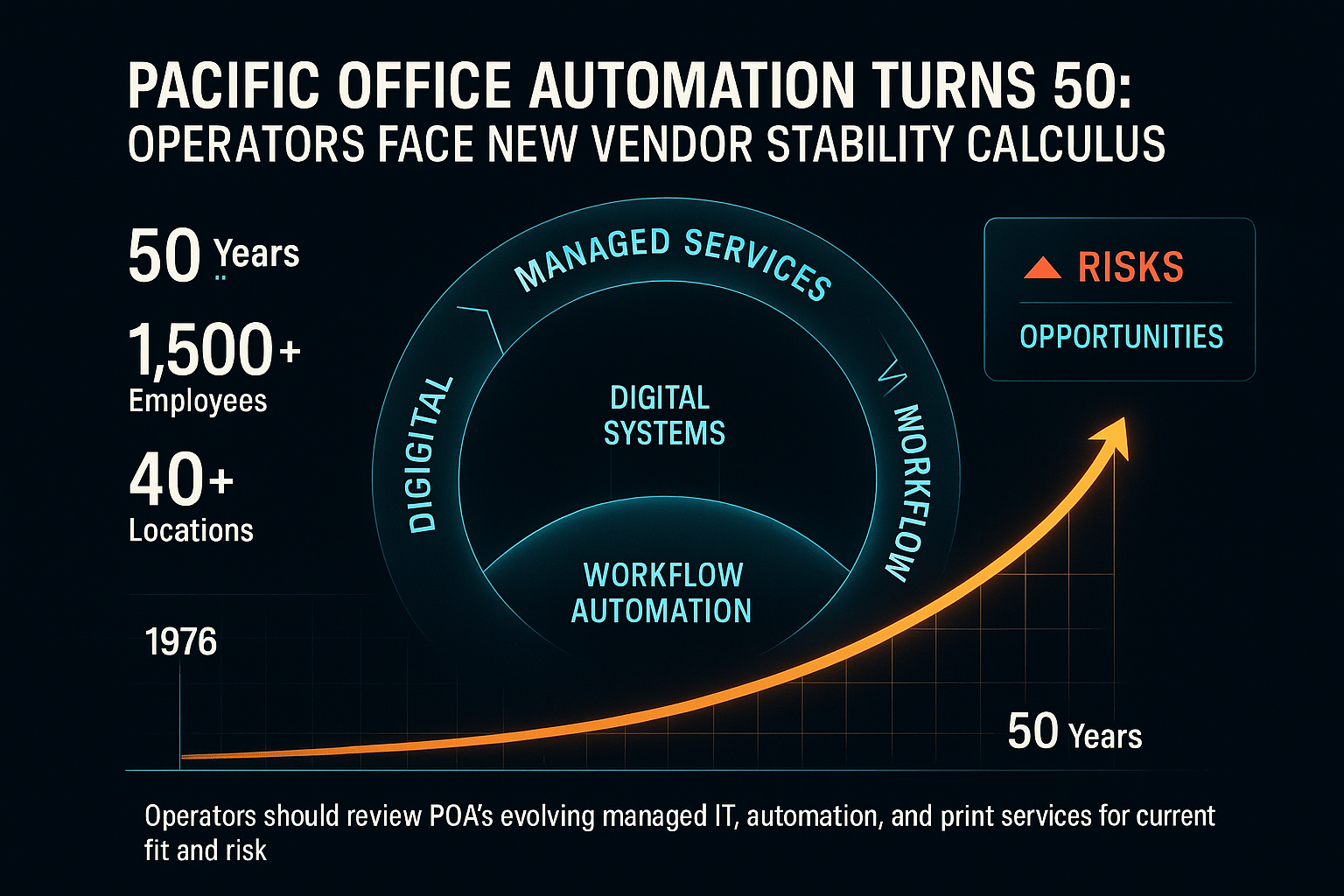
Key data behind the update
One of the largest independent office technology vendors, indicating support capacity.
Geographical reach enables diversified regional support.
Longevity exceeds typical vendor lifespan, reducing risk of abrupt exit.
Started pre-digital, signaling evolutionary adaptability.
Workflow impact
- Procurement and IT teams gain evidence of POA's scale for risk evaluation.
- Operators balancing cost versus continuity may see reduced risk in POA's longevity.
- Long-term contracts or integrations benefit from supplier stability, though platform-level insight is limited.
- Leadership succession and family stewardship may appeal to those valuing consistent values and low-turnover vendor culture.
Comparison criteria
50 years in operation
Higher continuity and institutional knowledge40+ offices across U.S.
Broader on-site support and disaster recovery flexibility1,500+ staff
Greater resource pool for support, projects, or business continuityEmployee appreciation/legacy emphasis
Values-driven but may not signal digital agilityOperational consequences
- Operators can leverage POA's high headcount and regional reach when negotiating service SLAs.
- Long-tenured vendors may better support legacy workflow transitions versus new entrants.
- Absence of direct product performance data means risk remains if service innovation lags.
- Those requiring proof of digital mastery must seek platform-specific case studies beyond milestone claims.
Signals to watch
Future releases may clarify how POA integrates new workflow automation or AI tools.
Continued board and executive moves could affect service priorities.
National ambitions suggest more support, but require IT and procurement monitoring for service consistency.
Vendor Evaluation Moves After POA's Milestone
Operator Decision Checklist
With POA hitting 50 years, procurement and digital workflow leads should test whether stability and scale now justify expanded engagements or new integrations.
Headcount and multi-location presence may enable smoother business continuity, but missing digital platform data requires deeper diligence.
- Evaluate current contracts for renewal confidence
- Request platform-specific innovation roadmap
- Ask about cultural policies that sustain support quality
Tradeoffs and Remaining Information Gaps
POA's scale and culture offer rare vendor resilience, but the announcement lacks granular details on software offerings or customer outcomes.
Operators needing digital-first transformation must push for proof of deployment speed and service agility.
- Stability vs. Agility: Is legacy culture an innovation asset or liability?
- Support depth vs. Latest tech: Are resources focused on cloud/automation?
- Missing: Platform benchmarks, deployment turnaround, incident response metrics
Stability, Legacy, and Digital Evolution
Leadership succession planning and value stewardship—evident in the recognition of Karen Newsom—ensure continuity but may also slow cultural change.
Operators valuing long-term accountability over rapid pivoting may find alignment; Others should confirm digital modernization pace.
- Leadership presence across generations
- Strong employee appreciation culture
- Service expansion into IT, automation, cybersecurity