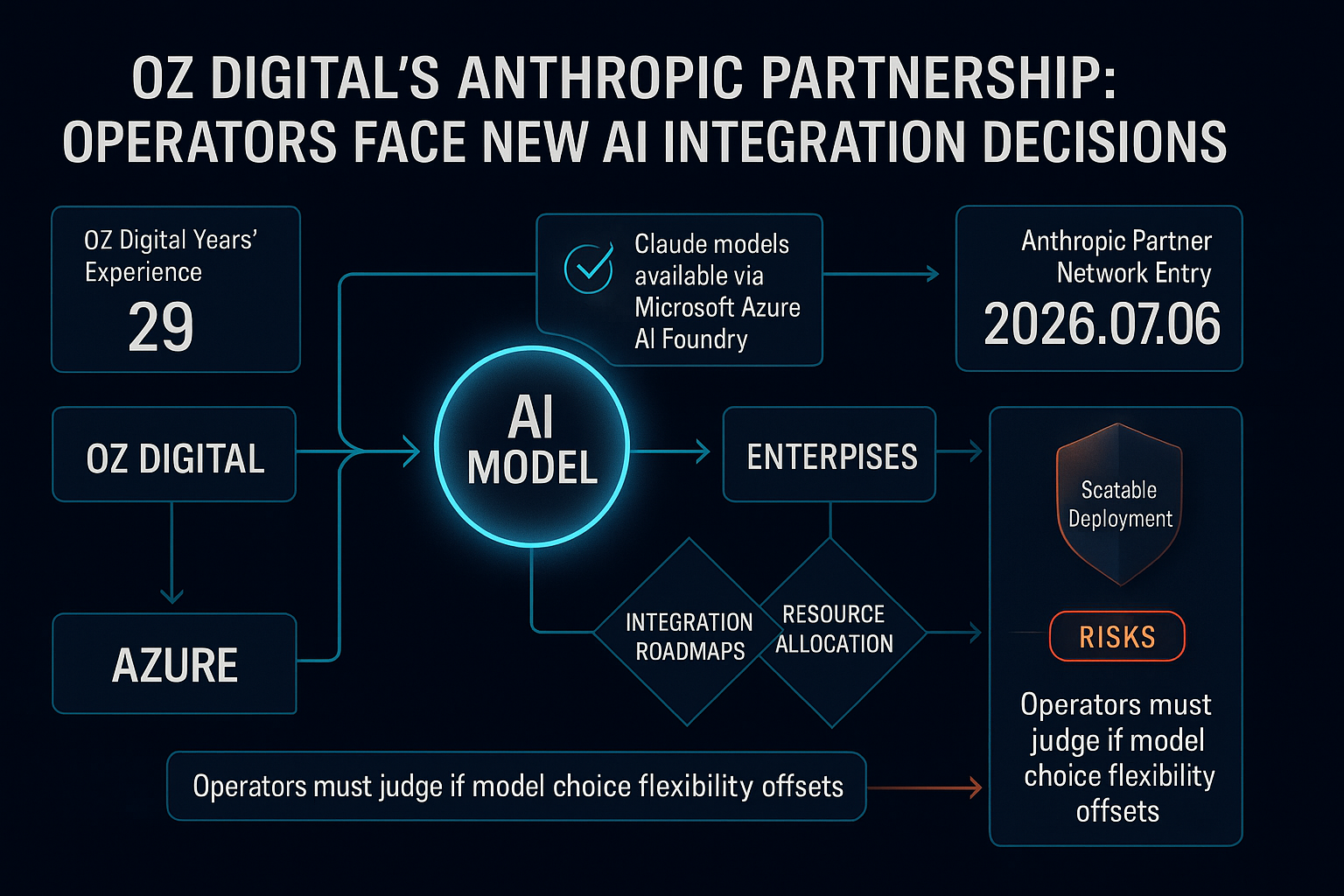
OZ Digital and Anthropic Partnership Event Metrics
Years / dateOZ Digital Years' Experience
Anthropic Partner Network Entry
Key data behind the update
OZ Digital claims over 29 years in tech consulting, signaling depth but not recent deployment metrics.
OZ Digital officially joined the Anthropic Partner Network in July 2026.
Azure Foundry is now the conduit for Claude in OZ Digital's enterprise deployments.
Workflow impact
- Expands the model set available for AI automation within Azure ecosystems.
- Potentially accelerates enterprise AI operationalization, reducing reliance on experimentation.
- Increases pressure to build robust evaluation frameworks for model selection and vendor accountability.
- Shifts consulting risk: operators must ensure model security and compliance align with internal policies.
- Influences budgetary and staffing plans as practical deployment support becomes more readily available.
Comparison criteria
Multiple leading models, including Claude, selectable in Azure stack.
Greater configuration but increased need for model evaluation.Emphasis on moving from experimentation to enterprise-scale deployment.
Potential acceleration in AI operationalization if practical support is effective.Declared focus but no published benchmarks or frameworks.
Operators must assess security posture and fill gaps.Operational consequences
- Operators face increased pressure to justify continued AI experimentation if scalable deployment paths are now available.
- Evaluation cycles may compress, as model variety becomes less of a technical bottleneck.
- Vendor trust and integration expertise become differentiation factors, absent clear ROI evidence.
- Potential need to realign internal AI governance, security, and compliance review processes.
- Consultancy partnerships could impact the perceived neutrality of vendor-agnostic AI service providers.
Signals to watch
Provides direct evidence on productivity, ROI, and security benefits.
Signals ease of use and operational scaling potential.
Changes the competitive benchmark and reference pricing.
Clarifies operational and compliance risk handling for sensitive workflows.
Operators Face New Pressure To Modernize AI Workflows
Strategic Implications for Integration and Model Selection
This partnership offers enterprises broader AI model choices within Azure, particularly for document processing, software development, and automated workflows. Teams may reevaluate integration blueprints to exploit multi-model flexibility, but must weigh security and ROI uncertainties.
- Opportunity to escape 'one-size-fits-all' model deployments.
- Integration with existing cloud systems via Azure.
- Unclear competitive edge versus other consultancies.
Tradeoffs and Evidence Gaps in Vendor Decisions
Operators must balance expanded model access with a lack of supporting case data. No specific outcomes, productivity metrics, or cost comparisons are supplied, complicating direct budget or workflow recalibration. Evidence of productive deployments is pending.
- No published benchmarks or reference architectures.
- Governance, security, and trust are prioritized, but not substantiated.
- Operators should request client success stories before large shifts.
Next Operational Moves and Evaluation Triggers
The absence of hard numbers means evaluation cycles continue for many. Operators should monitor public case studies and integration announcements, particularly those illustrating productivity or security gains. Realignment of AI governance frameworks may be required.
- Monitor for OZ Digital-released client outcomes.
- Check for competitor partnerships with similar access.
- Track new AI governance best practices.