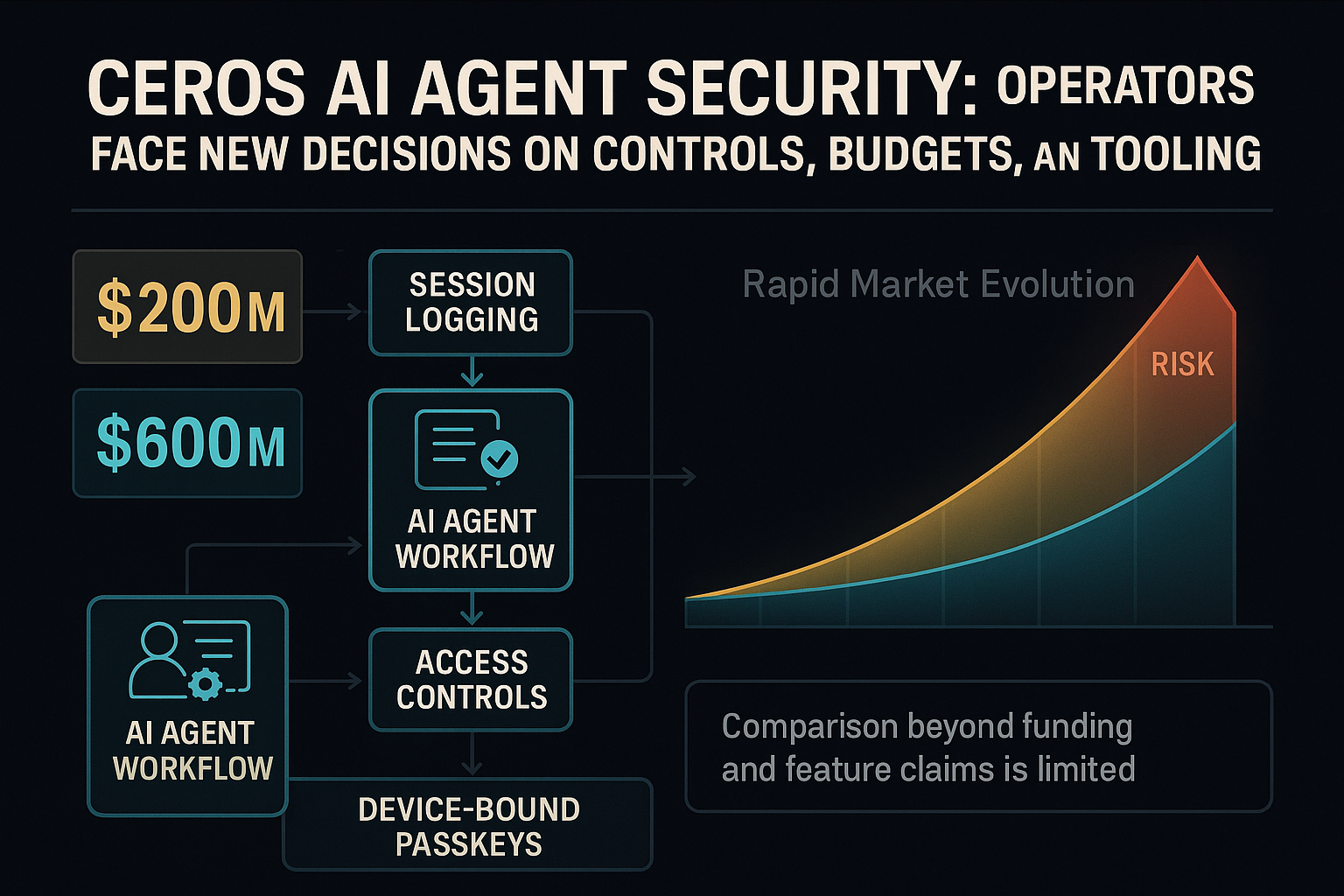
Key data behind the update
Indicates serious backing for the development and scaling of Ceros.
Highlights intense market competition and validation for AI security tools.
Represents the typical scale and complexity of workflow environments that Ceros targets.
Workflow impact
- Enables tracing of actions by automated agents, improving post-incident audits.
- May require teams to budget for new security tooling to cover non-human actors.
- Reduces manual developer effort for mitigating prompt injection and credential leaks.
- Moves device authentication standards beyond employee-focused IAM.
- Accelerates pressure on platform choice as competitors and hyperscalers add similar controls.
Comparison criteria
Covers individual AI agents and non-human actors.
Requires operators to update controls for machine-initiated actions.Device-bound passkeys restrict off-device theft.
Improved resistance to agent credential abuse.Logs every AI agent session, including origin and device.
Faster incident response and accountability.Automates switching models when one goes offline.
Reduces downtime and developer toil during vendor outages.Operational consequences
- Teams will need to classify all AI agents and set per-agent access controls.
- Security budget allocations must explicitly cover automation and agent observability.
- Vendor lock-in risks increase as more workflows tie into proprietary agent management ecosystems.
- Increased pressure to update incident response playbooks for agent-origin traceability.
- C-level leaders must revisit risk registers to include automated agent actions.
Signals to watch
If hyperscalers integrate similar controls, market standards and expectations will shift quickly.
Integration or lack thereof will decide adoption outside greenfield projects.
Real-world incident data will validate or question advertised improvements.
Decision Analysis: Enterprise AI Agent Security Shift
Who Must Decide and What Changes Now
Security leads, operations managers, and platform architects responsible for AI-driven workflows must update policy frameworks and tool selections.
Automation product owners must now factor non-human agents into access and credential controls, shifting from user-centric to agent-centric security.
- Audit all current AI agent workflows for access coverage.
- Evaluate compatibility with Ceros-style session logging.
- Update procurement checklists to include agent-level observability.
Tradeoffs Introduced
Expanded session-level logging may increase storage and monitoring costs, but streamlines forensics.
Device-bound keys constrain credential theft routes, yet could complicate agent migration or scale-out if not universally supported.
- Higher initial integration workload for complex automation environments.
- Potential lock-in as rivals and hyperscalers build similar ecosystems.
- Reduced manual developer effort for known-agent credential management.
Missing Evidence and Risks
No adoption statistics or case studies are provided; Operational learning curves and integration pain remain unknown.
The platform's LLM failover feature is described as relieving developer toil, but no performance benchmarks are reported.
- Unclear real-world compatibility with multi-cloud and legacy systems.
- Efficacy of prompt-injection mitigations not independently documented.
- Market trajectory could shift quickly if hyperscalers absorb similar controls.
Market Implications and Comparisons
Recent large funding rounds for Cyera and entrance of OpenAI into agent management highlight fierce competition.
Operators must compare not only feature sets but depth of integration and cross-vendor operability as industry standards consolidate.
- Platform’s automation may leapfrog ad hoc internal scripts.
- Cost and feature differentiation will depend on which ecosystems support agent-level APIs.
- Incumbents' response timelines (e.g., OpenAI, Anthropic) bear closely monitoring.