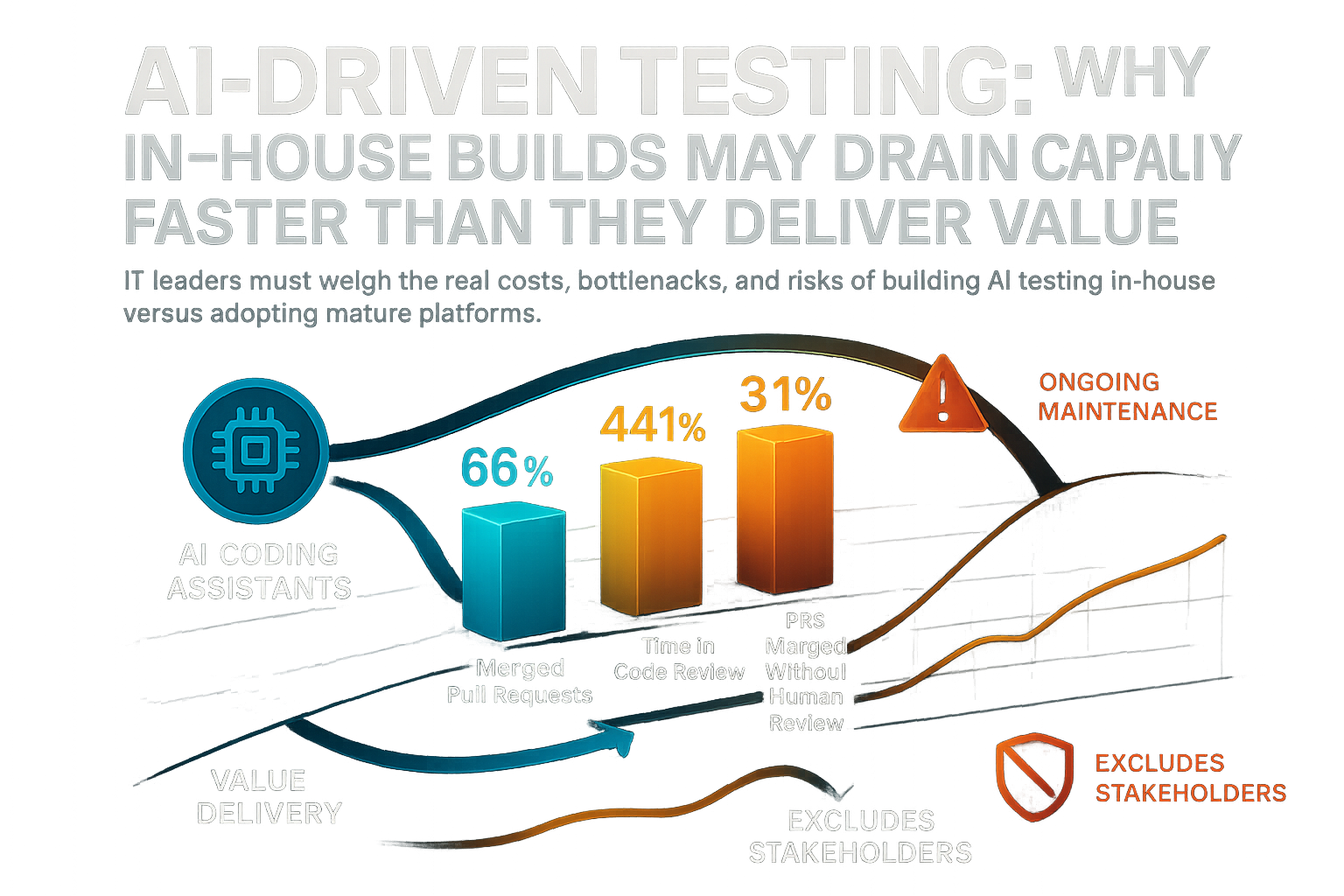
Key data behind the update
Developer throughput nearly doubled after adopting AI for coding.
Product delivery pace rose significantly across tracked teams.
Review bottlenecks massively increased with AI-generated code.
Almost a third of code changes avoid traditional checks, increasing risk.
Workflow impact
- Internal teams risk shifting engineering capacity from product to maintenance if they build AI testing stacks.
- Organizations in regulated sectors face unanticipated compliance and audit costs with in-house solutions.
- Widely available AI-native testing platforms provide separation and reliability not easily recreated with coding agents.
- Workflow and reporting for non-developers suffers when custom solutions remain developer-centric.
- A misstep could slow product improvements while competitors outpace with proven platforms.
Comparison criteria
AI coding agent appears very low-cost ($19 subscription cited)
Superficial savings vanish at scale—full costs emerge over time for in-house approachBuild approach sees exponential maintenance scaling post-launch
Maintenance dominates TCO after first year, favoring proven platformsCustom builds remain developer-centric, challenging for QA or business roles
Limits QA coverage and hinders product reliabilityIn-house stacks require new layers for governance, adding cost and risk
Audit/auditability becomes a major factor in regulated environmentsOperational consequences
- Engineering teams that build may divert resources from core product delivery.
- DIY stacks risk becoming brittle and hard to scale, straining QA autonomy.
- Vendor platforms may lock in faster, but offer system-wide accountability and audit capability.
- As test volume grows, maintenance efforts for DIY multiply—potentially exceeding initial estimates.
- A build-then-abandon scenario could undermine reliability and user trust.
Signals to watch
Trend tracking is critical for assessing quality impacts of AI-accelerated workflows.
Escalating, unplanned costs may push organizations back to vendor platforms.
If only developers can triage and update, broader adoption will stagnate.
Audit-readiness and governance may tip organizations against in-house builds.
Operators' Guide: The New Economics of AI Testing Infrastructure
Who Must Act—and When
The evaluation to build or buy an AI testing solution falls squarely on IT and engineering leaders, with CIOs and architects leading the risk review. QA managers must weigh if current and projected test volume justify taking on a multi-year system project.
- Engineering leads must project three-year maintenance, not just first-year costs.
- QA heads must confirm if DIY utility will scale outside core dev teams.
- Operations architects must scrutinize compliance and audit case coverage.
Real Tradeoffs and Bottlenecks
AI coding tools mask true investment by only pricing per seat, omitting the doubling of complexity when scaled. The real bottleneck shifts from code writing to verification—and trust.
Rapid buildout increases operational burden, especially if stacked atop open-source frameworks that demand ongoing context retrieval and device-grid management.
- Platform build-outs never end—maintenance scales with usage, not linearly.
- Developer-centric DIY solutions marginalize QA and business user access.
- Regulatory requirements introduce extra system layers not priced in up front.
Missing Evidence and Next Proof Points
Though AI reportedly boosts developer output, the effect on long-term software reliability and organizational cost is less clear. DORA telemetry highlights new pain, but specifics on maintenance hours, system failures, and regulatory incidents are absent.
Questions remain: Does platform vendor lock-in become a drag? Do hybrid build-buy models deliver the best of both worlds, or just add friction?
- No longitudinal data yet on 3-year QA system TCO for DIY vs. Platform.
- Few independent studies trace change failure vs. QA method after AI adoption.
- The optimal balance of QA autonomy vs. Platform dependency still under debate.
Long-Range Workflow Implications
Building in-house multiplies system ownership loads, often without non-dev usability. Vendor platforms plug context and reporting gaps, but may curb customization.
The business impact: faster time-to-value and higher reliability for most buyers, unless in-house testing is a true product differentiator.
- Maintenance outpaces subscription costs after first budget cycle.
- DIY systems increase risk of fragmented knowledge and siloed accountability.
- Out-of-the-box platforms promote cross-role engagement and stable delivery.