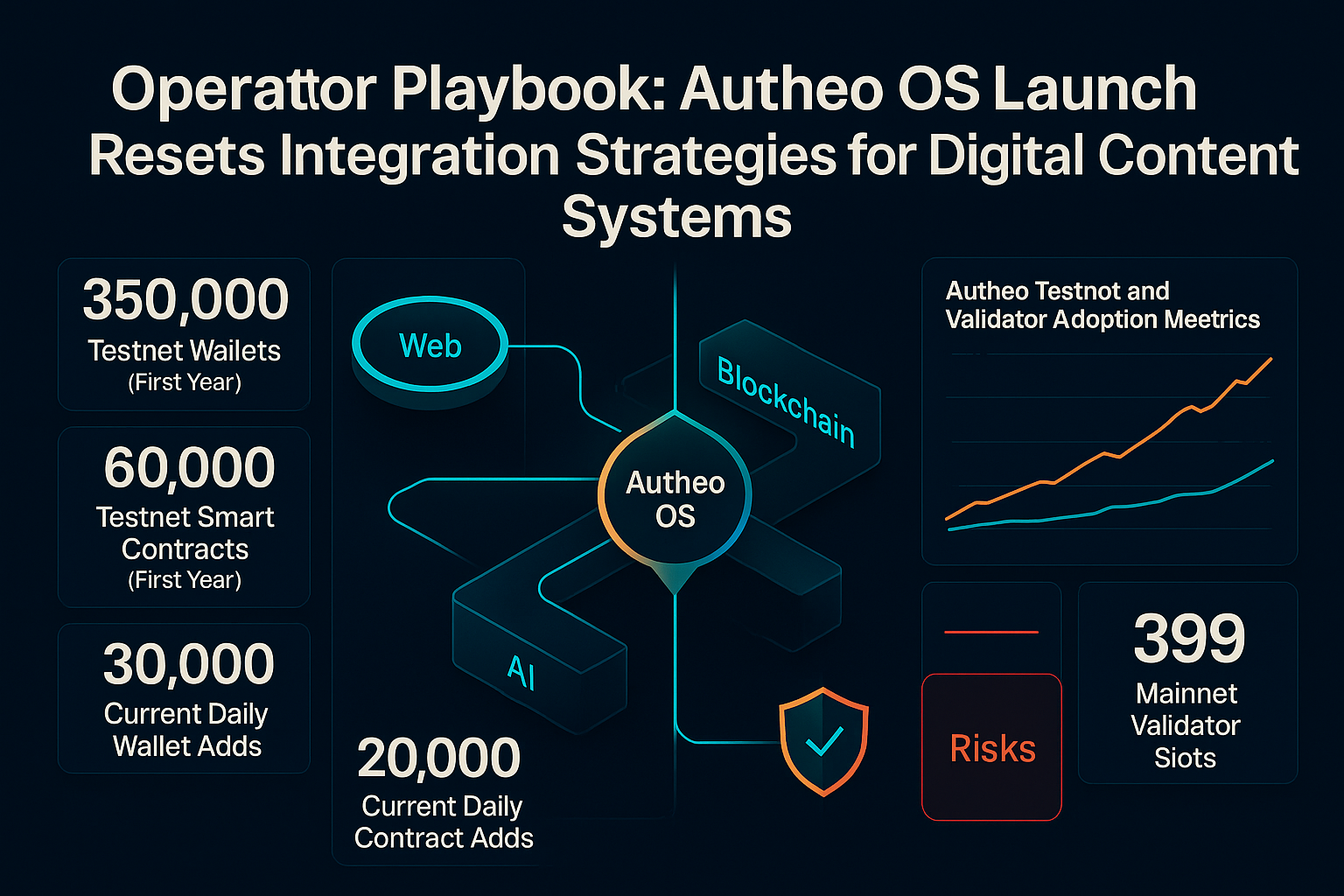
Autheo Testnet and Validator Adoption Metrics
Testnet Wallets (First Year)
Testnet Smart Contracts (First Year)
Current Daily Wallet Adds
Current Daily Contract Adds
Workflow impact
- Teams integrating video or data workflows must revisit cross-domain system maps and automate credential/storage functions.
- Operations heads should benchmark against native interoperability environments versus bridge-dependent solutions.
- Ecosystem partnerships and compliance strategies may need to adapt to quantum-resistant identity and validator eligibility requirements.
Key data behind the update
Indicates early developer uptake and system stress-testing.
Demonstrates significant experimentation and contract deployment by development teams.
Network is onboarding far more wallets daily vs historic monthly totals, indicating major acceleration.
Contract deployments per day now outpace entire previous monthly volumes, reflecting expanded use cases.
Signals enterprise and ecosystem focus—most slots allocated, with reserved capacity for industry partners.
Operational consequences
- Manual custom integrations between Web, blockchain, and AI agents may rapidly lose value for production teams.
- Credential and identity handling may shift toward distributed, post-quantum standards for video and SaaS workflows.
- Growth in contracts and wallets on testnet forecasts rising demand for such integration substrates in content-heavy sectors.
Comparison criteria
Native, OS-level interoperability for Web, blockchain, AI
Reduces need for custom connectors, supports plug-and-play automationPost-quantum credential and messaging layer, independent audits
Potentially future-proofs content and identity workflows against quantum threats5x wallet and 15x contract growth in under 2 months post-mainnet
Unusually high early developer traction may portend strong ecosystem lock-in399 slots, most pre-subscribed, reserved enterprise capacity
Blends decentralized uptake with enterprise focus; May appeal to digital workflow operatorsSignals to watch
Token economics and availability could affect developer incentives and platform adoption schedules.
Accessible onboarding paths will determine which teams can pilot video/content projects at scale.
Clarity on integrations, audits, and compliance shapes roadmap decisions for large ops teams.
Signals how reserved capacity is distributed and what level of enterprise involvement is possible.
Timeline
- 2021: Project Founded
Autheo project begins R&D on decentralized OS with focus on integration and post-quantum security.
- 2025: Testnet Launch
Public testnet attracts over 350,000 wallets and 60,000 contracts in first year.
- May–June 2026: Mainnet Announcement and Launch
Spike in wallet addresses and contract deployments; Mainnet transitions to public availability.
- Early July 2026: THEO Token and Builder Portal Launch
Token availability and new ecosystem programs set to open further expansion and participation.
Action Brief for Video and Digital Content Operators
Immediate Workflow Adjustments
System architects should map out dependencies on bridge-based integrations and assess replacement paths for core video, storage, and messaging workflows. Autheo’s OS provides modules for identity, state, and scheduling—these could disrupt current SaaS and video automation stacks.
- Review all bespoke integrations; Expect consolidation opportunities.
- Check credentialing and storage infrastructure for post-quantum readiness.
- Audit automation triggers for compatibility with new native OS services.
Integration and Security Opportunity
Cross-environment automation now has the option to use a shared substrate instead of one-off bridges. Operators should monitor audit results and compliance docs as claims of post-quantum security and decentralized identity attract scrutiny from compliance and enterprise stakeholders.
- Monitor security audit releases (Halborn and CertiK) for deployment confidence.
- Track validator slot allocations if staking or operational presence is relevant.
- Assess project onboarding via upcoming builder portal releases.
Ecosystem Signals for Adoption Timing
Token launches, portal access for developers, and early enterprise partnerships are immediate signals for adoption. Teams should time deeper engagement to platform documentation, tool maturity, and enterprise onboarding updates.
- Watch for THEO token listing and liquidity events.
- Prepare for integration pilots by securing validator or builder slots if eligible.
- Evaluate how natively interoperable video or AI workflows could replace existing chained automations.