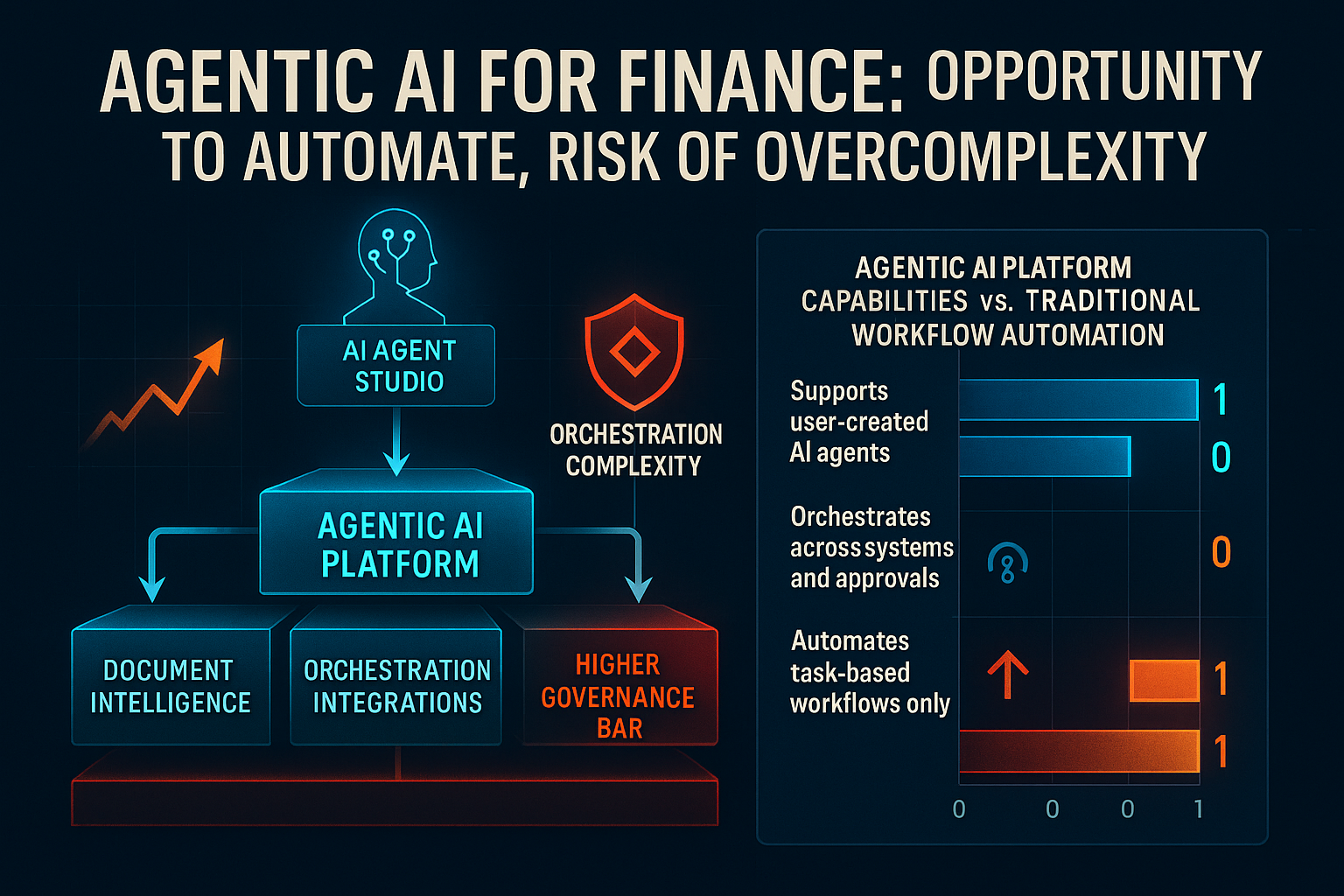
Why it matters for Agentic AI in Finance
Finance leaders seek more than incremental task automation. Kanverse.ai’s platform embodies the move to intelligent, outcome-driven agents—but risks arise from the need for greater oversight, explainability, and alignment with enterprise policies.
Operational consequences
- Organizations adopting agentic AI may decrease manual handling of finance operations but must reinforce oversight and policy controls.
- Business user empowerment creates new support and governance demands.
- If orchestration fails or exceptions are mishandled, operational risk increases.
Key data behind the update
Automation targets high-touch, document-driven processes, not just simple tasks.
Business users can build custom agents, broadening accessibility.
Reduced rip-and-replace risk, but unclear integration cost.
Comparison criteria
Business users create custom agents via AI Agent Studio
Potentially faster iteration, but raises support and oversight needsAgentic AI orchestrates across approvals, exceptions, systems
Higher flexibility, but increased configuration and governance complexityAgents act within existing enterprise environments
Lower rip-and-replace barrier, but integration friction unknownPossible outcomes
Teams deploy agents for complex approvals
Efficiency improves; Manual work declines; Teams focus on exceptions and oversight.Configuration and policy management overwhelm business teams
Adoption slows; Organizations face governance bottlenecks and potential process errors.Workflow impact
- Potential for faster, more accurate finance processes through context-aware AI agents.
- Business users gain tools for custom agent creation—reducing reliance on IT developers.
- Automation shifts strategic focus: from task flows to decision orchestration, but with a heightened need for audit and control.
Signals to watch
Early adoption patterns will reveal if configuration is practical for non-technical teams.
Will show if platform plays well with legacy systems and delivers measurable ROI.
Surface legal, audit, or operational risks tied to autonomous agent actions.
Agentic Automation for Finance: New Potential, New Risks
What’s New: Opportunity for Smarter Finance Workflows
Kanverse.ai’s platform moves finance automation beyond scripted RPA and task bots. Its AI agents use document intelligence and policies to automate approvals, exceptions, and process orchestration.
Business users—not just developers—gain the ability to configure and deploy these agents with natural language, cutting time-to-value and expanding who can drive automation.
- Offers orchestration across legacy and cloud systems
- Custom agents can reflect unique finance policies
- Focus on reducing manual document handling
The Risks: Oversight, Complexity, and Governance
Giving more autonomy to business users can create shadow IT concerns. Strong governance and audit trails become vital as agents execute decisions aligned with enterprise finances.
More capability also means more complexity. Teams may struggle with exception management and ensuring every agent’s logic complies with policy and regulation.
- Configuration errors could impact high-stakes financial approvals
- Need for clear policy safeguards and monitoring
- Integration with legacy systems could be a bottleneck
Winners, Losers, and Who Decides
Efficiency-focused finance and shared service teams benefit most if agent adoption succeeds.
However, teams lacking process clarity or oversight discipline may experience more disruption than improvement.
- Winners: Operations teams needing flexible, adaptable workflows
- Losers: Organizations unprepared for new audit and support models
- Deciders: Finance leadership and process owners