Timeline
- Pre-2024: Manual integration dominates
B2B enrichment flows rely on one-way sync, customer-owned connectors, and periodic manual updates.
- 2024-2025: iPaaS growth; Platform-native API layers emerge
Vendors begin to offer APIs for orchestration, but most connections are not thoroughly governed or bidirectional.
- June 2026: ZoomInfo-Konnectify two-way native integration launches
Bidirectional, governable integration debuts; Coverage extends to 500+ workflows and immediate effect for all mutual customers.
- Post-2026: Governance, audit, and data freshness define platform adoption
Operators shift focus from simply connecting systems to unifying policy, audit, and enrichment at the orchestration layer.
Context behind ZoomInfo Konnectify integration
In the last two years, the B2B automation stack has shifted from fragmented iPaaS and manual syncs to platform-native, API-driven context layers. ZoomInfo's GTM.AI now anchors integrations for major automation, agent, and AI toolchains, while workflow automation market size and spend have both increased. The two-way, native ZoomInfo-Konnectify model sets a fresh expectation: automation should be governed and context-aware by default, not a patchwork of one-off data flows.
Why it matters for ZoomInfo Konnectify integration
This event is a pivotal operational milestone: direct, profile-level data sync—without customer middleware—sets a new bar for workflow automation quality, data freshness, and control. It forces digital system leaders to re-examine assumptions about integration risk, data decay, and governance, especially as stale or ungoverned AI-driven decisions can undermine GTM and compliance goals.
Evidence-backed metrics
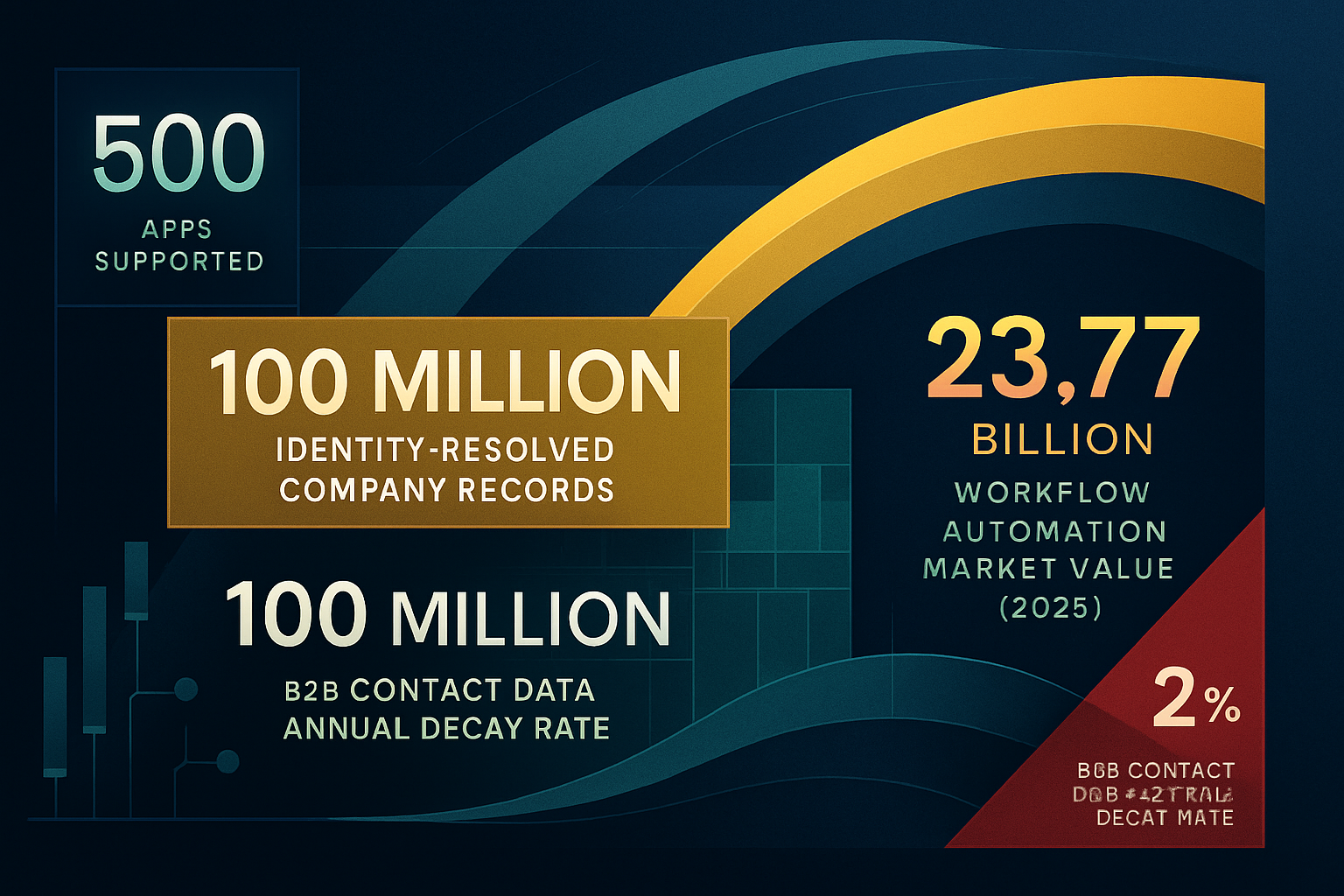
Integration supports automated data flow across a large ecosystem, reducing custom build needs.
Coverage scale ensures global enrichment; Mitigates data sparsity issues for larger go-to-market teams.
Agentic workflows can now access verified, up-to-date contacts without scraping or legacy sources.
Old, nonrefreshed data leads to risk; Closing the sync loop with real-time data is operationally critical.
The broader market underpinning these moves is large and growing, making operational standards significant.
Numbers behind the shift
Source-reported valuesMarket context at a glance
Source-reported valuesWorkflow automation market value (2025)
The workflow automation market size was valued at USD in 2025 and estimated to gro
Decision criteria
Native, two-way (ZoomInfo ↔ Konnectify)
Reduces manual mapping, risk of errors, and integration setup time.Single policy and access control for all endpoints
Consistent policy application and easier compliance management.Continuous, verified—tied to GTM Context Graph
Improved AI/agent decisions, reduced risk of machine-scale errors.Possible outcomes
Bidirectional, governed integrations become the new expectation, pushing competitors to shift architecture.
Standardization increases and single-point governance replaces scattered policy controls.Some workflows continue using legacy, one-way or manual connectors alongside new governed flows.
Data silos persist, and governance risk fragments across integration boundaries; Mixed posture may affect audit and incident response.Signals to watch
If these groups migrate to two-way governed models, the shift away from one-off middleware will be cemented.
Failures in permissioning or data freshness will test the operational posture and expose remaining weaknesses.
B2B Workflow Map
From Patchwork to Policy-Driven Flow
Legacy B2B automation depended on the customer to wrangle multiple systems: building custom connectors, shepherding API keys, and producing periodic data exports. Most flows remained unidirectional, with risk accumulating in endpoints and sync failures.
This integration shifts the model. The Konnectify–ZoomInfo link allows governing parties to control data access, enrichment, and signal output natively, with a single permissioning and audit framework wrapping both ingestion and outbound logic.
- Reduces technical debt tied to custom middleware
- Centralizes governance and audit controls
- Aligns data sync models with regulatory needs
Operational Risk: Data Decay and AI Workflows
Stale contact data leads directly to failed enrichment, pipeline leaks, and misrouted automation. When AI workflows act on nonrefreshed or unstable data, the resulting mistakes scale rapidly.
The platforms now enforce continuous refresh and shared context, improving both targeting accuracy and compliance posture for downstream flows.
- Annual data decay can reach 70%, making legacy sync unsustainable
- Platform-native integration enhances audit and troubleshooting
- Reduces the risk of AI-powered missteps resulting from outdated inputs
Architecture Shift: The New Baseline
Most previous integrations required manual setup and generated duplicated governance layers. Now, with the GTM.AI headless context layer and Konnectify's plug-in architecture, the system landscape favors API-first, permissioned, and continuous models.
Teams that retain legacy integration methods risk falling behind, both functionally and in auditability.
- Agent and automation platforms plug into verified, governed data surfaces
- Outbound audience targeting can leverage custom-built signals instantly
- System owners focus on policy layers, reducing endpoint overhead