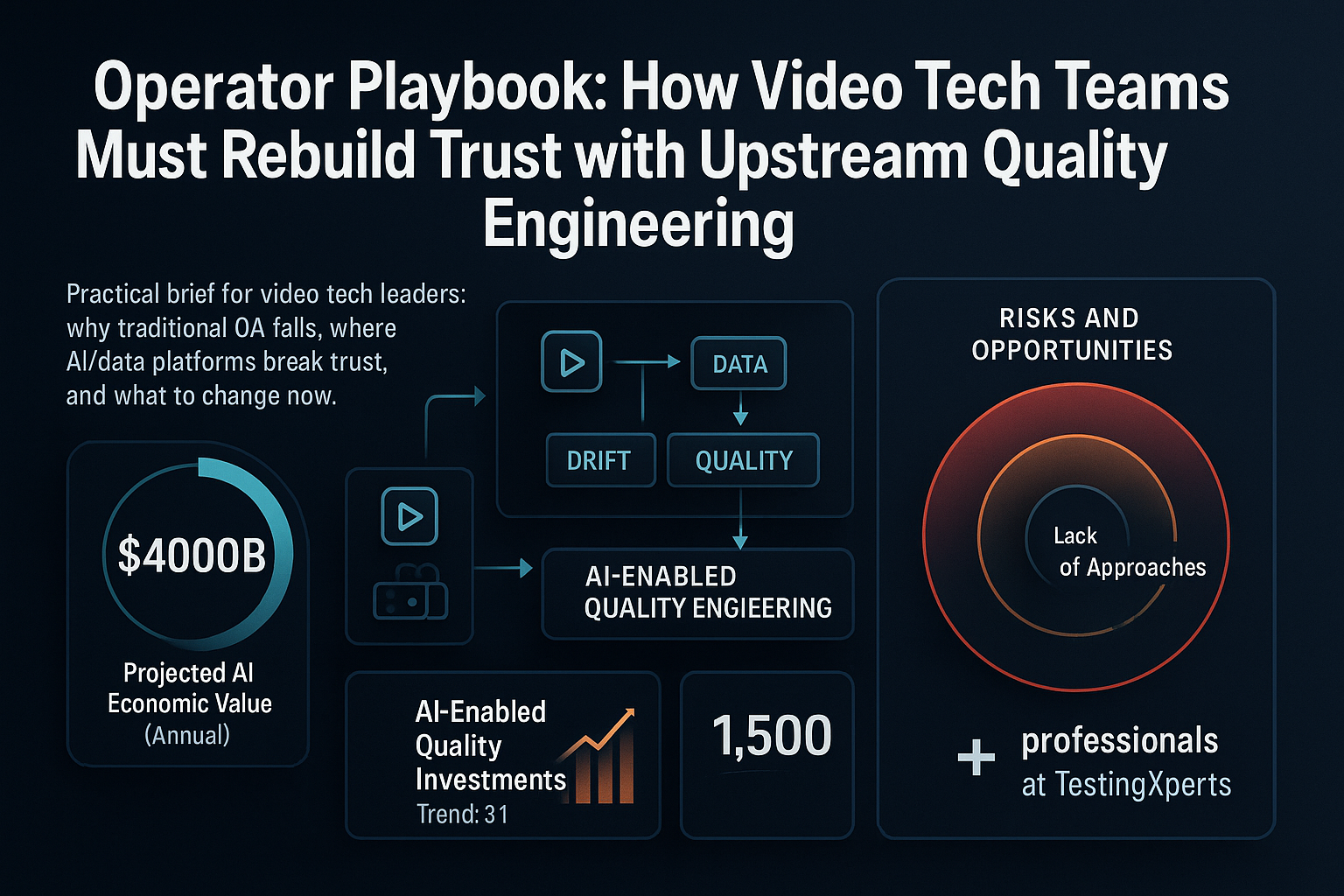
AI and Quality in Video Platform Operations: Key Metrics from Industry Research
USD / Trend (mixed)Projected AI Economic Value (Annual)
AI-Enabled Quality Investments: Trend
Workflow impact
- Video platform outputs could become unreliable as subtle data or model changes go undetected, affecting user experience and business reporting.
- Failure to redesign quality workflows can lead to regulatory exposure and reputational damage if trust in AI-driven recommendations collapses.
- Skill shortages in AI quality engineering widen the gap between technology deployment and operational assurances.
Key data behind the update
AI adoption will deliver enormous economic value—and video platforms are part of this high-stakes transformation.
Despite increasing investments in AI-enabled quality, many organizations struggle to scale operational improvements.
Teams shipping more code/data via AI need even stronger quality controls to manage growing complexity and risk.
Operational consequences
- Delayed detection of quality issues results in compounding errors across content delivery channels.
- Regulatory scrutiny may intensify for platforms unable to prove continuous monitoring of AI output integrity.
- Reliance on outdated skills and tools constrains a team's ability to evolve with automated and AI-driven workflows.
Comparison criteria
Quality monitoring is embedded from design through live operations
Earlier risk detection reduces downstream trust and compliance failuresQuality is shared across engineering, data, and AI roles
Integrated responsibility yields more resilient platformsRequires expertise in AI, data lineage, and systems engineering
Teams able to upskill gain an operational advantageContinuous and adaptive tracking required
Real-time signals catch failures that would go undetected longerSignals to watch
Such incidents will indicate which teams have not shifted quality controls upstream.
Personnel moves reveal which firms are operationalizing the integrated quality model.
Product announcements will reflect the market's response to operator concerns about evolving risks.
Refocusing spend signals maturing understanding of quality as an enterprise function, not a process phase.
Timeline
- Old Model: Post-Release Testing
QA conducted after building platforms, before production launch; Fails when fast-moving AI/data layers evolve independently.
- AI/Data-Powered Shift
Integrated AI and data workflows create new error types: undetectable drifts, silent bias, and fragmented accountability.
- Quality Engineering Moves Upstream
Leading organizations embed validation, monitoring, and governance during design and live operations.
- Operationalization Gap Remains
Most teams have not translated these concepts into day-to-day workflows; Skill and integration challenges persist.
Rewiring Video Operations: Actions for Trust in the AI Era
Move Quality Controls to the Start
Traditional validation comes too late for fast-changing video platforms using AI and dynamic data flows.
Shift quality practices into initial design, pipeline configuration, and ongoing operational governance to reduce drift.
- Embed automated tests for data consistency during pipeline build.
- Require explanatory logging on all AI-driven content recommendations.
Redesign Workflows for Continuous Oversight
Models and data sources regularly change; So must assurance processes.
Monitor in-production AI outputs, flag unusual patterns, and automate alerting for silent failure modes.
- Deploy drift monitoring across content distribution channels.
- Align quality metrics to platform business KPIs, not just technical error rates.
Address Operational Model Gaps
Most teams still segment QA, data, and AI engineering—fragmenting responsibility.
Practical implementation means cross-functional workflows and shared ownership of quality outcomes.
- Form integrated assurance teams combining data, AI/ML, and video ops personnel.
- Refactor hiring priorities to include skills in data lineage, AI explainability, and live pipeline metrics.
Monitor Skills and Tooling Shortages
AI-enabled content workflows demand novel expertise in quality engineering.
Productivity gains from AI-assisted code and content increase operational risks if not matched with upskilled staff.
- Track industry hiring trends for AI quality roles as benchmark.
- Invest in training cycles on monitoring ML systems, not just traditional QA.