Why it matters for TechForce Robotics in Pharma
Tech buyers, pharma ops leads, and automation architects are watching if general-purpose AI robotics platforms can meet the rigorous and regulated demands of pharma, offering a blueprint for scalable, cross-industry automation—but only if integration and risk factors are actively managed.
Operational consequences
- Labs adopting general-purpose robotics face possible compliance audits and operational downtime if the platform fails GMP checks.
- Successful use-case data could spur more RaaS offerings targeting life sciences.
- Failed integration or workflow disruptions may shift labs toward incumbent automation suppliers.
- Early-adopter partners like Oncotelic may gain process insights but also bear first-mover risks.
- TechForce’s success or stalling could shape future investment and vendor selection for pharma automation projects.
Key data behind the update
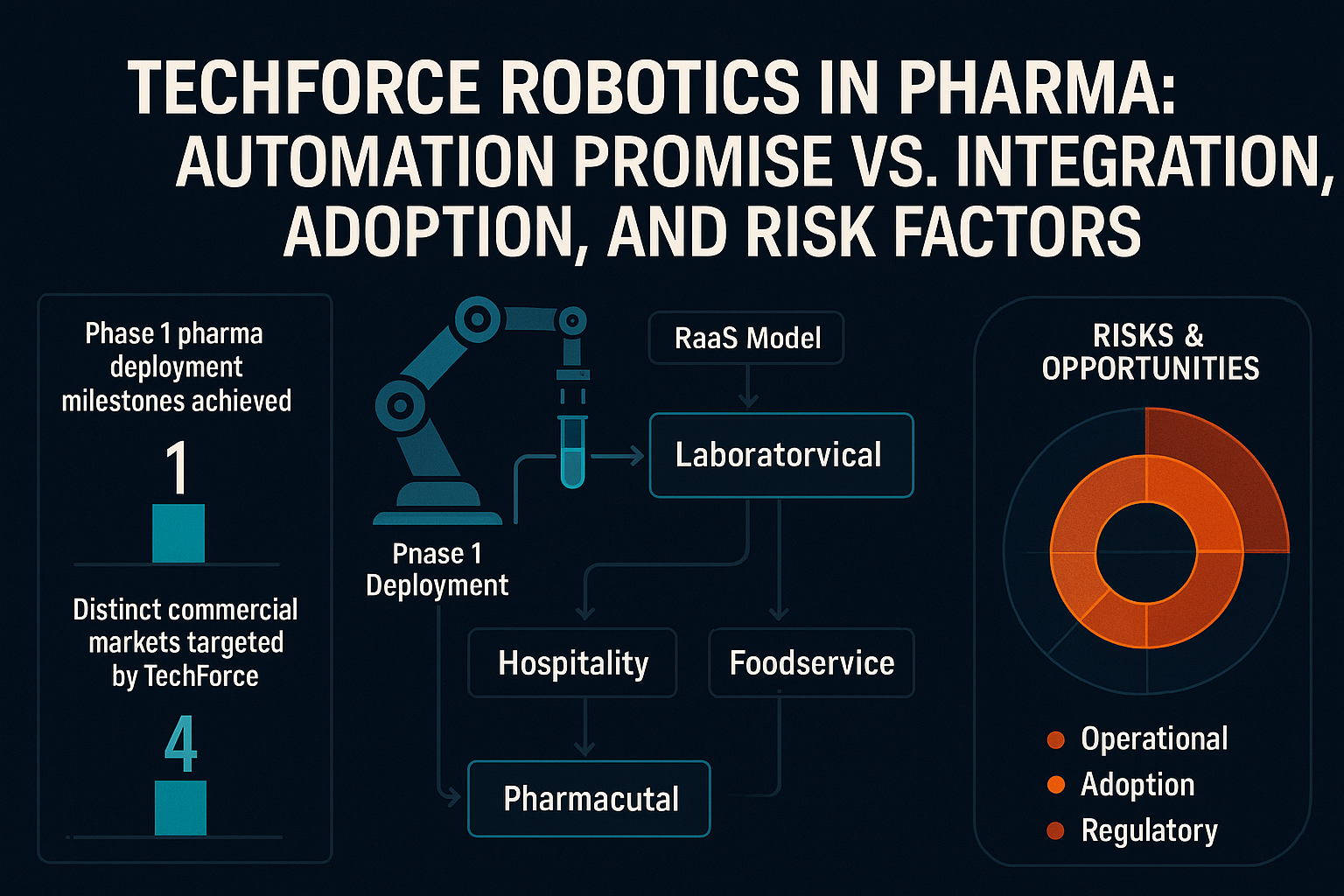
First milestone in lab deployment complete; Technical deployment confirmed.
TechForce now aims at hospitality, commercial, laboratory, and pharmaceutical markets.
Active deal with Oncotelic for evaluation, co-development, and future workflow automation pilots.
Comparison criteria
TechForce expands from hospitality to pharma
Broader platform reach, but less domain specializationAdapting RaaS for GMP-compliant environments
Potential for scalability, but uncertain compliance fitUnknown reliability and safety in high-stakes lab workflows
Higher flexibility but greater deployment risk for early adoptersRobotics-as-a-Service with adaptable AI-enhanced software
Lower barrier for entry if compliance is proven, but service SLAs may become more complexPossible outcomes
Further workflow pilots proceed smoothly, leading to new contracts and partnerships.
Pharma and biotech labs accelerate automation investment using flexible RaaS models.Regulatory bottlenecks or technical integration failures stall further rollouts.
Labs defer new automation projects; TechForce may revert focus to less-regulated sectors.Workflow impact
- First-mover labs may see workflow efficiency gains if integration hurdles are overcome.
- Digital systems vendors must recalibrate RaaS and AI-automation models to pharma's compliance context.
- Poor technical or regulatory fit could deter further pharma adoption and set back cross-sector robotics expansion.
- Operational staff face changes in task allocation; Retraining and new SOPs may be required.
- Early deployments will shape pharmaceutical companies’ willingness to automate critical processes.
Signals to watch
Key to understanding true impact, user satisfaction, and operational fit—currently lacking in public results.
Will show if initial deployment converts into commercial expansion, or stalls after the pilot.
Could influence buyer confidence and define integration requirements for cross-industry automation solutions.
May trigger new partnerships, price pressure, or proprietary solutions from sector incumbents.
Balancing Efficiency Potential With Regulatory and Operational Complexity
Cross-Sector Robotics: Promise and Constraint
The initial LIM-E deployment gives TechForce a new foothold in pharmaceutical automation after previous focus areas like hospitality. The appeal: AI-driven workflow robots can optimize lab routines, cut repetitive tasks, and adapt over time.
But pharma brings requirements unfamiliar to hospitality robots—validation, documentation, and error-free operation in strict GMP environments.
- More efficient handling of lab supplies and materials
- New compliance and integration hurdles
- Unclear cost-benefit without real-world performance data
- Lab specialists may need to adapt processes
Strategic Risk: From Feasibility to Compliance
TechForce’s expansion leverages a Robotics-as-a-Service model and modular AI-enhanced platform. If proven, this could inspire sector-wide automation adoption that remains flexible and cost-effective.
However, GMP labs face fines or process shutdowns for non-compliance; Risks include not just technical fit, but audit-readiness, SOP updates, and workflow revalidation.
- Unproven reliability in heavily regulated labs
- Potential for workflow disruption during integration
- Success could open up pharma and life sciences for RaaS
- Failure could reinforce reliance on incumbent vendors
Who Gains, Who Faces Exposure
Automation vendors stand to enter a high-value, traditionally insulated market if they meet pharma's high bar. Early adopter labs gain a voice in product feedback and could streamline operations—but at the potential cost of downtime or compliance issues.
Service robotics platforms may find new life, but only if they go beyond pilot and prove day-to-day robustness and audit readiness.
- Automation teams: process learning and innovation
- Lab leadership: new decision complexity, regulatory risk
- Tech vendors: market validation or reputational setback
- Regulators: new cases to assess RaaS model fit