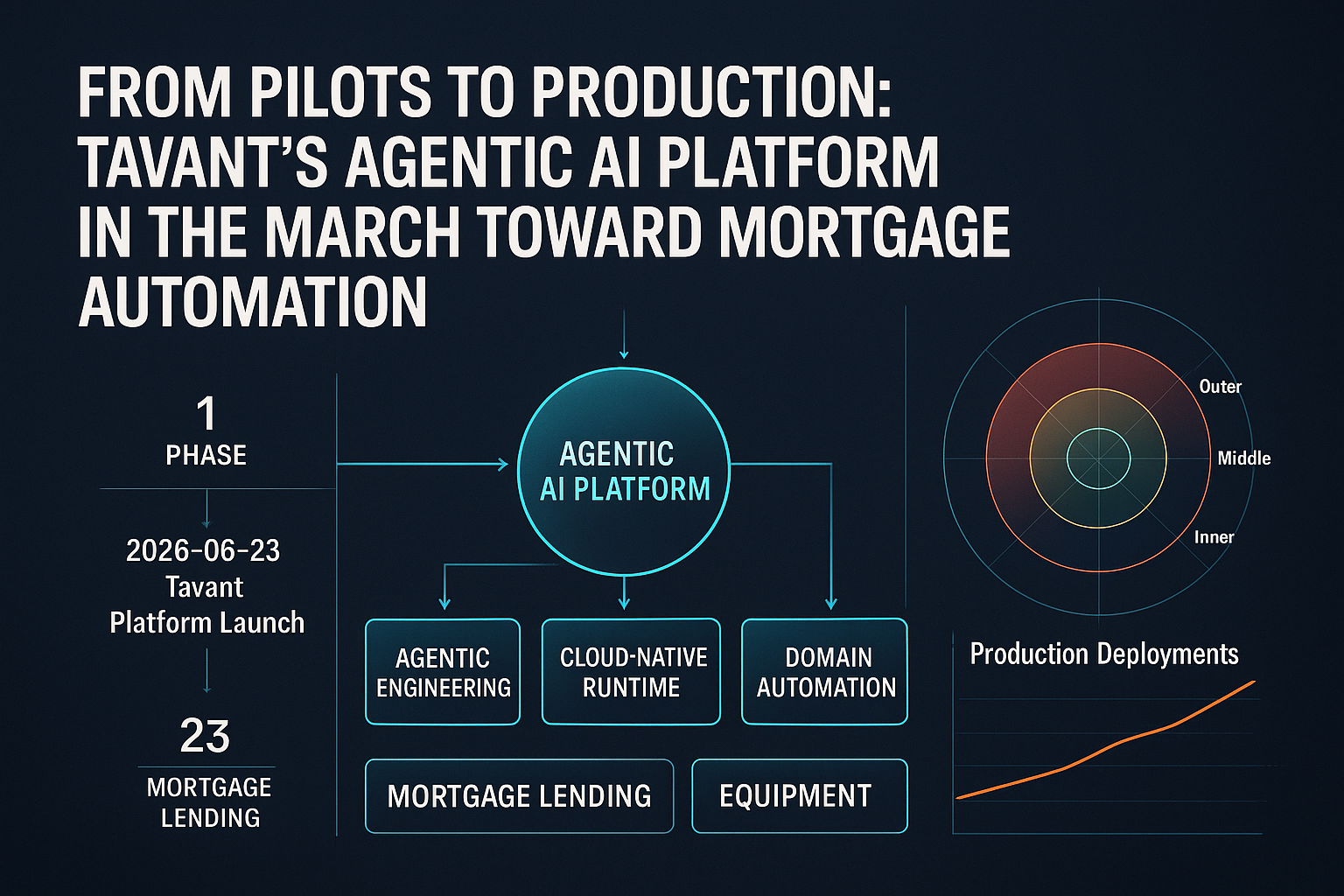
Timeline: From AI Pilots to Production Automation in Financial Services
PhaseTimeline
- Early 2020s: AI Pilots in Enterprise
Most large firms test AI/automation in isolated, non-critical environments, encountering challenges with scale and integration.
- 2026-06-23: Tavant Platform Launch
Tavant introduces agentic AI platform offering production-ready tools for mortgage and equipment markets.
- Post-launch: Enterprise Production Scaling
Market to watch for successful deployments, integration with legacy systems, and pace of industry adoption.
Context behind Timeline
AI pilots have been common across enterprise IT, but most encounter friction moving from proof-of-concept to resilient, maintainable production systems—often due to proprietary technologies and inflexible workflows. Tavant's approach emphasizes agentic engineering tools, domain-shaped specifications, and optional runtime layers to meet the market’s need for portable, governable, and upgradable AI infrastructure. The platform’s initial use cases focus on industries where modernization urgency clashes with high integration costs and regulatory mandates.
Why it matters for Timeline
Tavant’s new AI platform provides a tangible response to persistent concerns—cost, rigidity, and lock-in—hindering legacy process modernization in highly regulated markets. For operators and architects, it suggests a more adaptable approach for embedding LLM-driven automation into critical business workflows, setting a new standard for portability and domain alignment.
Key data behind the update
Platform entered market mid-2026, after AWS Generative AI services competency achievement.
Tavant focuses initial rollout on mortgage lending and equipment aftermarket solutions.
Platform comprises agentic engineering tools, cloud-native runtime, and domain-specific automation components.
Can be deployed on Tavant’s runtime or customer’s preferred stack.
Comparison criteria
Open, optional runtime; Customer portability supported.
Eases migration and reduces future costs.On Tavant or customer stack.
Flexibility for enterprise IT teams.Domain-specific (e.g., mortgage, equipment).
Stronger fit for regulated, process-heavy sectors.Aims for lower development/maintenance expense.
Potential for improved ROI, lower TCO.Possible outcomes
Enterprises adopt agentic AI automation for legacy modernization at scale.
Creates standard for open, portable AI platforms and prompts competitors to shift their architectures.Incumbent AI platform providers respond by enhancing proprietary feature sets.
Organizations may face more complex, heterogeneous automation ecosystems, complicating integration and governance.Financial regulators closely examine generative AI in workflow automation.
May trigger new compliance requirements, affecting deployment velocity.Signals to watch
Early customer success will validate or refute claims of speed, cost, and reduced lock-in benefits.
Move by rivals to introduce similar portability options will show market validation.
Case studies documenting migration from proprietary to open platforms will show real-world portability.
Uptake in other industries with similar legacy pain points would indicate wider trend.
Agentic AI Takes the Next Step in Enterprise Automation
Platform Launch as a Turning Point
The debut of Tavant’s platform marks a move beyond experimental AI—signaling commitment to enterprise-scale automation.
The inclusion of optional, open deployment models could reset how digital leadership approaches modernization.
- Signals end of AI as isolated pilot projects
- Highlights flexibility in deployment and integration
- Shows an effort to bridge legacy and modern platforms
Prior Context: Barriers to AI Scale
Most AI projects stalled at proof-of-concept due to proprietary tech and process rigidity.
Tavant’s architecture responds by offering agentic tools tailored to vertical domains, aiming for both productivity and control.
- Legacy modernization often blocked by vendor lock-in
- Generic LLM solutions lack domain alignment
- High platform fees deter broad adoption
Immediate Implications for Operators
Decision-makers now have a new framework for evaluating cost, flexibility, and long-term automation strategy.
- Faster deployment of automation workflows
- Reduced risk of being locked into a single provider
- Potential savings on development and operational upkeep
What’s Next: Signals and Uncertainties
Uptake in financial services, case studies on migration, and competitor shifts will show if this model becomes the industry norm.
Regulatory responses and governance plans remain key areas needing close monitoring.
- Adoption rates will indicate real impact
- Integration stories will demonstrate portability
- Regulatory updates could influence architecture choices