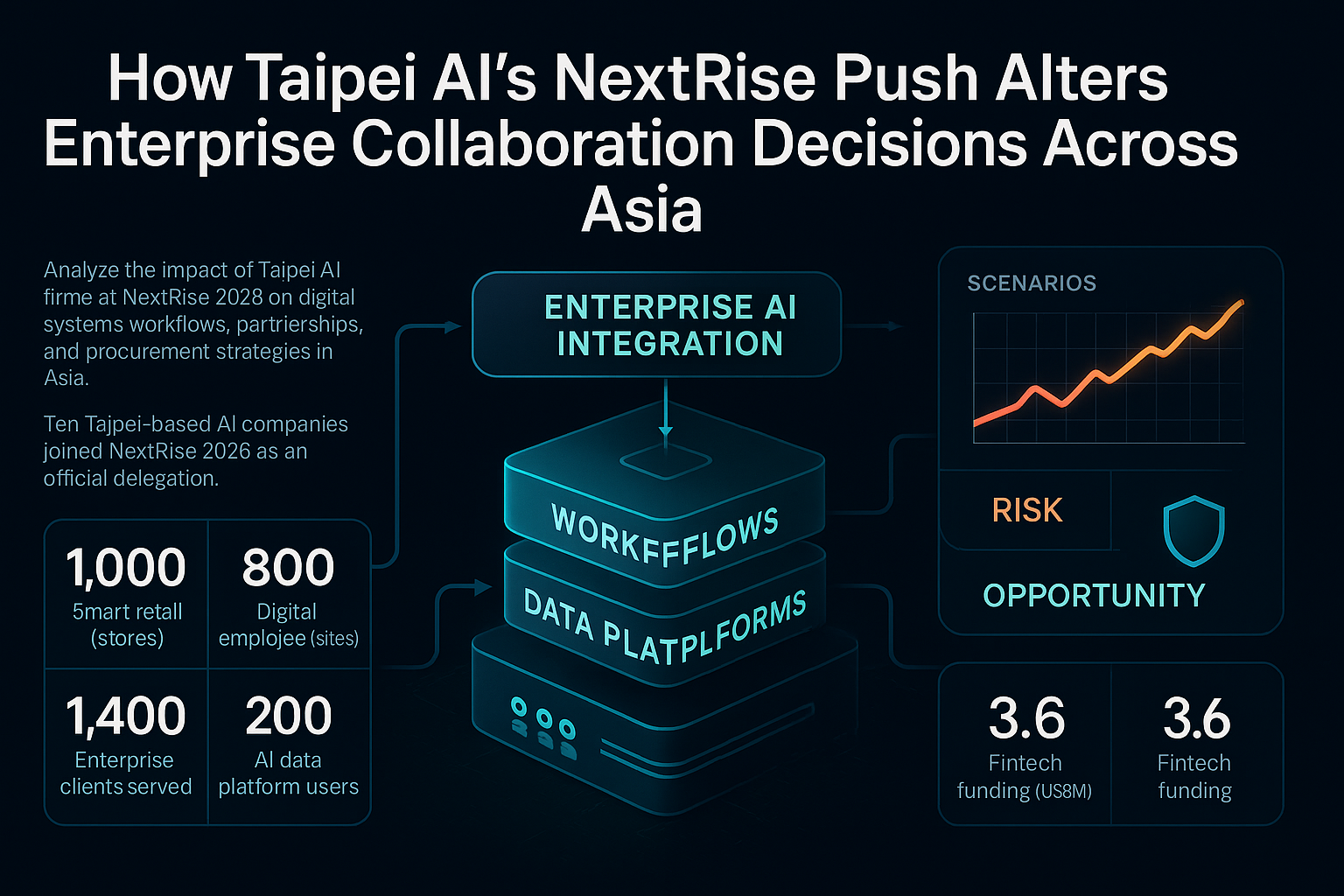
Key data behind the update
KABOB CLOUD rolled out smart retail solutions across more than 1,000 stores in Korea.
PlusBlocks Technology’s AI Digital Employee is active in over 800 locations.
Giftpack’s AI network serves more than 1,400 enterprise customers across 42 countries.
Metabiz’s data platform supports 200+ corporate customers across Asia.
NOX AI raised US$3.6 million to drive AI-powered fintech adoption in Taiwan and Southeast Asia.
Workflow impact
- Increased AI tool availability for enterprise operations in Korea and Southeast Asia.
- Operational workflows may require adaptation for integration with new multi-country AI and data platforms.
- Procurement strategies could shift to evaluate Taipei-origin solutions for retail, finance, communications, and data management.
Comparison criteria
Mature, multinational rollouts (1000+ stores, 800+ sites)
Operators now face real procurement and integration choices, not just scouting.Transparent availability of Taipei-origin enterprise products
Broader sourcing options with different integration, support, and compliance risks.Data platforms and digital employees embedded across corporate clients in multiple countries
Higher need to validate cross-border workflows, data governance, and API compatibility.Governments and VCs facilitating cross-border AI adoption in critical infra
Likely rise of formal procurement programs and long-term co-development deals.Operational consequences
- Operators may need to reassess incumbent vendor relationships in light of new Taipei-based competitors.
- Potential for accelerated cross-border scaling of AI agents and data platforms.
- Convergence of Korean and Taipei innovation ecosystems could set new regional standards for enterprise data infrastructure.
- Short-term procurement cycles may extend as companies benchmark Taipei versus incumbent or Western vendors.
- Integration risks rise where multi-country collaboration imposes governance and workflow challenges.
Signals to watch
KABOB CLOUD and partners have now proven deployments in 1,000+ stores.
Giftpack and PlusBlocks demonstrated large customer networks and operational scale.
Meetings included investment arms, local governments, and venture firms.
Metabiz, IHH, and NOX AI represent vertical integration into critical operations.
Taipei AI Decision Brief
Who Needs to Act—and Why Now
Digital systems, operations, and procurement heads managing enterprise AI or workflow automation must review supplier landscapes after widely-deployed Taipei AI platforms appeared in Korea’s enterprise ecosystem.
With deployments at over 1,000 retail sites and mature AI workflows for supply chain and data management, both incumbents and new buyers face strategic risk and opportunity.
- Procurement and IT integration teams in retail, finance, consumer operations.
- Companies seeking cross-border supply chain automation or data intelligence.
- Incumbent tool vendors at risk of customer churn.
Tradeoffs and Evidence Gaps
Operators can access additional, proven solutions for retail and enterprise AI, but face workflow complexity in cross-border API, data, and compliance integration.
Missing: Any direct evidence of cost-of-integration, TCO, or client satisfaction versus alternate regional solutions.
- Broader solution choice vs. Increased configuration/oversight needs.
- Alignment with Korean/Japanese workflows not fully demonstrated.
- Retention rates above 80% (Metabiz), but vendor lock-in risk not quantified.
Immediate and Longer-Term Market Shifts
The event moves Taipei’s AI firms from fringe to major contender status for high-scale digital operations and B2B content infrastructure within Asia.
Ongoing partnerships signal a potential acceleration in regional AI standard-setting, impacting procurement cycles.
- Potential for formalized co-development contracts between Taipei and Korean firms.
- Benchmarking required for digital employee productivity impacts.
- Operators must monitor expansion into adjacent sectors like healthcare and finance.