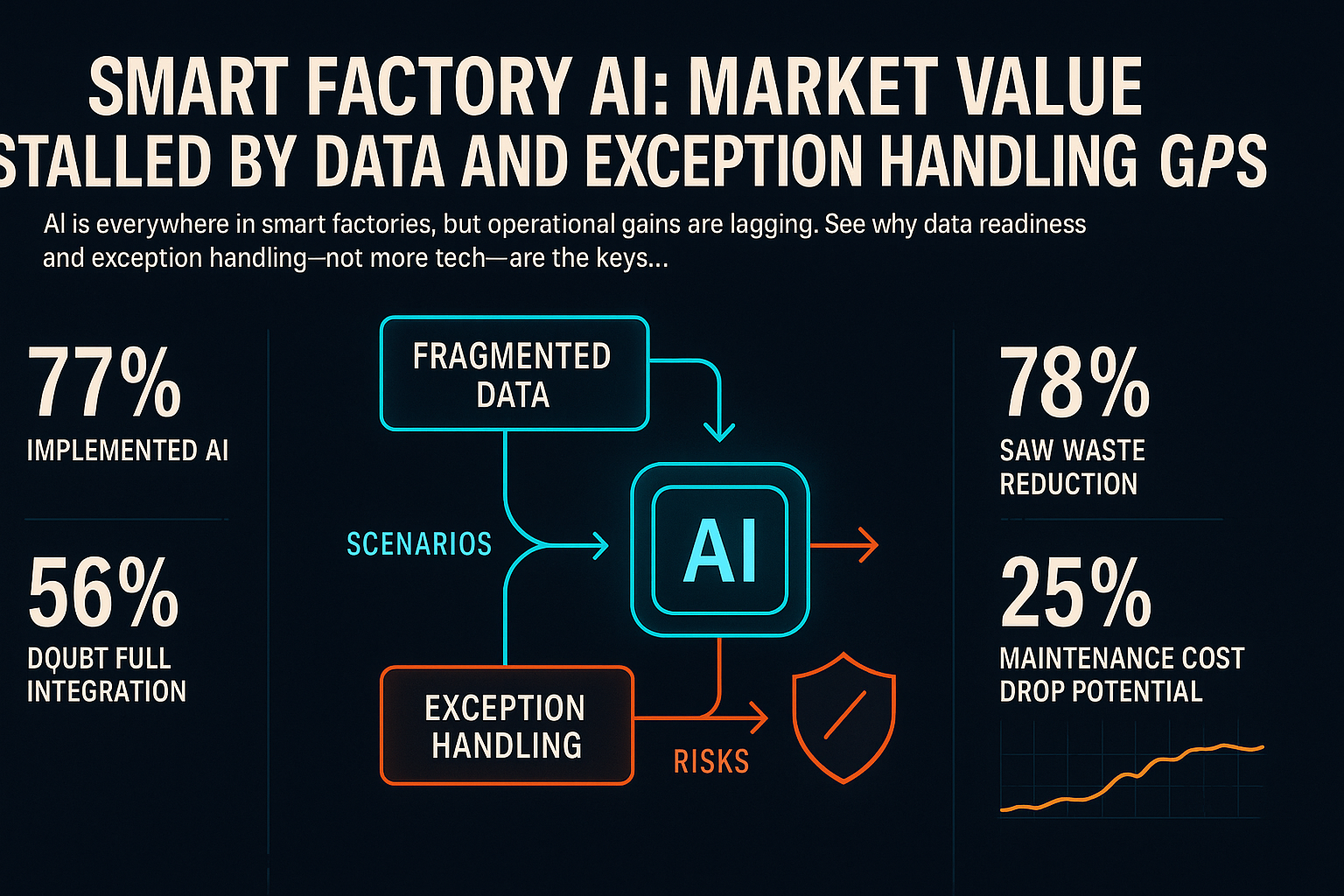
AI in Manufacturing: Adoption, Readiness, and Impact
%Implemented AI
Doubt Full Integration
Saw Waste Reduction
Maintenance Cost Drop Potential
Key data behind the update
Adoption is widespread but not always mature; Investments are already made.
Many firms have doubts about integrating existing systems, signaling stalled impact.
When AI is deployed well, measurable gains in waste reduction are common.
AI holds potential for substantial cost reductions—if operationalized effectively.
Planned investments will not realize value unless the data foundation improves.
A majority favor AI systems that augment, not replace, human workflows.
Why it matters for Why Smart Factory AI Is Stuck
The stakes are high for digital operations leaders betting on smart factory automation. Without unified data and structured decision transfer between machines and people, AI adoption generates unreliable insights and hidden risks—slowing ROI and jeopardizing production resilience. The next competitive edge will come not from more AI features, but from disciplined operational design and empowered cross-functional teams.
Context behind Why Smart Factory AI Is Stuck
While investments in AI for manufacturing continue to grow, most smart factory projects are limited by legacy data systems, fragmented workflows, and insufficient planning for real-world exceptions. As market attention shifts from AI potential to delivered value, firms must reframe successful deployment as a leadership, process, and data problem—rather than a race for new algorithms.
Workflow impact
- Many manufacturers risk underwhelming returns on substantial AI investments unless data architectures are standardized and unified.
- Production and logistics teams must collaborate on data governance and escalation protocols to harness automation value.
- Vendors and system integrators face a demand shift from feature expansion to robust, context-aware integration for client success.
- Delayed realization of AI's operational value may cause competitive gaps among slow adopters and market leaders.
Comparison criteria
AI widely implemented, but uneven integration; Context-aware systems remain rare.
Technical promise exists; Value is stalling without new operational discipline.Fragmented, siloed systems dominate. Unified data is rare.
Real-time decisions and optimization cannot emerge without a single source of truth.Rarely implemented robustly; Escalation protocols often missing.
AI fails silently or overreacts, hiding errors or blocking efficient scaling.Collaborative AI preferred by most, but not consistently operationalized.
Optimal mix depends on escalation clarity and operational trust.Timeline
- Early AI Adoption in Factories
Industry sees widespread AI introduction over past several years, focused on experimentation and pilots.
- 2025 Manufacturing Survey
77% AI adoption reported; 56% of firms uncertain about full integration readiness.
- Current Pivot
Attention shifts from adding AI features to solving data and process bottlenecks for value realization.
- Next 2 Years
41% of executives prioritize new automation hardware—critical test if data integration keeps pace.
Signals to watch
Would indicate market movement toward solving the biggest operational bottleneck.
Signals a shift to robust, real-world system validation beyond the 'happy path.'
Evidence of operations and IT working together to define sustainable AI intervention.
Would reveal new market recognition of the data fragmentation problem.
Operational Shifts Needed for Smart Factory AI Payoff
Adoption Outpaces Real Impact
AI systems are everywhere in modern factories, but most decision-makers recognize unresolved gaps in their process readiness.
Executives invest in automation hardware, yet operational outcomes remain inconsistent across sites.
- 77%+ of firms use AI, but 56% doubt system readiness.
- 41% plan further automation investment in the next two years.
Data Deficit: The Core Operational Bottleneck
Disparate legacy systems and inconsistent data pipelines hinder AI's ability to optimize across production, quality, and logistics.
AI models may appear competent until reality diverges: then unreliable data leads to misdiagnoses, inefficiency, and avoidable downtime.
- Lack of a unified data layer distorts insights.
- Data pipeline consistency is a precondition for AI value realization.
Exception Handling and Human-in-the-Loop Are Non-Negotiable
AI systems often break down outside normal conditions, exposing weaknesses in escalation and error handling.
Most operations teams now prefer collaborative AI—machinery and people sharing meaningful, clearly defined responsibilities.
- 53% of specialists favor collaborative augmentation over full automation.
- Escalation protocols enable trust and resilience in mixed human-machine workflows.
What Market Leaders Do Differently
Successful firms invest in process integration, not just sophisticated AI models.
They pilot in limited settings, focus on system-level metrics, and co-design handoff protocols with frontline operations staff.
- Prioritize data architecture before scaling.
- Involve operators in escalation framework design.