Key data behind the update
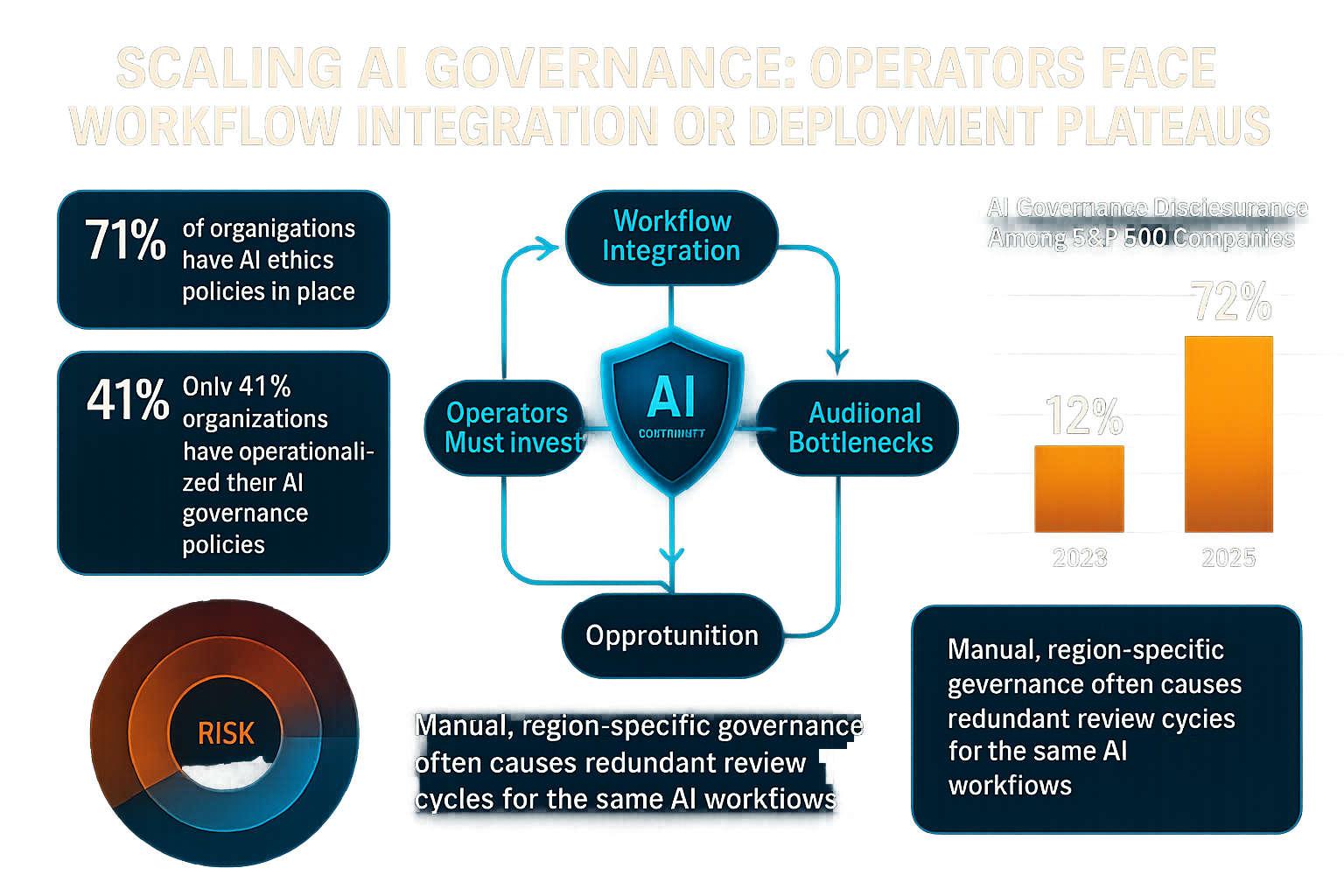
Most enterprises set high-level AI governance principles.
Less than half move beyond intent, creating enforcement weak spots.
Disclosure of AI governance practices was rare among large firms in 2023.
Workflow impact
- AI rollouts face multi-month delays due to manual approval, fragmented controls, and reactive auditing.
- Operational teams must redesign workflows to embed identity, permission, and escalation policies from the data layer up.
- Regulatory and investor scrutiny on governance disclosures is intensifying, making non-operationalized policy a business risk.
- The transition from pilot AI tasks to trusted, autonomous workflows depends on a functioning 'control plane.'
Comparison criteria
Operationalized, workflow-integrated control planes adopted
Automated escalation and compliance vs. Process bottlenecks and risk exposureReal-time, embedded enforcement
Clear audit trails, less local fragmentation vs. More manual exceptions and regional friction72% of S&P 500 disclose governance details (2025)
Rapidly rising accountability and risk if lagging in operational deliveryOperational consequences
- Delays in AI workflow deployment due to fragmented or reactive controls.
- Vendor-neutral governance platforms and real-time control planes likely to become enterprise standards.
- Increased compliance costs and operational complexity if governance is not addressed at the workflow level.
- Potential erosion of trust and pushback from regulators or investors due to gaps in transparency.
Signals to watch
Vendors and buyers who succeed at scale will likely be those who operationalize governance at every step.
Oversight is shifting from policy presence to lived workflow control.
Organizations unable to unify controls risk falling behind despite technical AI progress.
AI Governance at Scale: Priority for Digital Operators
From Guideline to Enforcement Gap
Enterprises may set AI principles, but often lack system-level enforcement. Most have policies, less than half have true operationalization.
This lag leaves organizations exposed—intent doesn’t stop risky actions or meet audit needs.
- Approval cycles extend implementation by months.
- Manual review unable to cope with AI acting across systems.
- Edge cases and escalations remain ad hoc.
Scaling Pain: Manual Controls and Regional Fragmentation
AI validated for a single region can trigger a new approval process elsewhere. Data residency and compliance rules shift between geographies.
What technically works may still stall if governance is fragmented.
- Same workflow, different local compliance review.
- No issue with AI model, but lack of unified control plane.
- Multi-region expansions face repeat effort.
Why Now: Oversight and Investor Expectations
Disclosure of governance has surged, turning operational transparency into table stakes for major enterprises.
Regulators and stakeholders now pursue evidence of working control—not just policy documents.
- Public AI rollouts now scrutinized for workflow-embedded controls.
- Lagging operationalization threatens external relations and opportunities.
- Ethics and compliance become engineering priorities.
Next Steps: Embedding Control in the Workflow
Operators need policy engines, control planes, and escalation paths in every AI-powered process.
Success hinges on not just the workflow agent but the governance layer dictating what data, tools, and exceptions are allowed.
- Operational logic moved to data foundation for consistency.
- Support for region-by-region adaptation without code forks.
- Vendors who embed governance gain operator trust.