Why it matters for Pega AI pricing shift
For business operators and technical architects, the move to per-case pricing and deterministic workflows promises lower run costs and clearer compliance. However, operational value depends on customer willingness to invest in new design tools and manage integration risks across diverse agent ecosystems.
Operational consequences
- Organizations must assess integration readiness for Model Context Protocol if connecting diverse AI agents.
- Teams relying on flexible, ad hoc AI workflows may face friction adapting to design-time constraints.
- Success with per-case pricing depends on high accuracy in workflow definition and agent assignment.
Evidence-backed metrics
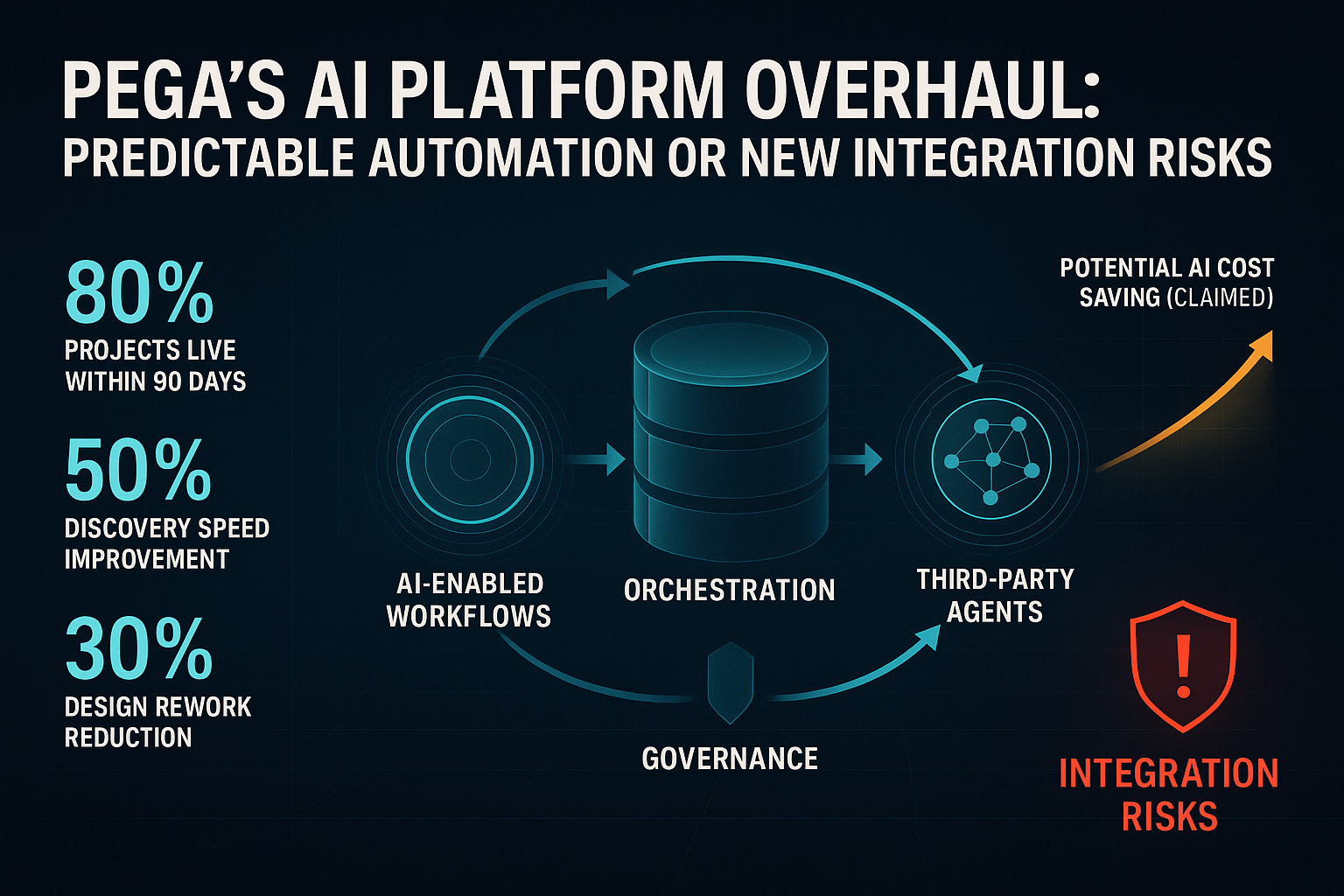
80% of projects using Blueprint Delivered methodology went live within 90 days.
Discovery phase cut in half for early Blueprint Delivered clients.
30% less rework for clients adopting Pega's methodology.
Pega claims some customers could cut AI operating costs by more than 20 times using new pricing.
Estimated global market value, situating Pega’s moves in a high-growth context.
Source data behind the story
Source-reported valuesDecision criteria
Flat fee per completed case (Pega)
Reduces variable cost risk but may require upfront workflow definition and controlDesign-time deterministic orchestration
Greater governance and predictability but potential loss of agile improvisationOpen protocol (MCP) for agent interoperability
Supports multi-vendor agent access but adds integration/standardization requirementsAI-powered Infinity Studio with best practices
Speeds integration for trained teams; Risks learning curve for new usersPossible outcomes
Large enterprise clients standardize on Pega's design-time tools, reduce AI operating costs, and see lower rework.
Market share may rise for platform-centric automation approaches but could reduce flexibility for less controlled workflows.Clients face friction integrating third-party agents via Model Context Protocol; Platform lock-in concerns increase.
Short-term integration risks may limit uptake among firms with diverse or legacy systems.Workflow impact
- Cost control is improved for organizations sensitive to unpredictable AI token charges.
- Adoption of a 'predictable AI' model may favor large enterprises with mature design practices.
- New agent integration protocols could raise short-term complexity for teams not aligned on platform standards.
- Workforce upskilling and credentialing become critical for extracting value from new platform features.
Signals to watch
Tracking if major Pega customers actually see the promised 20x cost savings in production, not just pilot phases.
Monitor which agent platforms (e.g., AWS, Google, Anthropic, OpenAI) are natively interoperable and how well governance is enforced.
Watch if other vendors follow with non-token-based billing and predictable workflow models or stick with prompt-driven/flexible agentic AI.
Pega Workflow Automation Playbook
What Changes for Workflow Operators
Pega now offers a flat-fee, per-business-case AI pricing model, moving away from unpredictable token charges. This aligns cost to business outcomes, which immediately shifts budgeting practices for teams scaling agentic automation.
- Flat-fee pricing caps runaway AI costs.
- Model Context Protocol supports major LLM/agent platforms.
- Deterministic design may reduce unexpected runtime issues.
Where the Guarantees Stop: Evidence and Gaps
Blueprint Delivered showcases strong early returns—faster go-live and lower rework—but this is based on a limited sample. Claimed 20x AI cost savings rest on scenario-specific workflow complexity and strict adherence to Pega's architectural methodologies.
Comparative market data positions Pega in a $23.77B segment, but broader industry benchmarks for agentic AI integration or long-run cost outcomes remain scant.
- Early clients saw 80% of projects live in 90 days.
- 30% design rework cut—if Blueprint methodologies are closely followed.
- Long-term, cross-industry benchmarks are not yet publicly available.
Operator Risks: Integration and Governance
The pivot to design-time deterministic workflows means less unpredictability but reduces flexibility for teams used to prompt-driven tools. Integration with external LLMs and agents via MCP could surface new compatibility or governance bottlenecks.
Organizations with mixed platform portfolios may face a higher initial integration curve and will need to align on standards or risk fragmented results.
- Design-time control secures outcomes but slows improvisation.
- MCP opens ecosystem but demands shared protocols.
- Rapid change will require new skills and credentialing.