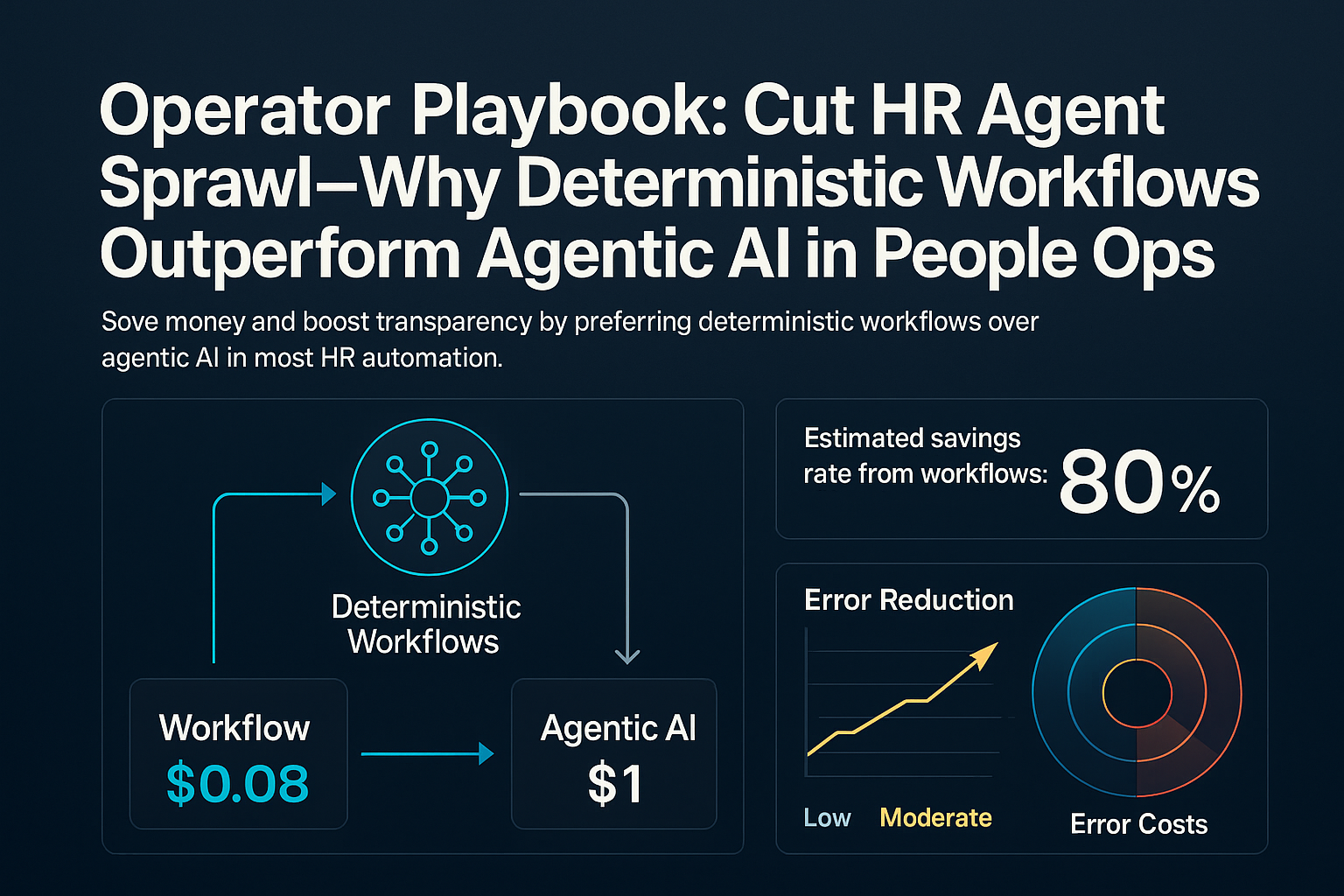
Workflow impact
- Significant cost savings—simple workflows reduce per-task and per-candidate costs by up to 12x in cited cases.
- Enhanced transparency and auditability—fixed workflows allow easier inspection and justification to leadership.
- Reduced legal and reputational risk—workflows flag ambiguous patterns for human review, avoiding agent-driven errors.
Key data behind the update
Workflow saves about $0.92 per candidate; Agent cost is approx. $1 per candidate as per consulting case.
Workflows offer nearly 12x cost efficiency versus agentic approaches in resume screening example.
Workflows outperform agents in about 80–90% of current HR AI applications, according to expert experience.
Operational consequences
- Unjustified agent adoption drives up operational expenses and clouds accountability.
- Workflows, if properly mapped, minimize both visible and latent legal exposures.
- Teams failing to audit their automation architectures risk future compliance problems and employee mistrust.
- Redirected resources (from agent to workflow) can fund higher-impact, complex AI projects.
Comparison criteria
Workflow at $0.08–$0.10 per task
Workflows deliver over 10x cost efficiency in common HR scenarios.Workflows with predefined steps and clear logic
Auditability is much higher in deterministic workflow systems.Workflows outperform agents in 80–90% of HR AI applications
Most current automation does not require agentic complexity.Signals to watch
May pressure teams to overuse agents; Check if new releases offer real value beyond workflows.
Workflow-based systems ease compliance and transparency; Agentic systems complicate both.
Opaque agent decisions can undermine trust or create legal challenges.
Timeline
- Recent months: Agent adoption spike
Teams and CHROs initially build AI agents for most HR functions following industry hype.
- Discovery of unnecessary complexity and cost
Consultant-led audits reveal tasks with fully mappable logic; Workflows provide same result at far lower cost.
- Adoption of workflow-first approval
Organizations replace broad agent usage with workflow-centric design and explicit agent justification.
Operator Playbook: Reviewing AI Automation in People-Focused Operations
Audit and Classify Existing Automation
Many HR teams built agentic AI systems due to initial market enthusiasm. Most such projects can be reframed as deterministic workflows, unlocking major savings and clearer rationale.
- Run a process discovery workshop: Identify which HR workflows have fixed logic.
- Require every agent deployment to prove workflow is insufficient.
- Document logic pathways—when IF-THEN logic covers all expected branches, default to a workflow.
Budget and Cost Implications
Agents cost substantially more: in one resume screening case, $1 per candidate for agentic AI vs $0.08 for workflow. Aggregate savings scale with volume.
Redirect workflow savings to cover the rare process domains requiring genuine agentic logic.
- Map current spend by process (onboarding, reporting, screening).
- Project annual cost differential of workflow vs. Agent for each module.
Governance and Human Oversight
Agentic systems risk introducing bias or errors, especially in high-stakes tasks like leadership screening. Human review remains mandatory where misclassification carries risk.
Clear audit trails and explainable outcomes are more attainable in workflow-based logic.
- Set mandatory human 'final review' for ambiguous or high-consequence outputs.
- Require process explanation logs for every workflow or agent output.
Scenarios and Compliance Triggers
As vendors market more agentic functionality, teams should resist complexity unless justified by true uncertainty.
Monitor feedback and incident reports for transparency and outcome fairness.
- Calibrate automation policies quarterly based on real-world errors.
- Respond promptly to board or regulator audit requests with mapped workflow logic.