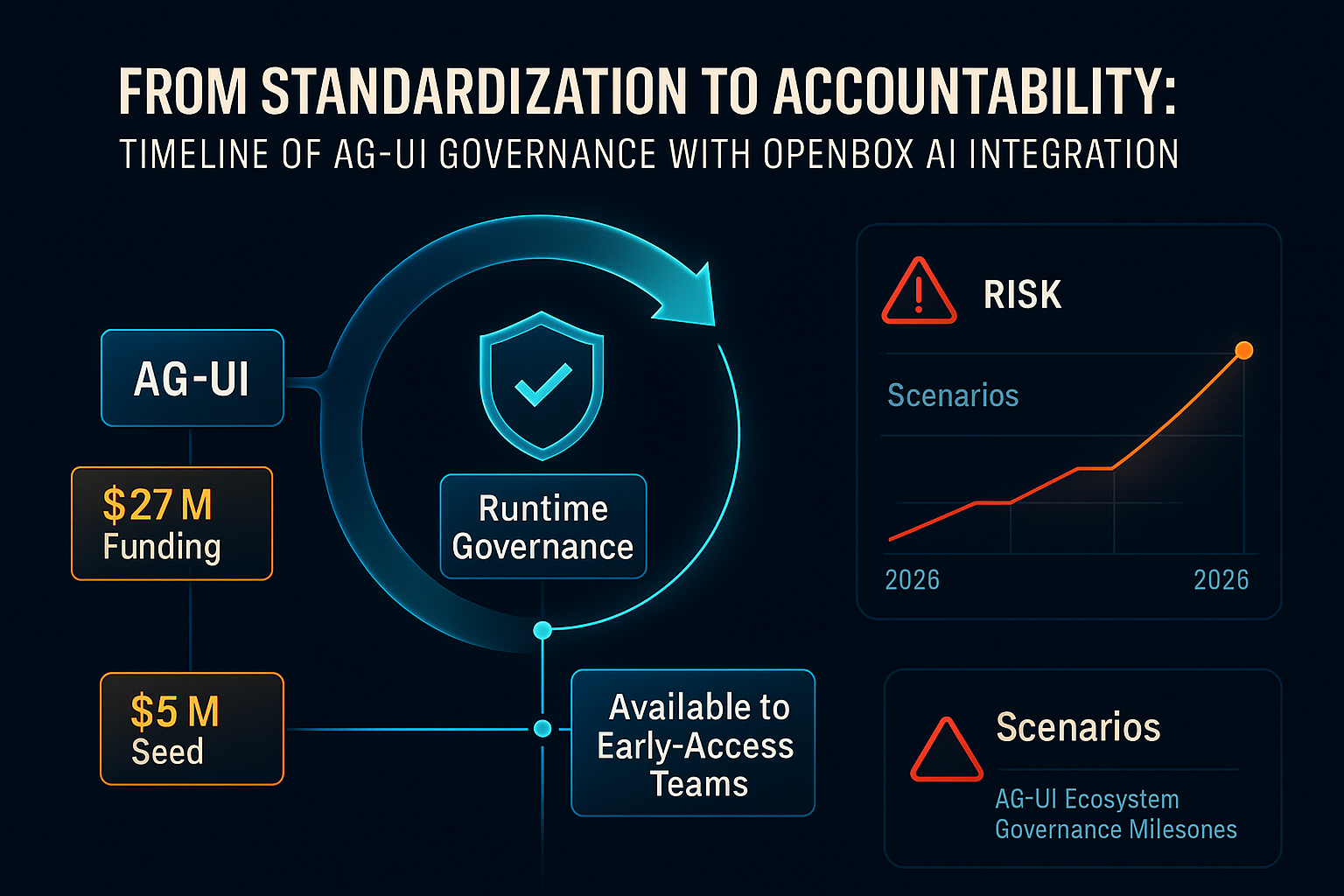
AG-UI Ecosystem Governance Milestones — 2026
Million USDTimeline
- May 2026: CopilotKit Funding Milestone
CopilotKit secures $27M, signaling rapid agentic AI protocol adoption.
- June 2026: OpenBox-CopilotKit Integration Announcement
Partnership brings runtime governance into the AG-UI ecosystem.
- June 2026: Early Access Rollout
Governance integration opens for select teams, enabling new compliance workflows.
- June/July 2026: General Availability
Full market rollout expected, marking a functional inflection for governed agent deployment.
Context behind Timeline
Prior to this development, agent frameworks generally solved user/agent interaction through open protocols but left security and compliance as external, often manual, concerns. AG-UI's adoption signaled standardization, but lacked real-time enforcement. The OpenBox integration addresses this by combining protocol-level standardization with enforcement beneath the interface layer, responding directly to new funding and scaling signals from the AG-UI community.
Why it matters for Timeline
While open protocols simplify agent development and user interaction, enterprises need rigorous, tamperproof evidence of AI agent decisions. This integration automates accountable oversight and auditability that regulators and risk teams demand, unlocking mainstream adoption in sensitive workflows.
Key data behind the update
Significant capital enables AG-UI’s ecosystem expansion and enterprise targeting.
Recent market arrival suggests rapid productization tailored to current standards and needs.
Early VC backing demonstrates demand for governance tools within the agentic stack.
Rollout to early-access teams with general availability announced for the same month.
Comparison criteria
Enforced at runtime, before agent actions.
Reduces lag in compliance and improves error prevention.Directly overlays open AG-UI interaction layer.
Minimizes need for custom middleware or reengineering.Uses cryptographically signed proof certificates for each agent decision.
Provides immutable, regulator-grade evidence for all agent decisions.Possible outcomes
Major platforms (Google, Microsoft, Amazon, Oracle) adopt AG-UI; Compliance demands grow.
Enterprises employing sensitive data scale agent use, increasing demand for runtime compliance enforcement.Requirements for cryptographically signed proof and approval workflows.
Middleware enforcing pre-action policy becomes mandatory for certain regulated sectors (finance, healthcare).Signals to watch
Shows market readiness and willingness of early-adopter enterprises to move to governed deployment.
Indicates potential standardization and interoperability for agentic workflows.
Marks shift toward enforceable trust, not just process documentation or loose auditing.
Mapping the Shift to Accountable Agentic AI
From Protocol Adoption to Enforceable Trust
Over the past years, digital systems operators have used emerging agentic AI frameworks to improve workflows, but security and compliance gaps remained. AG-UI’s expansion provided a universal way for agents and users to interact.
OpenBox now delivers runtime governance directly within this flow, allowing stakeholders to move from loose monitoring to strict, auditable controls.
- Agent deployment for multi-step operations previously lacked preventive controls.
- OpenBox integration intercepts and assesses agent actions before commitment.
- Automated, cryptographically signed records satisfy increasing audit scrutiny.
Catalysts: Capital and Ecosystem Readiness
CopilotKit's $27M funding and its AG-UI’s acceptance by market leaders signal the agent-interaction standard’s maturity.
OpenBox’s governance layer arrives as demand spikes for deployable oversight, with early access rolling out as general availability nears.
- Funding cycles often presage accelerated platform adoption.
- Governed agent frameworks shift operator focus from building to hardening systems.
- System architects seek vendor solutions that overlay, not replace, current stacks.
Operational Implications for Enterprise Workflows
Security teams gain live, in-flow policy enforcement and combinatorial checks across agent steps. This addresses regulatory mandates and internal risk frameworks.
Developers can apply these controls via SDK, minimizing rework and avoiding holistic re-architecture.
- Supports sector-specific mandates, including EU AI Act.
- Immutability and proof certificates are table stakes for compliance reviews.
- Supports real-time human intervention for sensitive agent actions.