Why it matters for OmniDimension AI Customer Engagement Platform
Business operations teams increasingly need customer engagement solutions that connect AI communications directly to actions in workflows and CRMs. OmniDimension promises to bridge this gap, but the shift to truly automated processes comes with integration risks and analytics dependencies—key considerations for operators managing growth, scale, and compliance.
Operational consequences
- Organizations with fragmented workflows may struggle to realize promised automation efficiencies.
- Platform success hinges on analytics reliability and actionable downstream integrations.
- Teams lacking automation maturity or clear escalation paths risk introducing new bottlenecks.
- Early adopters in regulated industries will need to assess compliance support for multi-language and global rollout.
- SaaS providers and agencies may see a rise in white-label automation platforms, intensifying service integration demand.
Key data behind the update
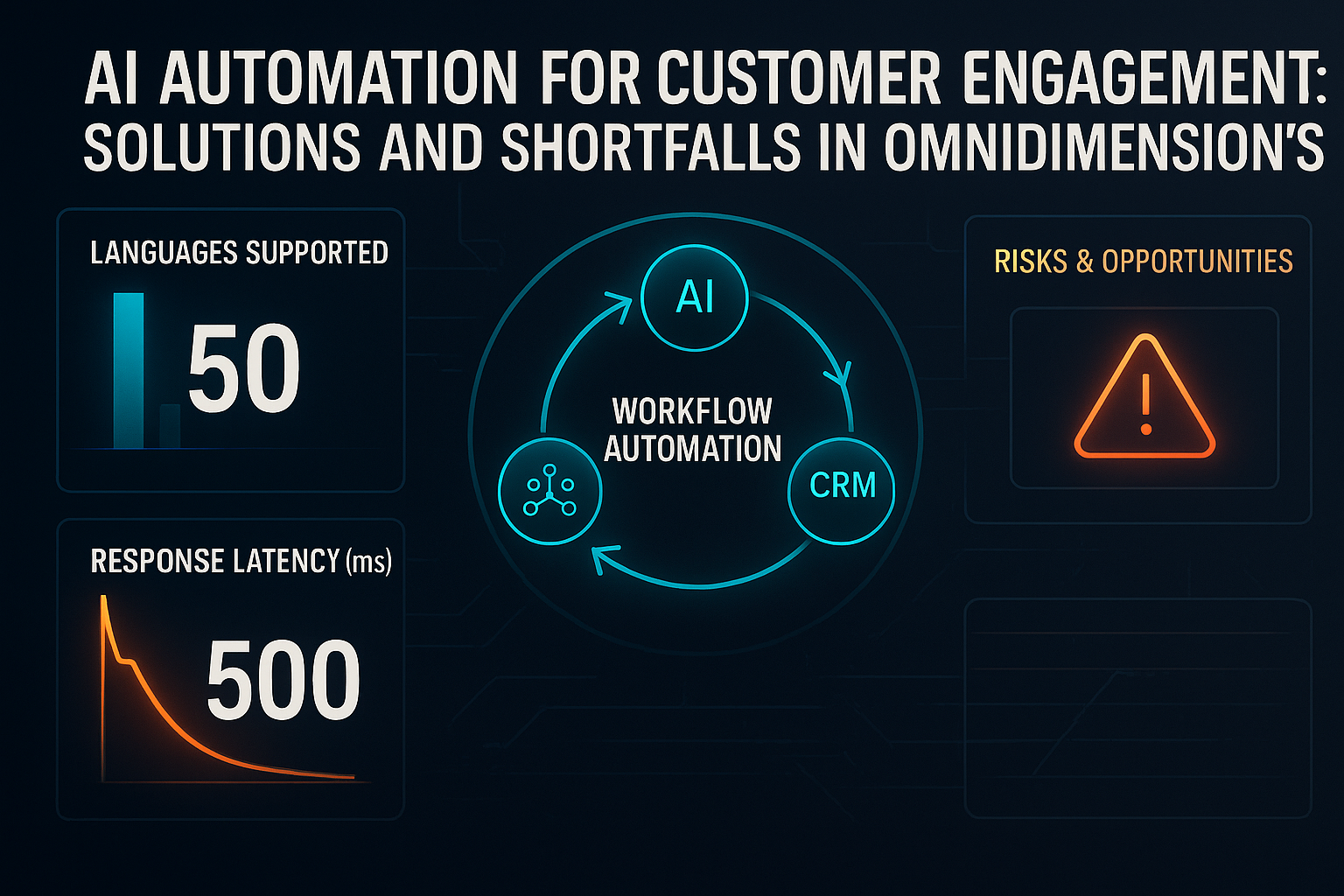
Global deployment is feasible but operational complexity increases with growing linguistic coverage.
Sub-second AI action enables real-time engagement but requires robust backend performance at scale.
Variable cost aligns to operational activity, but ROI depends on realized automation savings.
Comparison criteria
Unified AI, CRM, and analytics in one platform
Improved continuity, but integration remains a riskSupports >50 languages, multi-industry use
Facilitates global rollout if consistency can be maintainedNo-code setup, natural language config
Faster implementation, but edge-case reliability unprovenUsage-based
Can scale with business, but value depends on automation effectivenessPossible outcomes
Unified platform connects AI agents to workflows and CRM in real time.
Teams see faster handoffs, less manual work, and improved data accuracy.Disconnected tools or weak workflow automation persist post-deployment.
Operational gaps remain, reducing automation impact and creating new process risks.Workflow impact
- May accelerate resolution rates and lead qualification for customer-facing teams.
- Could lower operational costs by minimizing manual data entry and follow-ups across verticals.
- Raises the bar for required workflow infrastructure, pressuring IT teams to modernize and tightly integrate core systems.
- Broader language support opens multinational market opportunities but complicates consistency and compliance management.
Signals to watch
Real operational ROI and adoption hinge on not just conversation quality, but reliable downstream automation.
Compliance and multi-language support may reveal hidden integration and oversight challenges.
Operating teams will look for impartial metrics on end-to-end performance, not just features.
As platforms impose new demands on backend systems, integration expertise becomes a market differentiator.
Operational Advantage and Real-World Challenges in AI-Driven Customer Engagement
Unified System Upside—Speed, Coverage, and No-Code Deployment
The platform’s integration eliminates the need for multiple disconnected customer engagement tools, making it possible to automate actions like scheduling and lead routing straight from the conversation.
Natural language configuration accelerates deployment and supports rapid iteration, reducing IT dependency.
- No-code agent setup for faster rollout
- Automated post-call updates to CRM and workflows
- 50+ language support for multinational reach
Key Roadblocks—Integration, Workflow Reliability, and Analytics Gaps
Disconnected workflow tools and weak automation have hindered real adoption of AI engagement. Integration with existing systems remains a significant operational hurdle.
Analytics must provide actionable insights, not just call transcripts, or process value falters.
- Process silos increase risk of missed actions
- Workflow breakdowns undercut lead/conversion gains
- Analytics coverage must extend beyond basic metrics
Who Benefits, Who Faces Hurdles
Teams with mature CRM and workflow stacks gain the most from unified automation. Multi-location or multilingual operators can better standardize engagement.
Organizations with legacy infrastructure or low automation maturity risk greater implementation complexity and new integration headaches.
- Benefit: Customer-facing teams in sales, support, and operations
- Risk: IT, legal, and compliance face integration and oversight demands
- Unknown: Effectiveness in regulated and highly customized enterprise environments