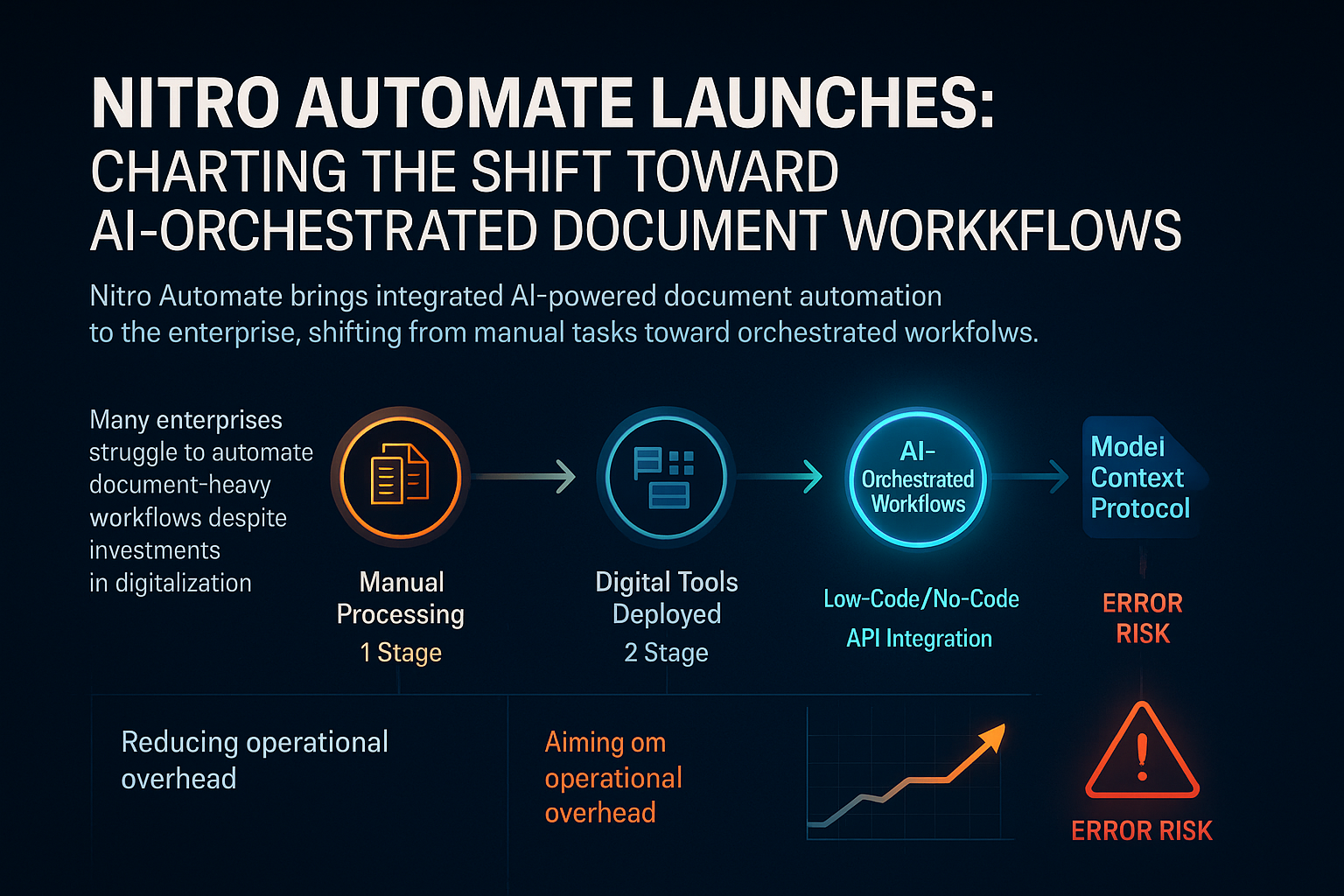
Evolution of Enterprise Document Automation
StageTimeline
- Manual Document Processing Era
Routine document tasks handled by employees across disparate systems, often in isolation from workflow automation.
- Rise of Document Productivity Tools
Introduction of digital document editing and electronic signatures, but persistent manual data extraction.
- Launch of Nitro Automate (2026-07-07)
Platform debuts, unifying automation, data extraction, and workflow orchestration with AI integrations.
- Next Stage: AI Agent Integration via MCP
Open protocol adoption will allow autonomous AI agents to initiate, manage, and complete document workflows end-to-end.
Context behind Nitro Automate
Traditional enterprise approaches to document management focused on digitizing forms and enabling simple e-signatures but left critical data siloed and required manual processing for many steps. As organizations aspire to scale both AI assistants and autonomous agents, platforms that unify data extraction, orchestration, and workflow integration—like Nitro Automate—are becoming foundational. The launch reflects a response to the growing demand for deeper workflow automation, spanning document intake to execution and integration with modern AI protocols.
Why it matters for Nitro Automate
For enterprise operations teams, the transition from stopgap digital tools to holistic document automation unlocks new efficiencies, reduces repetitive work, and enables smarter use of data—with direct impact on workflow flexibility, risk management, and future AI adoption.
Key data behind the update
Small repetitive manual actions compound into a significant operational burden at scale.
The solution targets not small routine tasks but the high-throughput needs of large organizations.
Time-to-value is rapid, reducing the barrier for adoption and transformation.
Comparison criteria
Orchestrated, end-to-end automation with integrated AI and workflow routing.
Current launch eliminates remaining manual bottlenecks in complex workflows.Supports both human-initiated and AI agent-driven processes via protocols and APIs.
Broadened integration footprint increases operational flexibility and future-proofs against evolving AI strategies.AI-powered data extraction transforms unstructured content for downstream systems.
Unlocks actionable data, feeding analytics and compliance systems.Rapid, near-immediate value on rollout.
Accelerates digital transformation projects and lowers switching costs.Possible outcomes
Widespread adoption of Model Context Protocol by enterprise AI and integration with Nitro Automate.
End-to-end document workflows operate autonomously, with human input required only for judgment calls.Slow adoption of automation for edge cases or legacy systems.
Organizations remain exposed to high error rates, invisible process delays, and missed data extraction opportunities.Signals to watch
Indicates whether the platform can adapt to more varied, organization-specific workflow logic.
Measures readiness for cross-system, agent-driven AI automations.
Directly tests the platform’s value and quantifiable impact on workflow efficiency.
Mapping Document Automation’s Inflection Point
From Digitization to Orchestration
Earlier enterprise solutions digitized documents but left data locked in files, requiring staff manual intervention for reviews, approvals, and routing.
Nitro Automate bridges this gap, enabling automated flows that extract, process, and route documents without constant human oversight.
- Legacy: Task execution scattered across staff and tools.
- Integration: Orchestrated process chains using AI for data extraction.
- Operational focus moves from document movement to workflow outcomes.
Unlocking Trapped Data for Systemic Value
Information extraction from documents was a slow, manual process, especially across contracts, invoices, and onboarding records.
With AI-powered extraction, Nitro Automate transforms this static content into process-ready data, available to systems and stakeholders downstream.
- Critical data no longer hidden in PDFs or forms.
- Faster access supports compliance, analytics, and automation goals.
- Enables process consistency and reduces risks from manual entry.
Preparing for AI Agent-Driven Workflows
Support for open protocols like MCP makes Nitro Automate compatible with incoming waves of autonomous AI that require deep tool access.
This allows hybrid workflows—some parts human-driven, others fully agent-executed—improving flexibility and future scalability.
- Flexible integration: Low-code/no-code for teams, API for developers.
- Agent readiness expands automation horizon.
- Basis for cross-system, intelligent orchestration.