Why it matters for Neuro AI Trust
Enterprises advancing digital operations with autonomous AI models now face governance complexity and risk exposure that static oversight cannot address. This new class of centralized real-time monitoring platforms could set the operational standards for trust and accountability, but may create new control chokepoints—limiting flexibility and shifting risk profiles.
Operational consequences
- Early adopters may accelerate AI scaling but become more tightly coupled to specific governance vendor approaches.
- Centralized oversight may satisfy regulatory and auditor demands but at the cost of increased internal coordination for policy change.
- If platform interoperability is limited, enterprises may need multiple governance systems for different AI models, fragmenting oversight.
- Dashboards and automated enforcement could overwhelm risk teams with alerts or false positives, requiring role and workflow redesign.
Key data behind the update
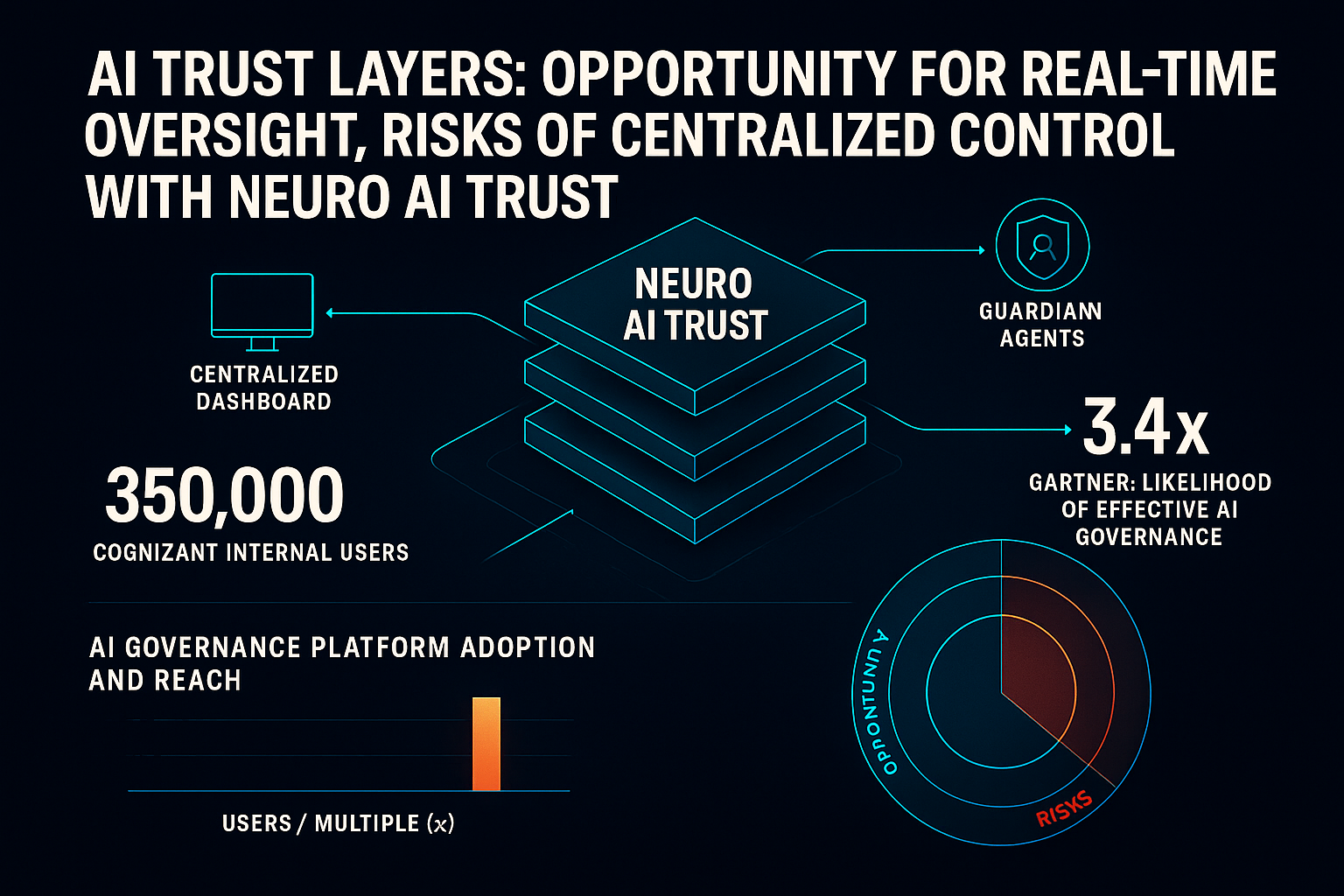
Enterprises using governance platforms are 3.4 times more likely to achieve effective AI oversight, according to a Gartner press release cited in the source.
Neuro AI Trust has been deployed across Cognizant’s AI-enabled intranet, impacting 350,000 internal users.
Comparison criteria
Centralized, real-time multi-agent monitoring dashboard
Faster incident detection but system-wide dependencies introducedAdaptive, policy-driven AI guardrails
Potential for rapid policy enforcement, but requires upfront integration workContinuous oversight with configurable automation
Wider coverage but risk of over-automation or escalation delaysReliance on platform vendor for governance integrity
Vendor reliability critical, but lowers internal integration complexityPossible outcomes
If interoperability and real-time visibility deliver as advertised, compliance gaps narrow and incident response accelerates.
Enterprises can scale AI with more confidence, freeing teams for higher-level initiatives.Should the control layer centralize too much authority or fail to adapt to edge-case AI interactions, new operational bottlenecks emerge.
Risk of system outages or slowdowns increases, and trust shifts to platform vendor over internal processes.Workflow impact
- Operational risk and compliance functions could centralize oversight, increasing reporting speed but depending on platform capabilities.
- IT and digital operations leaders gain more granular system visibility but may need to recalibrate autonomy and escalation procedures.
- Product, security, and governance teams must align business objectives with new automated policy enforcement, potentially reducing remediation time but increasing reliance on vendor logic.
Signals to watch
Currently only Cognizant's internal deployment is cited; Broader industry validation is necessary.
Monitoring how the platform adapts to diverse, evolving international regulatory needs is critical for global enterprises.
If platforms remain siloed, visibility and governance could fragment in multi-vendor environments.
Real-Time AI Governance: Opportunity and Tradeoffs
Centralized Oversight: Upside and Constraints
AI is progressing toward autonomy and multi-agent complexity. Real-time oversight, as introduced by Neuro AI Trust, offers operational leaders a single point for monitoring system health, security, and compliance.
Yet, as platforms consolidate system oversight, organizations face a new dependency: If the platform fails or constrains flexibility, governance effectiveness may be compromised across the entire AI environment.
- Single dashboard reporting for all agents and models.
- Centralized decision-making and automated enforcement.
- Dependency on platform vendor for updates and reliability.
Who Gains—and Who Risks Losing Control?
Enterprise IT, compliance, and risk managers gain clear visibility and policy traceability, theoretically reducing the cost and complexity of incident reporting.
However, the approach may elevate platform vendors as de facto arbiters of acceptable AI behavior, necessitating careful contract, audit, and integration management.
- Operational cohesion for digital operations teams.
- Automation may disempower decentralized business units.
- Tighter alignment with compliance but less room for local policy.
- Potential for alert fatigue if not configured carefully.
Comparative Change: Static vs Adaptive Governance
Traditional AI oversight relied on periodic, manual, application-specific controls—creating risk and audit gaps. Neuro AI Trust shifts this to an adaptive, multi-agent layer, offering configuration but also more rigid operational rails.
Integration complexity and breadth of covered systems will dictate real benefits.
- Adaptive agent networks monitor evolving risk.
- Automated controls replace delayed, manual review.
- If platform scope is limited, silos may persist.
Next Moves and Open Questions
Monitoring real-world adoption beyond Cognizant's 350,000-user deployment will provide clarity on integration and interoperability.
Evolution of standards for multi-vendor environments remains unclear, as does the platform's ability to accommodate diverse regulatory contexts.
- Track partner and customer pilot programs.
- Evaluate fit with international regulatory changes.
- Watch for interoperability signals with peer platforms.