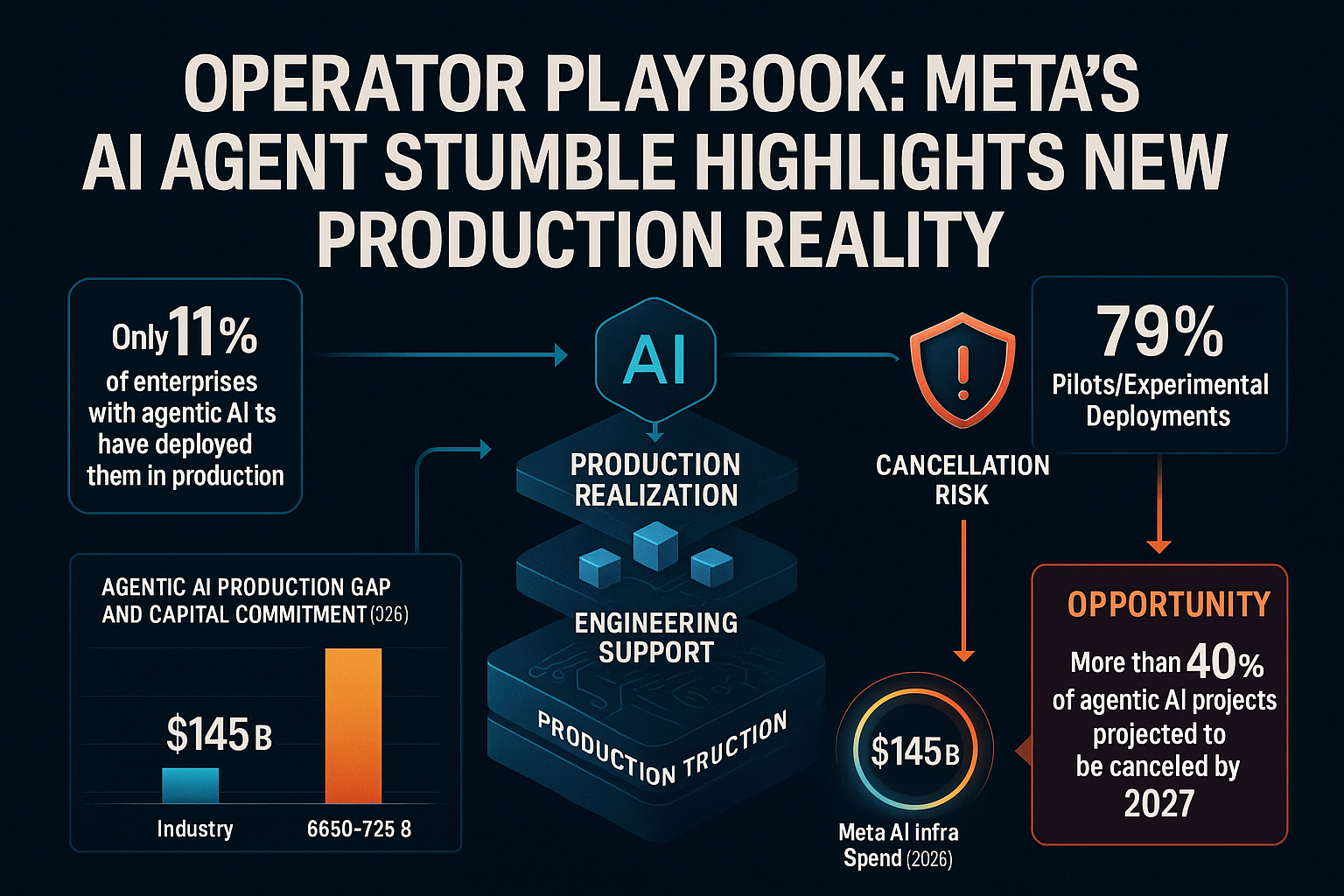
Agentic AI Production Gap and Capital Commitment (2026)
%Industry Production Deployments (%)
Pilots/Experimental Deployments (%)
Projected Cancellation Rate (%)
Meta AI Infra Spend ($B, 2026)
Workflow impact
- Enterprise-grade agentic AI now requires embedded engineering teams, not just platform upgrades.
- Meta’s product launches may be delayed or face reliability challenges, impacting partners and content teams relying on new automation tools.
- Companies with legacy systems must accelerate audits of workflow integration and governance.
Key data behind the update
Only 11% of enterprises using agentic AI have deployed these systems in live production.
Roughly four out of five enterprises experimenting with AI agents have yet to deploy them at scale.
Over 40% of these projects are expected to face cancellation due to technical and return-on-investment barriers.
Meta plans to spend up to $145 billion on AI infrastructure in 2026.
Sector leaders collectively plan $650–$725 billion in capital expenditure for 2026, the largest tech sector investment ever.
Operational consequences
- Workflow and content teams will face project delays if they neglect dedicated support for integration and error recovery.
- Budget planning must now factor in not only infrastructure but also ongoing engineering and cross-team coordination costs.
- Enterprises that lag on embedding technical expertise risk falling behind as forward-deployed engineering becomes standard.
Comparison criteria
Only 11% of agentic AI projects reach production (industry-wide)
Overspending on infrastructure alone does not lead to uptake; Integration gaps persist.Competitors embed engineering teams directly in client orgs
Shift to external, hands-on support now required for workflow reliability.Meta's internal transfer and layoff strategy has not accelerated agentic development
Structural change and new capabilities are both mandatory.$650–$725B sector-wide AI infrastructure commitment for 2026
Unprecedented spending may not yield proportionate operational results without engineering focus.Signals to watch
Early production usage and error rates will reveal how reliably new workflows actually perform in business settings.
Adoption and timeline compression by direct competitors may signal shifting standards for project success.
Actual production adoption versus pilot abandonment will clarify required scope for successful deployment.
Watch for confirmation of any acceleration in production deployment and realized workflow benefits.
Timeline
- May 2026
Meta lays off 8,000 staff, reassigns 7,000 to AI teams in major internal restructuring.
- June 3 and July 1, 2026
Meta releases enterprise AI agent platform for major messaging/social app partners; Developer launch and billing schedule set.
- June 30–July 2, 2026
AWS and Microsoft announce $3.5B in new engineering organizations to embed technical staff directly at client sites.
- Q4 2026
Meta expects tangible production-grade impact from AI investments, per leadership remarks.
Operator Brief: What To Change, What To Monitor
Production-Ready Agentic AI: New Minimum Requirements
Only a minority of enterprises reach full production-grade deployment of agentic AI systems. Most firms reporting implementation are stuck at pilot or experimental stages.
Engineering support embedded within client organizations is now validated by leading providers as the key to overcoming real-world workflow integration and reliability challenges.
- Audit current agentic AI workflow for dependency on manual oversight.
- Assess viability of executing multi-step tasks autonomously.
- Plan organizational chart updates to incorporate embedded technical expertise.
Consequences of Focusing Only on Infrastructure Spend
Despite record investment, production deployment rates remain low. Model improvements alone are not addressing failure points identified at scale.
The industry is shifting toward coupling agentic AI products with on-site engineering support to close the prototype-to-production gap.
- Infrastructure overspend risks without progress on full workflow integration.
- Pilot conversion rates should be measured quarterly.
- Operational metrics must track error compounding and workflow dependability.
How Competitors Are Changing the Game
AWS, Microsoft, Anthropic, and OpenAI have moved to forward-deploy engineering teams within top client organizations, following the Palantir model.
Meta’s internal reorg alone has not achieved acceleration, but its business agent product is entering the market amid this structural shift.
- Monitor direct competitors’ announced deployments and integration methods.
- Benchmark new tool launches not just on features, but on reliability in workflow hands-off conditions.
- Track industry project cancellation rates to update ROI assumptions.