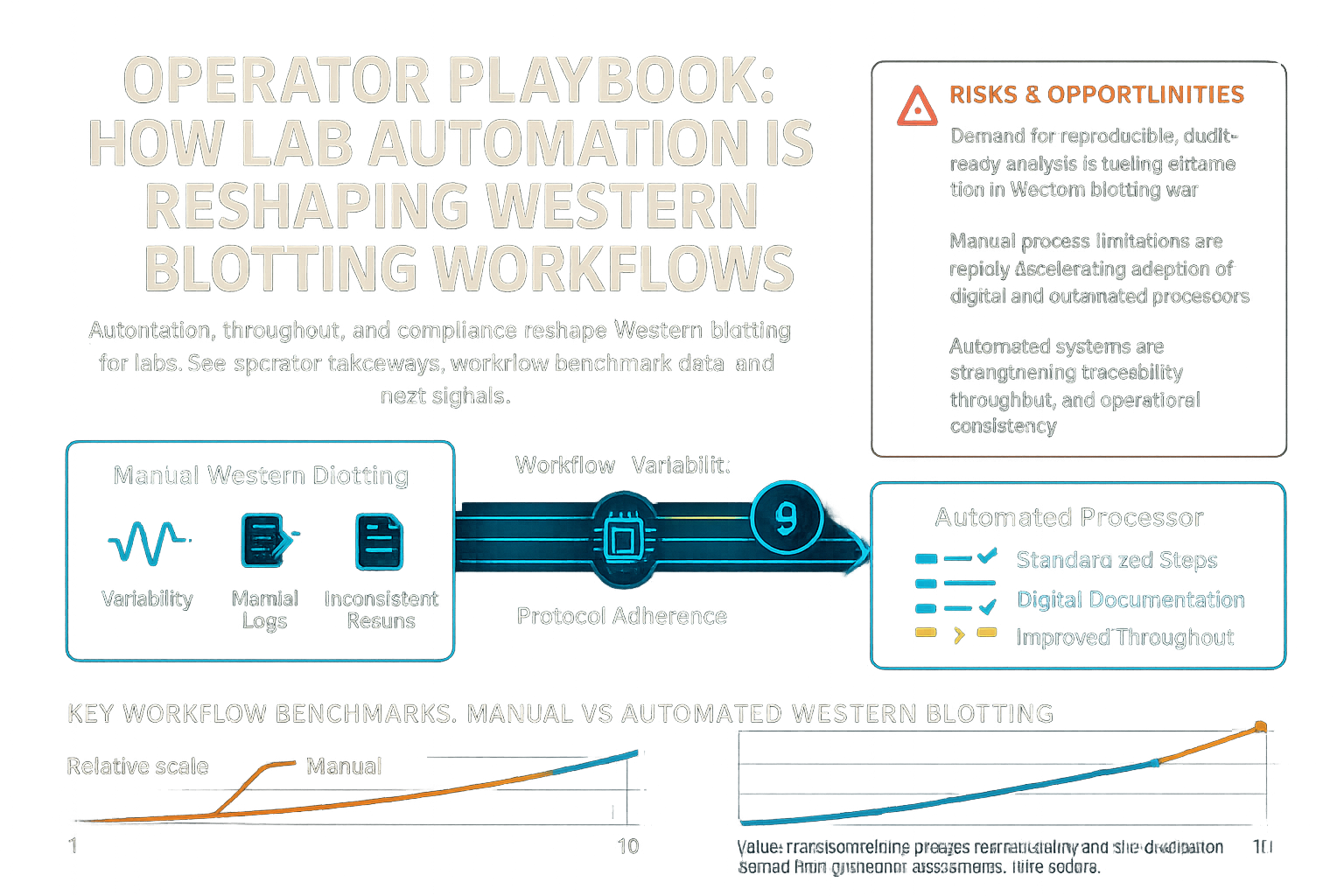
Key Workflow Benchmarks: Manual vs Automated Western Blotting
Relative scale (1-10)Manual: Workflow Variability
Automation: Protocol Adherence
Workflow impact
- Labs with automated Western blotting more readily meet regulatory documentation requirements.
- Workflow standardization reduces operator-dependent result variability, enabling more reliable outputs at scale.
- Throughput gains free specialized staff for higher-value analytical or interpretive work.
- Automation platforms set new benchmarks for compliance-readiness and digital integration.
- Manual users may face growing pressure and risk lagging behind in quality and audit-readiness.
Key data behind the update
Human steps in blocking, incubation, and washing undermine reproducibility.
Automation removes operator bias, ensuring every run follows validated standards.
Skilled staff can redirect focus to high-value tasks instead of repetitive processing.
Improved compliance and error reduction due to digital protocol and reagent logs.
Operational consequences
- Research efficiency and data quality are set to improve where automation is adopted.
- Higher compliance costs and risks may accrue for organizations persisting with manual workflows.
- Market consolidation may favor vendors who combine automation with affordable digital recordkeeping.
- Smaller labs must plan for phased adoption or risk exclusion from advanced research collaborations.
Comparison criteria
Automated processors ensure standardized results
Overall data reliability increases with automationAutomation provides digital, audit-ready logs
Audit preparation and risk management become less burdensomeLess time spent on repetitive steps
Staff can address complex or interpretive tasks, maximizing valueAutomation adoption accelerated in high-throughput/compliance labs
Resource-rich environments pull ahead; Others may lagSignals to watch
Operators will benefit from evaluating vendors who offer complete traceability and digital record integration.
High-volume labs are the first to demonstrate workflow ROI, setting new peer benchmarks.
Teams may seek platforms that bridge screening and confirmatory needs, enhancing flexibility.
New or updated regulatory standards may further compel process documentation upgrades.
Timeline
- 2025: Labs accelerate automation adoption
Market growth driven by standardized workflow, automation, and compliance focus.
- Next: Broader demand for digital, scalable, and auditable systems
Future market expansion increasingly shaped by automation, system integration, and regulatory compliance.
Actions and Benchmarks for Lab Workflow Operators
Evaluate Your Workflow for Automation Readiness
Teams should map out current manual steps where variability and time waste occur, particularly in blocking, incubation, washing, and recordkeeping. Automation platforms are now market-ready, especially for labs running multi-user or multi-shift operations.
Standardized automation is more than a productivity upgrade; It is increasingly a compliance imperative as audits demand tight traceability.
- Identify manual touchpoints that could pose compliance or reproducibility risks.
- Assess available automation solutions for integration and digital traceability fit.
Integrate Digital Documentation for Compliance
Automated systems produce detailed digital logs capturing every step, reagent use, and environmental variable—key for regulated research.
Labs without this infrastructure should prioritize digital upgrades or risk manual record gaps during audits.
- Ensure audit trails are digitally accessible.
- Plan for integration with existing lab information management systems.
Balance Throughput and Budget Constraints
Biopharma and core labs typically realize faster ROI from increased throughput and redeployed staff.
Smaller research groups may need phased implementation to balance immediate budget limits and standardization requirements.
- Quantify hands-on time savings versus technology investment.
- Monitor grant and vendor programs that support automation upgrades.
Monitor Market and Regulatory Trends
Stakeholders should track emerging vendor offerings and regulatory shifts pushing digitized, traceable analysis.
Being early to automate raises both a lab’s internal data quality and its collaboration profile with larger partners.
- Watch for combined capillary and traditional system options.
- Align upgrades with anticipated compliance requirements.