Why it matters for HP Deploys OpenAI at Scale
HP’s transition from AI pilots to global-scale deployment marks a pivotal moment for organizations designing operational systems around AI. For digital workflow leaders, this highlights the necessity of balancing speed and efficiency with rigorous governance, integration, and security standards. The outcomes and challenges from HP’s rollout may shape future best practices for enterprise-wide AI adoption.
Operational consequences
- Pressure to define and standardize governance, permissions, and data standards across complex systems.
- Likely short-term productivity bursts, especially where routine tasks dominate, but longer-term integration overhead.
- Potential difficulty maintaining quality of AI outcomes as models operate on increasingly heterogeneous and global data.
Key data behind the update
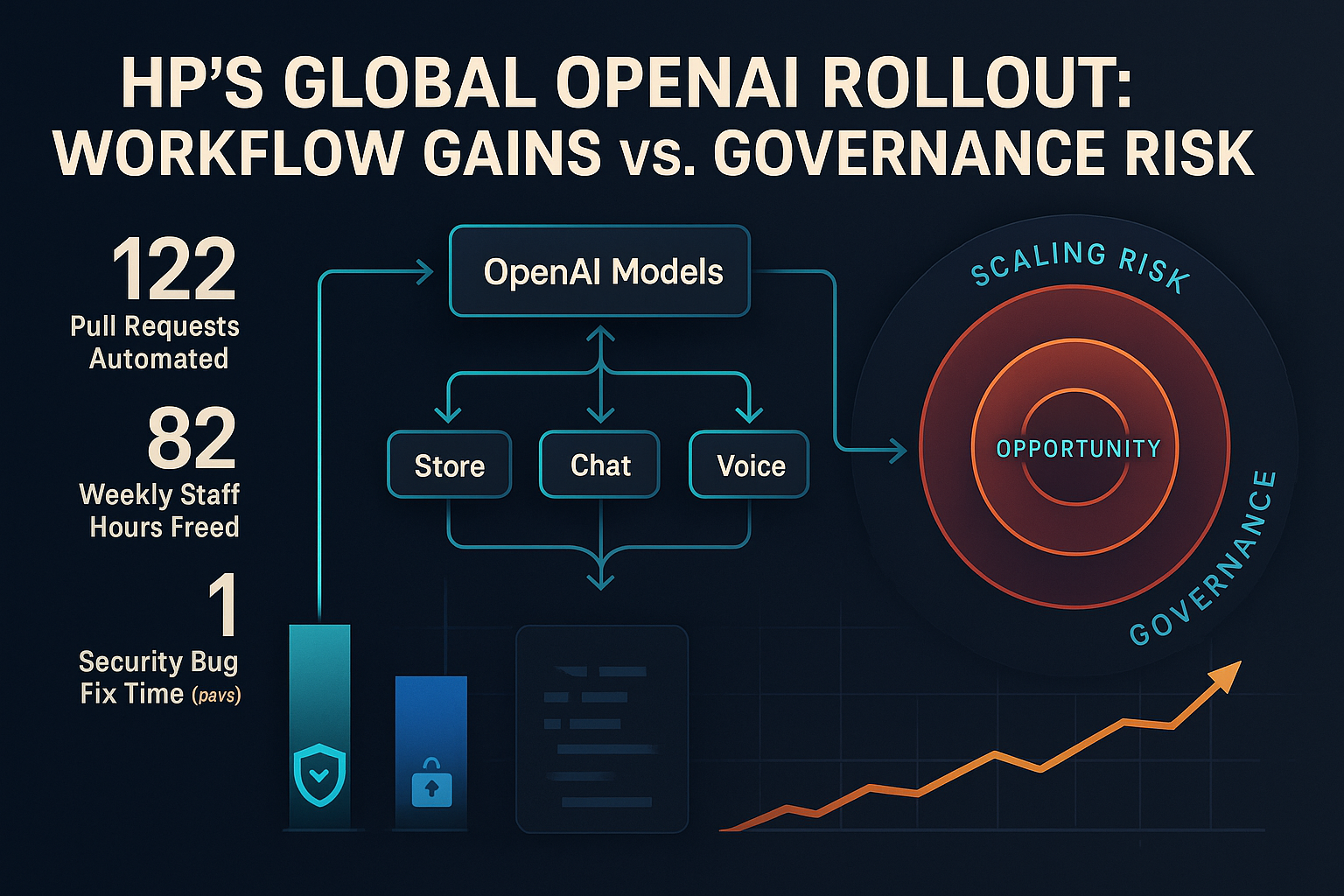
One HP engineer processed 122 pull requests across 43 projects within several weeks, illustrating code review acceleration.
HP security teams fixed bugs in a single day with AI tools, compared to previous timelines of about a month.
AI-assisted security work freed an estimated 82 staff hours weekly, indicating large automation potential.
Comparison criteria
HP deploying AI as an operational layer across departments and countries
Greater upside for unified automation but significantly expanded integration riskWeeks of routine work reduced to days or hours in pilots
Raises baseline automation expectations; Depends on scaling successManaging governance and permissions globally
Harder to enforce security and compliance consistentlyAI interacting with increasingly diverse and distributed data
Potential for both richer insights and data quality or privacy lapsesPossible outcomes
Sustained automation in software and security functions matches or exceeds pilot results.
Other departments push for cross-functional AI adoption, accelerating digital transformation strategies.Integration and data governance issues slow or stall global expansion of AI workflows.
Project pivots to a more conservative or segmented approach, reducing cross-system workflow gains.Workflow impact
- AI-powered automation could substantially reduce repetitive workload across IT, security, and customer support teams.
- Operational integration of AI may accelerate service delivery but demands new skills in data curation and governance.
- If successful, HP’s deployment could establish frameworks for architecting cross-functional enterprise AI systems—shifting how internal platforms are built.
- Missteps in governance or security could lead to operational disruptions, regulatory scrutiny, or loss of stakeholder trust.
- HP’s move will likely pressure competitors to accelerate broader, risk-aware AI integration strategies.
Signals to watch
Will reveal whether pilot efficiencies translate to distributed operations with real-world risks.
Could set new benchmarks and integration expectations across the industry.
Will indicate whether HP’s approach sets a pattern or exposes common pitfalls.
May provide actionable data on employee adoption and ongoing productivity returns.
Operational AI at Scale: Concrete Progress, Emerging Risks
Early Automation Wins: Productivity Gains in Development & Security
HP’s pilots with OpenAI’s platform led to clear, measurable improvements. Developers leveraged automation to process over a hundred pull requests across dozens of projects in weeks, not months.
Security teams slashed routine bug fix cycles from about a month to just a day, freeing an estimated 82 hours each week for higher-value work.
- Code review automation scaled rapidly in engineering units.
- Security operations compressed from weeks to hours.
- AI tools handled cross-project workflows efficiently.
Global Rollout: Benefits Meet Systemic Complexity
Expanding these efficiencies from controlled pilots to 180 countries demands wide-reaching data integration and policy harmonization. HP acknowledges that AI success now depends on robust governance and access controls.
The multi-department approach elevates AI to an operational layer, touching customer service, partner support, employee analytics, and software engineering.
- Potential for compounded gains across interconnected teams.
- Every new system amplifies integration and compliance risk.
Governance and Data Risks Outpace Technical Adoption
As HP institutionalizes AI, challenges around permissions, data quality, and security move to the forefront. Early pilot controls may not generalize easily across regions or regulatory regimes.
The company will have to solve for both technical and human-centered governance—potentially making or breaking project sustainability.
- Variable data standards between units pose risk.
- Security gaps could open as scale increases.
- Ongoing ROI hinges on continuous monitoring and contextual adaptation.
Redesigning Digital Operations: Opportunity and Precedent
Beyond technical impact, HP’s initiative signals a shift in how digital businesses architect work itself. Rather than just experimenting, the enterprise is redefining routine operations around AI-enabled systems.
For industry peers, this move becomes a reference case—its successes and setbacks informing strategies for cross-system AI adoption.
- AI moves from tool to core operating principle.
- Industry peers will benchmark against HP’s scaling outcomes.
- Sustained performance requires tying technology gains to business process redesign.