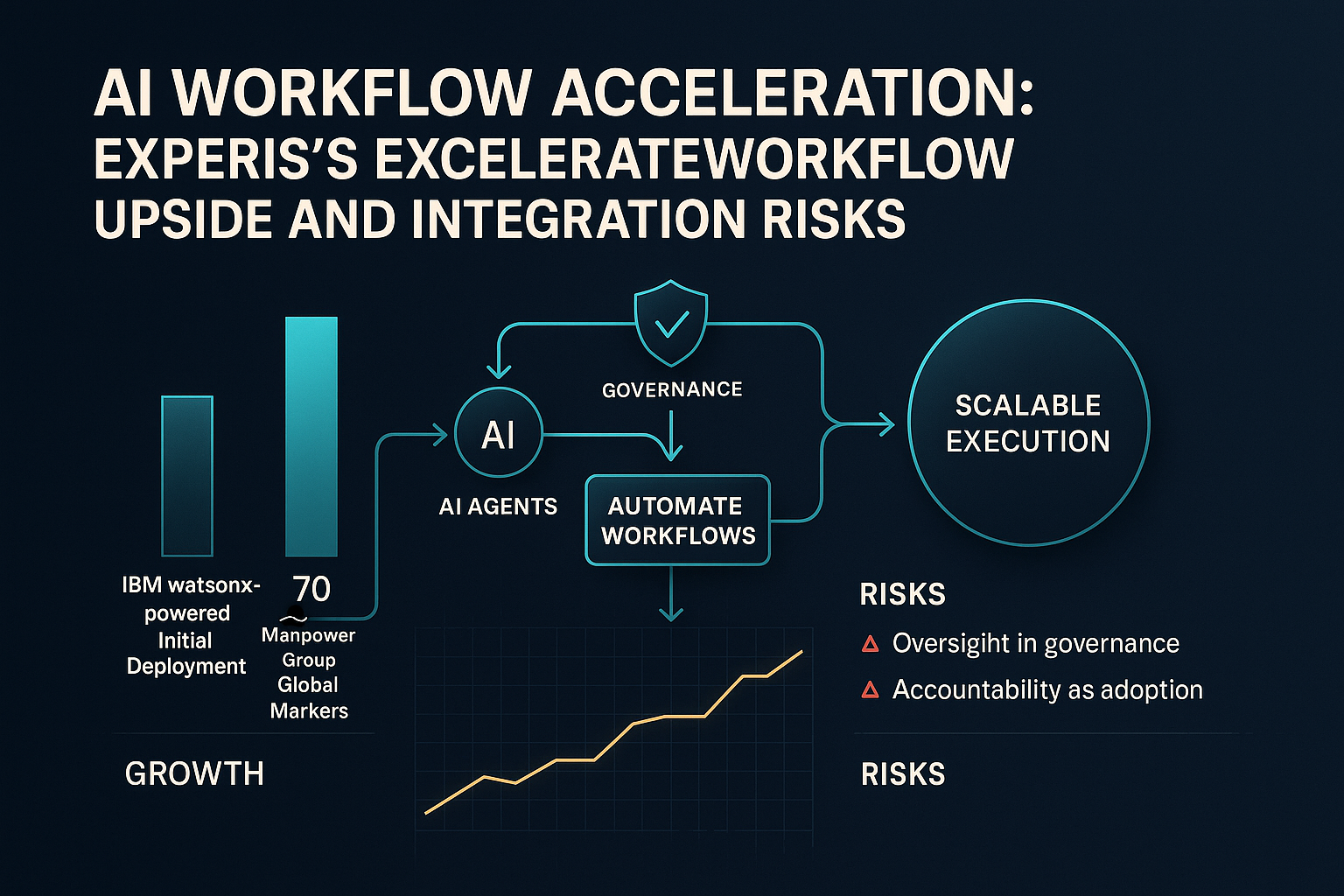
Why it matters for Experis ExcelerateWorkflow
Adoption of AI-powered workflow orchestration shifts enterprise automation from pilot projects to critical production processes. This transition makes governance, skill development, and operational trust decision-grade issues for platform operators. Early adopters shape integration practices and risk profiles that will affect internal and client-facing workflows company-wide.
Operational consequences
- Workflows may become dependent on AI agent orchestration, raising complexity in troubleshooting and accountability.
- Organizations using ExcelerateWorkflow could face higher costs if skills and governance gaps emerge post-deployment.
- Regulatory scrutiny is likely to increase around data handling and process accountability as AI workflow systems scale.
Key data behind the update
Initial deployment includes BankIQ, a SaaS for banks, suggesting a focused early-stage rollout.
ManpowerGroup claims presence in more than 70 countries, indicating potential reach if offerings scale globally.
Experis’s parent group, ManpowerGroup, claims 17 years as one of the World's Most Ethical Companies, suggesting a culture of governance.
Comparison criteria
Claims full-stack integration with governance and talent support
Potentially faster transition to measurable results if claims holdEmphasis on end-to-end business outcomes, not technology isolated from operations
Broader impact on operational models beyond ITExplicit inclusion of governance, oversight, human-in-the-loop
Could reduce future compliance and trust gapsCombines AI tools with workforce development
May shorten transition from adoption to self-sufficiencyPossible outcomes
Organizations prioritize internal skill-building and apply ExcelerateWorkflow within clear accountability structures.
Operational automation delivers measurable outcomes; Risk of AI missteps is minimized.Rapid adoption outpaces governance and staff training.
Workflow automation leads to errors, accountability gaps, and increased compliance risk.Workflow impact
- Increases pressure on digital operations leaders to define and enforce new governance standards.
- Offers faster AI deployment for enterprise clients but with increased dependency on third-party expert services.
- Could accelerate market-wide transition from experimentation to real-world, at-scale business AI execution.
Signals to watch
Will indicate ability to scale practices and surface new integration and policy challenges.
Will stress-test governance models under stricter compliance requirements.
Will reveal how much value is driven by implementation expertise versus technology stack.
AI Workflow Acceleration: Risk-Opportunity Analysis
Scaling AI in Enterprise Operations
ExcelerateWorkflow's selling point lies in automating operationally critical workflows rather than isolated tech pilots. Early focus is on financial services, targeting high-value processes with measurable business outcomes.
- Moves AI beyond demo environments into daily operations
- Brings governance and skill-building into the automation process
- First-adopter tactics likely to influence best practices
Governance and Human Control Dilemmas
Integration at scale introduces risk of operational complexity and gaps in accountability. Tight coupling of AI and workflows demands continuous oversight, governance, and upskilling of existing staff to prevent process failures.
- Governed solutions require disciplined execution frameworks
- Potential for skill and accountability gaps post-launch
- Scaling may attract heightened compliance and regulatory attention
Comparative Positioning and Unknowns
Compared to traditional software consultancies, Experis's model claims combined governance, integration, and talent development. However, limited independent data exists on real-world impact, making cross-vendor comparison and ROI calculation difficult at this stage.
- Combines technology, talent, and oversight in one service
- Actual post-launch performance largely unreported
- Evolving market may reveal gaps in competing platforms’ governance models