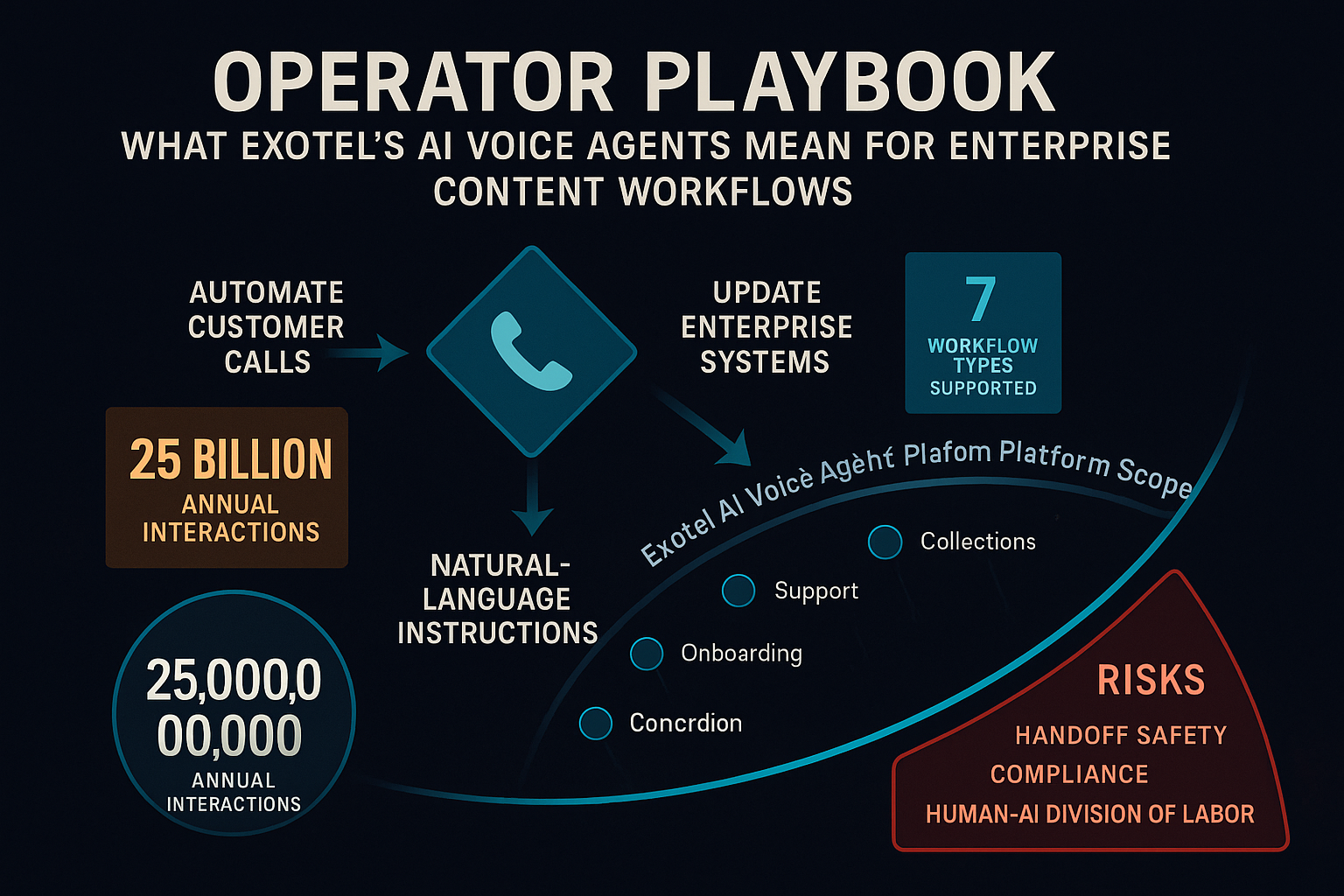
Exotel AI Voice Agent Platform Scope
Discrete metricsAnnual Interactions
Workflow Types Supported
Workflow impact
- Workflow pace accelerates but demands new oversight of AI-driven exceptions.
- IT teams can skip custom scripting, increasing configuration speed but raising data governance stakes.
- Escalation design becomes critical as more routine calls never reach a human.
- Voice-based content delivery may outpace other channels for standardized tasks.
- Compliance standards shift: audit trails for autonomous AI actions are now required.
Key data behind the update
Shows the operational scale Exotel’s AI agents could access.
Covers collections, customer support, sales outreach, appointment scheduling, onboarding, identity verification, post-sales—indicating broad applicability.
No coding required for agent config, lowering barrier to deploy.
Operational consequences
- Teams gain speed and flexibility, but lose line-by-line visibility into how instructions are interpreted by AI agents.
- Integration and compliance reviews become ongoing, not just pre-deployment steps.
- Responsibility for misrouted or misunderstood customer issues must be redefined between AI and human teams.
- Operators in regulated sectors now need natural-language-based audit tools.
- Routine tasks may migrate to voice agent automation faster than expected, demanding new customer experience metrics.
Comparison criteria
Natural-language instructions, no code needed.
Lowers barrier, accelerates rollout but may create ambiguity.Initiate, converse, update, escalate autonomously.
Increases process automation, adds need for new oversight.Open standard protocol (MCP) enables external connections.
Faster deployment, but integration security and governance must be re-evaluated.Automated escalation on exceptions.
Smooths simple handoffs but raises complexity for edge cases.Signals to watch
These industries are sensitive to unscripted agent behavior and compliance risks.
Most teams rely on more than one platform for CX; True value requires cross-platform data flow.
Missed or ambiguous instructions could create new error modes in content operations.
Traceable, explainable AI actions matter most in high-stakes workflows.
Timeline
- July 2026: Exotel launches AI voice agent automation
First AI-initiated customer experience call launched via MCP framework.
- Immediate next steps: Operator pilot/validation
Enterprises begin deploying, testing, and integrating with current workflows, prioritizing compliance and security review.
- 3-12 months: Market observation phase
Performance in large-scale, regulated, and cross-platform environments tracked by industry analysts and early users.
AI Voice Agents: Practical Shifts and Operator Actions
Rethinking Agent-Onboarding and Workflow Setup
Where previous content operation systems required scripting for call flows, natural-language configuration now lets teams specify workflows without coding. This rapid onboarding raises deployment velocity but also introduces interpretation risk.
- Operators must validate how AI parses task descriptions.
- Pilot deployments should include edge case reviews.
- Role definitions shift to include monitoring natural-language intent translation.
Integration Points and Compliance Hotspots
With MCP acting as a bridge between AI and business systems, integrations move faster but require new governance steps. The line between business-data updates and agent actions becomes blurred, spotlighting compliance and audit trail needs.
- Review internal and external system access protocols.
- Require AI-based workflow changes to be logged for audit.
- Data governance must be steered by cross-functional teams.
Escalation, Exception Handling, and Customer Experience
While routine cases pass seamlessly through voice agents, the exceptions and human handoffs become higher-stakes. Operators must redefine escalation triggers and ensure oversight dashboards are in place.
- Monitor continuous performance on exception escalation.
- Map error modes created by natural-language configuration.
- Develop customer feedback loops for agent-handled cases.
Scalability and Workstream Readiness
Operators looking to scale must watch for bottlenecks in call data pipelines and in content updating mechanisms as volume rises. The platform's 25B+ annual interaction capacity hints at robust backbone, but integration complexity will be environment-specific.
- Stress-test system with simultaneous workload spikes.
- Benchmark call-handling versus other channels.
- Meticulously review third-party stack compatibility.