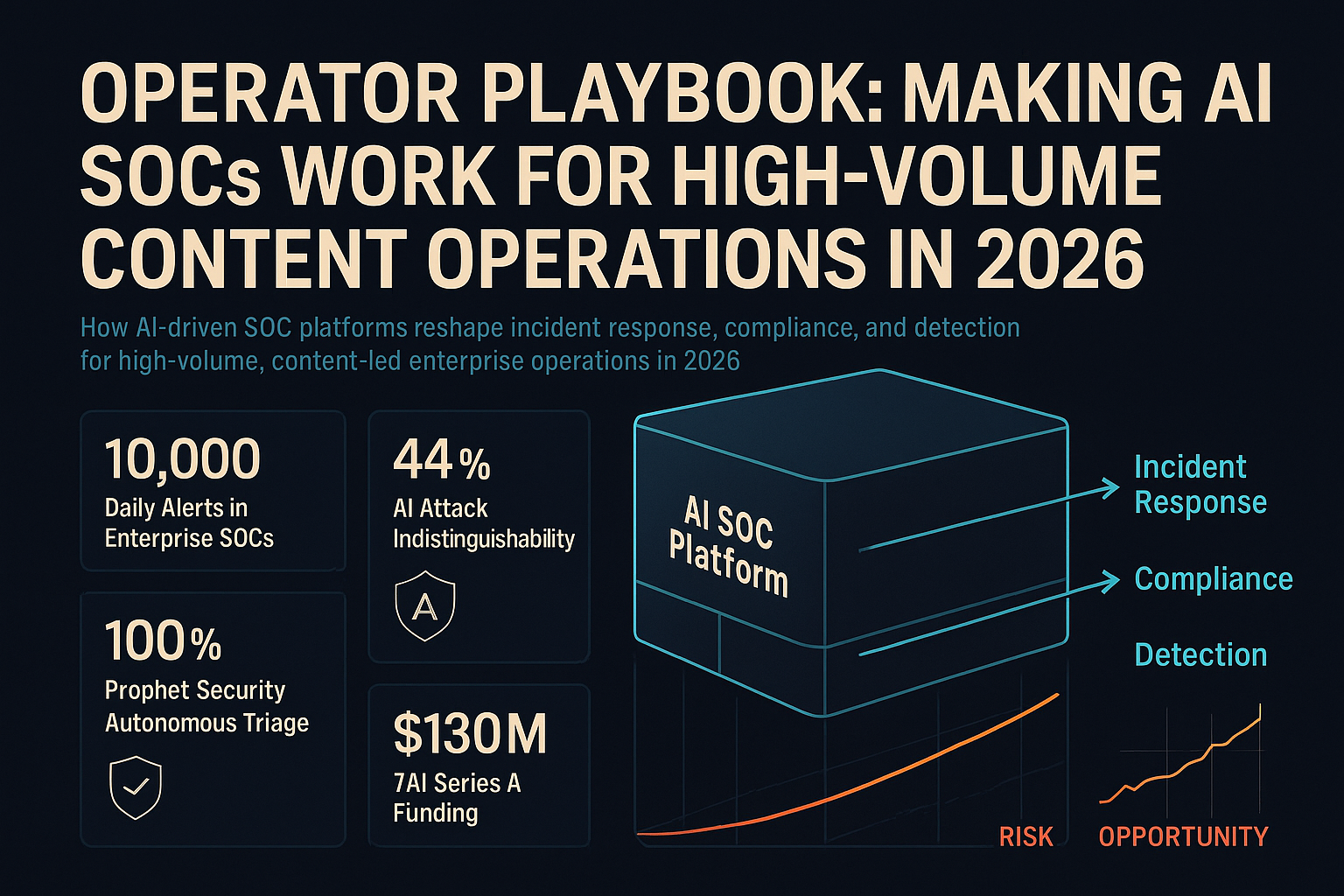
Enterprise SOCs: Alert Volume and Automation in 2026
Daily Alerts in Enterprise SOCs
AI Attack Indistinguishability (percent)
Prophet Security Autonomous Triage (percent)
7AI Series A (million USD)
Workflow impact
- SOC teams face 10,000+ daily alerts, demanding automation and high-volume triage.
- GRC processes increasingly constrain not just tool integration, but how AI makes decisions.
- Agentic SOC platforms let teams operate with faster, deeper investigations than rigid rulebooks enable.
- Buyers wedded to incumbent tools trade off full-stack AI benefits for better familiarity and compliance fit.
- Specialist AI platforms now allow customizable oversight—shaping buy/build decisions for high-scale operations.
Key data behind the update
Enterprises must handle over 10,000 security alerts daily, pushing current human-dependent systems past their operational limits.
Nearly half of platforms can't reliably separate AI attacks from legitimate activity, raising triage risk.
Prophet Security autonomously investigates every alert, eliminating unreviewed IOCs at enterprise scale.
7AI's $130M Series A in Dec 2025 signals high market appetite for agentic, parallel-case SOC models.
Operational consequences
- Selecting a platform optimized for speed may challenge organizations with strict GRC and in-the-loop requirements.
- Relying on incumbent tools with incremental AI upgrades risks missing the full productivity gains of agentic SOCs.
- Platforms with limited automation will perpetuate alert fatigue and may create new escalation bottlenecks.
- Teams focusing on agentic coverage need robust integration mapping and oversight configuration to avoid compliance gaps.
- A misfit between SOC automation and business process can slow down overall digital infrastructure modernization.
Comparison criteria
Some platforms deliver 100% autonomous triage
Fewer overlooked incidents but new pressure on GRC controlsDeep integration requirements, decade-old stacks supported
Smoother deployments for content-heavy operationsAgentic investigation and triage on novel threats
Better adaptation, but more complex oversight setupPlatforms allow flexible human oversight options
Improved compliance posture with tailored workflowsSignals to watch
Pilot results will reveal hidden compliance, training, and integration chokepoints that generic demos gloss over.
Forthcoming features from market leaders address CISO pushback on AI autonomy and auditability.
Attackers will probe and adapt to AI-generated and AI-detected behaviors, changing SOC defense priorities.
Timeline
- Fal.Con 2025: CrowdStrike launches agentic security layer
CrowdStrike introduces agentic AI agents to dramatically scale up alert investigations.
- Dec 2025: 7AI raises $130 million Series A
Marks largest cyber Series A and market confidence in agentic swarming approach.
- 2026: SC Awards recognize Legion Security
Legion Security wins Most Promising Early-Stage Startup; Browser-native workflow automation approach highlighted.
Translating AI SOC Choices into Content Team Operations
Redefining Alert Volume: Systems at the Breaking Point
Traditional SOCs can't scale to process 10,000+ daily alerts—content operations only amplify that volume.
AI agentic platforms offer 100% triage, but require rethinking oversight and incident documentation workflows.
- Alert surges risk fatigue and missed IOCs.
- Full automation demands rigorous validation.
- Standard playbooks now lag behind adversary scale.
GRC and Integration: Moving Beyond Out-of-the-Box SOC
Environments integrating decade-old tools and strict GRC must prioritize platforms with demonstrable oversight configuration.
Agentic and assistant platforms differ: some replace investigation, others merely augment it—impacting compliance and workflow.
- Platforms like Prophet Security, 7AI excel at autonomous investigations.
- CrowdStrike, Microsoft fit existing large stacks.
- Oversight options key for regulated industries.
Vendor Landscape: Fit, Flexibility, and the New Stack
Enterprise SOC solutions now split between legacy-ecosystem AI augmentation and agentic, automation-first challengers.
Legion Security and Stellar Cyber address workflow automation for teams keeping analysts in control, but may lag in deep automation.
- Agentic SOCs: Prophet Security, 7AI, Exaforce.
- Ecosystem assistant SOCs: CrowdStrike, Microsoft, SentinelOne.
- Best fit depends on integration roadmap and regulatory needs.
Decision Points: What Should Teams Change Now?
Buying teams must clarify if their priority is speed (autonomy), control (oversight), or seamless integration (ecosystem fit).
Monitor platform ability to scale, handle novel attacks, and document AI-driven workflows for GRC processes.
- Audit platform SOC automation rate.
- Benchmark alert closure and analyst workload.
- Map GRC process integration early.