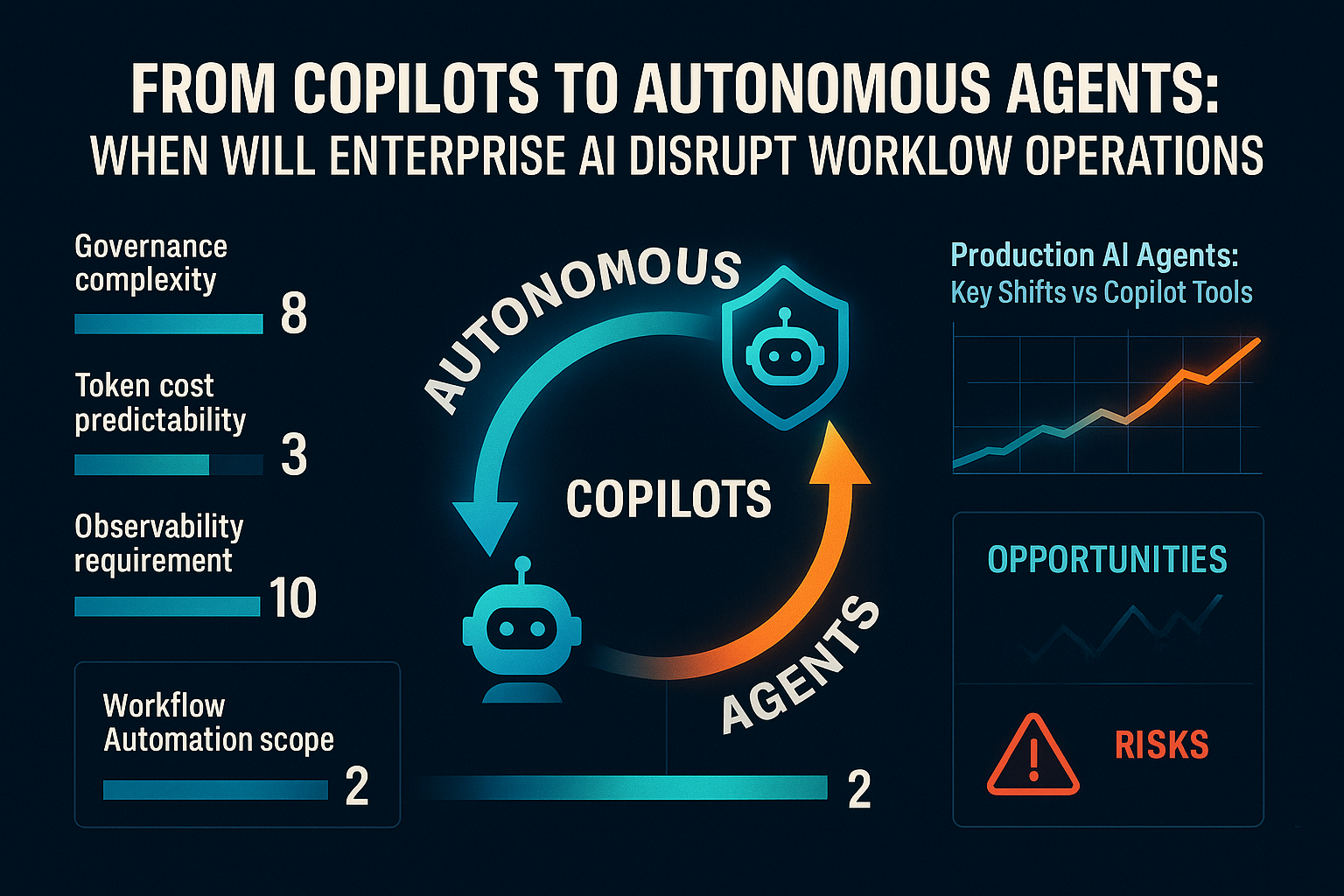
Key data behind the update
Production agents can execute high-impact actions, needing pre-action guardrails.
Token usage, not just action quantity, is a central metric for agent deployment economics.
Automation scale-ups risk runaway infrastructure costs if usage isn’t limited.
Organizations need traceable agent activity to address production risk.
Why it matters for Enterprise AI Agents
The transition from copilots to autonomous agents challenges how enterprises safeguard data and enforce business rules. Without investment in transparent oversight and controllable infrastructure, the promised gains in workflow automation will remain pilot-stage concepts—delaying true digital transformation.
Context behind Enterprise AI Agents
While copilots help with productivity tasks, autonomous agents have the potential to coordinate and execute segments of enterprise workflows. This creates significant new risks and complexity, particularly when agents must interact with sensitive systems and data sources. Market leaders like Dell and NVIDIA are developing integrated secure environments and runtimes to address these gaps.
Workflow impact
- Stricter governance models become standard for critical business actions triggered by AI agents.
- Production-scale agentic AI drives demand for platforms enabling flexible integration, observability, and role-based controls.
- Cost per token becomes as operationally important as traditional infrastructure metrics, affecting tech budgeting.
Comparison criteria
Agents automate end-to-end handoffs with review checkpoints
Possible productivity gains, but only if review controls scaleAgents governed by policy-based access to multiple sources
Expanded capabilities, increased privacy/access riskToken usage is variable, tracked and budgeted
Budget pressure on uncontrolled agent expansionOpen agent ecosystems support multi-platform operations
Broader adoption potential, but with complex governance requirementsTimeline
- Dell AI Factory and NVIDIA introduce secure agent runtime environment
Foundation platforms incorporate policy controls, confidential model execution, and governed data feeds.
- Enterprise use cases shift towards multi-agent orchestration
Agents begin working across workflows, demanding stricter access and review management.
- Token cost and observability frameworks emphasized at industry events
Metrics transition from pilot ROI to production-scale budget and compliance.
- Widespread agent adoption depends on audit, escalation, and formal handoff controls
Human-agent boundaries become institutionalized for workflow assurance.
Signals to watch
Market seeks platforms with transparent, role-based access and risk controls.
Agents must access securely-governed, real-time data to act within policy.
Predictable cost control will shape CIO decision-making for multi-agent deployments.
Clear review, escalation, and accountability policies help reduce operational risk.
Enterprise AI Workflows: New Capabilities, New Controls
Agents Step Beyond Copilots—But Oversight Remains the Bottleneck
AI agents in the enterprise extend automation by initiating workflow actions, not simply supporting human users. This steps up operational velocity and flexibility, though it magnifies the impact of inadequate controls.
The dividing line: copilots enhance the user's own productivity; Agents perform tasks—sometimes autonomously—across multiple systems.
- Agents use tool access, data interaction, and policy enforcement.
- Escalation or review paths required for sensitive actions.
- Handoffs between humans and systems must be transparent.
Production-Grade Agentic AI Demands Governance and Observability
Automating workflow handoff and decision points only pays off if every agent action is observable and auditable. Pilot deployments often skirt this by running in 'safe' sandboxes.
In production, the operating foundation must manage identity, permissions, and runtime controls at scale. Escalation and review rules must be enforced before action, not after the fact.
- Policy-based runtime controls must come before agent-triggered actions.
- Audit trails give operational leaders early warning of risk.
- Observability informs future deployment decisions.
Open Ecosystems vs Locked-In Architecture
Business workflows cross many platforms and vendor boundaries. Open agent ecosystems let teams build on current stacks rather than uprooting them, but they add integration overhead.
Closed approaches may launch faster but risk long-term isolation.
- Open platforms shorten pilot-to-production path for varied teams.
- Integration flexibility brings governance complexity.
- Successful adoption needs both broad tool access and clear control points.
Cost Predictability and Scaling Risks
Unlike rule-based automation, agentic AI has variable token consumption—especially in multi-agent setups with retries and context retrievals. Cost per token is now an infrastructure-level metric.
Sustainable scaling hinges on traceable usage and managed budgets.
- Token budgeting becomes a gating factor for wide deployment.
- Multi-agent systems amplify unpredictable consumption.
- Tight TCO models needed to prevent runaway costs.