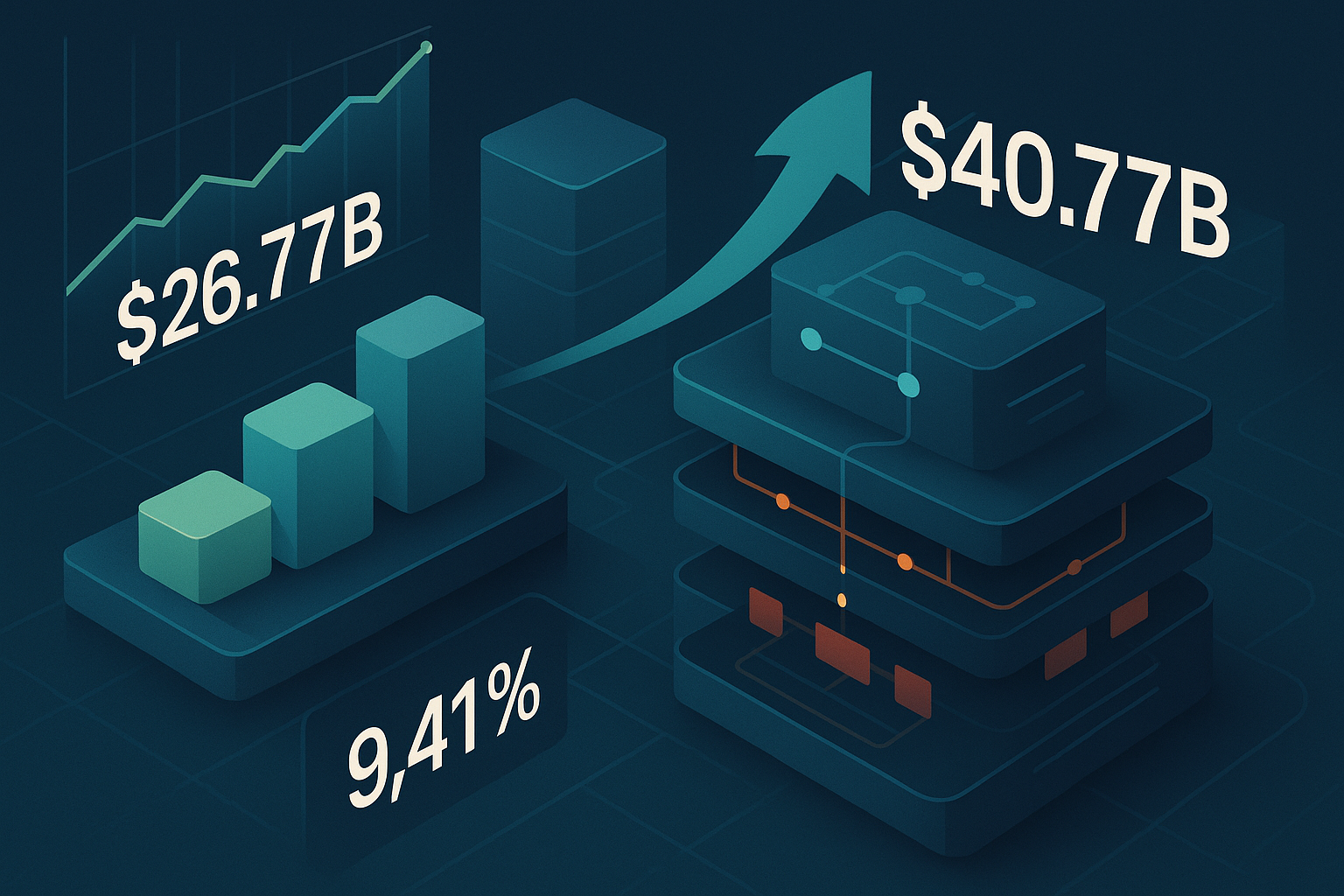
Automation Market Timeline
USDTimeline
- 2022-2024: Chatbot-First Adoption
Rapid uptick in UI-layer AI, limited by fragmented enterprise data and compliance silos.
- 2025: Automation Market Inflection
Market size hits $23.77B; Shift from RPA to unified orchestration stacks begins.
- 2026: Agentic AI and Data Foundations
Operator focus moves to complete, normalized datasets as key enabler for workflow AI agents.
- 2027-2031: Interoperability and Provenance Era
Emergence of protocol-driven agent orchestration and hardened data provenance for enterprise-scale GenAI.
Context behind Enterprise agentic AI
Since 2022, demand for workflow automation and advanced data pipelines has grown rapidly. Chatbots provided an accessible entry point but soon encountered limits: fragmented data, operational silos, and governance gaps. In parallel, both market size and technical sophistication have advanced, with hybrid deployments and hybrid AI-automation stacks becoming the norm.
Why it matters for Enterprise agentic AI
Leaders deploying automation stacks must now prioritize investments in data quality, normalization, and governance. Superficial AI features are being outpaced by architectures that ensure trusted, actionable data inside all automated flows. Missing this pivot risks systemic silos and compliance failures as agentic models proliferate.
Evidence-backed metrics
Strong growth in automation spend reveals enterprise focus beyond basic chatbot overlays.
Market trajectory suggests sustained investment through the adoption of deeper AI automation architectures.
Consistent compound annual growth reflects broad industry migration toward AI-powered automation.
Hybrid cloud/on-prem orchestration is now the default, requiring unified automation frameworks.
Despite broad integration, less than half have achieved fully unified, governable automation flows.
Command-and-control models are widespread, but scale and interoperability remain challenges.
Numbers behind the shift
Source-reported valuesMarket context at a glance
Source-reported valuesUnified workflow adoption (2026 survey)
Centralized automation teams (2026 survey)
We're roughly halfway through and the enterprise outlook remains incredibly
To navigate this transformation effectively, enterprise leaders must pivot away fr
Decision criteria
Agentic AI models with normalized data and provenance
Deep models improve insight, but demand stronger data operations and control frameworksInteroperable, policy-driven control planes
Centralized oversight reduces compliance and SLA risksHundreds/thousands of users supported by central teams
Operator scalability and support must adapt to broader, more complex user basesPossible outcomes
Enterprise invests in unified data layers and normalized telemetry across systems.
AI agents deliver reliable insight, operational anomalies decline, audit and compliance improve.Firm remains on chatbot overlays, skipping the data integrity work.
Agents return incomplete or incorrect answers; Regulatory risks and workflow fragmentation persist.Signals to watch
Wider adoption shows enterprises are moving beyond isolated automation, aiming for cross-platform AI orchestrations.
Indicates transition from management-only tools to robust control planes for GenAI and regulatory compliance.
Signals readiness to deploy agentic AI at fleet scale without losing traceability or governance.
Operator Brief: Agentic AI and the Data Foundation Timeline
From Chatbots to Data Layers
Early enterprise AI deployments favored fast wins through chatbots and simple workflow overlays. These generated initial excitement but quickly hit barriers: fragmented operational data and weak compliance controls.
By 2025, adoption stalled at superficial layers unless paired with robust investment in data centralization and normalization.
- Surface AI gains limited operational impact.
- Fragmented stacks failed at providing reliable, actionable insight.
- Market and audit pressure forced a pivot to foundational data work.
Why 2026 Is the Pivot Point for Agentic AI
Market evidence and operator demand now align: simply overlaying UIs no longer meets enterprise needs. Leaders are forging new data operating models—layering validation, normalization, and provenance atop all automated flows.
Automation is no longer merely about efficiency; It's about trust, traceability, and future-readiness.
- Real agentic systems depend on complete, vetted datasets.
- Data provenance ensures regulatory and audit defense.
- Interoperability paves the way for platform-agnostic agent orchestration.
Decision Pressures and What Operators Must Watch
New architectures bring both promise and risk. Teams must choose between incremental, UI-first features and complete rewiring of automation stacks around trusted data.
Operators should scrutinize vendor promises, prioritize telemetry normalization, and roadmap investments in data lineage technologies.
- Control plane architectures must support multi-agent integration.
- Look for operational proof of unified, protocol-driven workflow.
- Failing to upgrade invites both strategic and compliance liabilities.