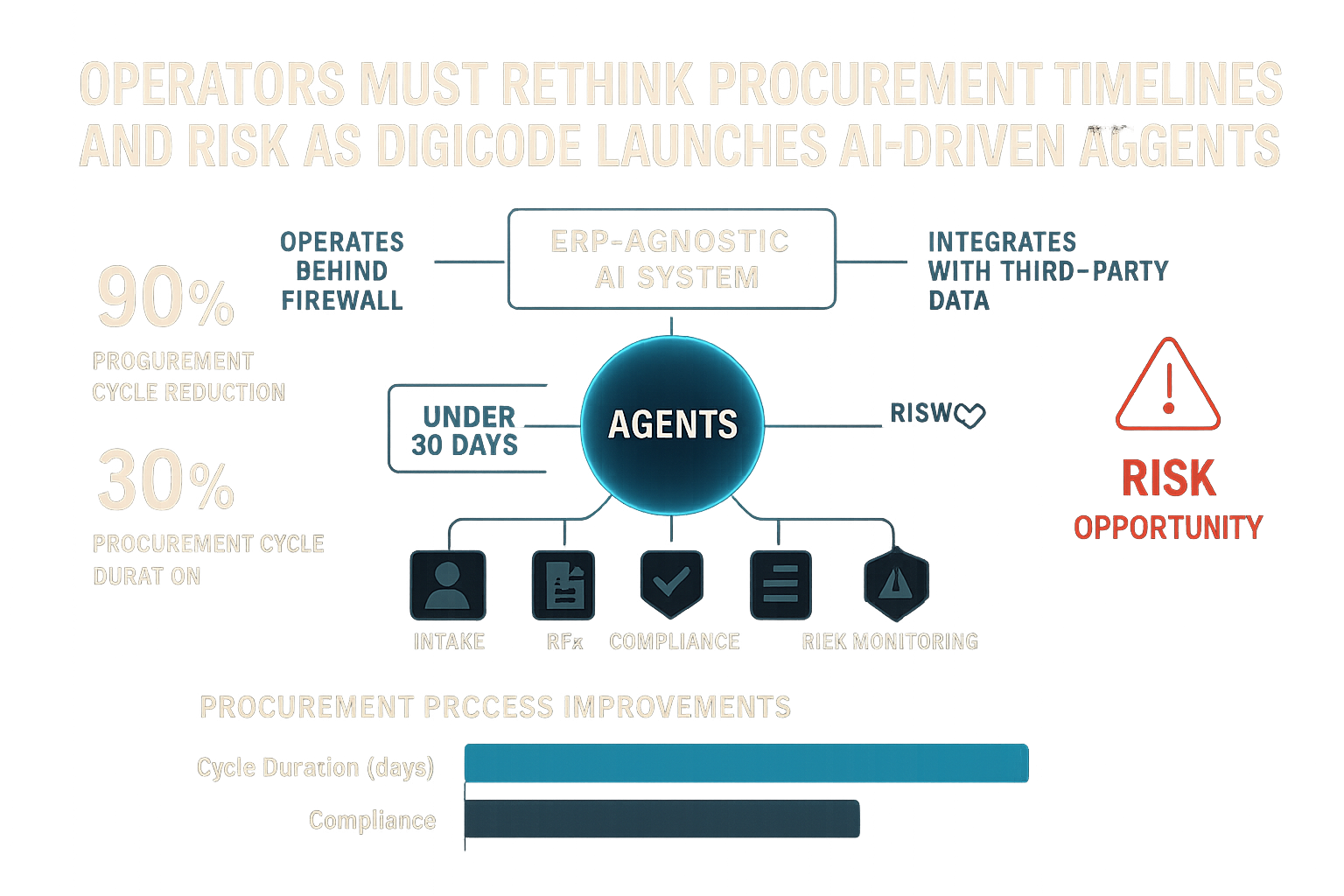
Key data behind the update
The full procurement cycle can be completed in under 30 days using agentic automation.
Traditional procurement cycles typically last between 60 and 90 days.
Agent-driven intake can reclaim 15–20% of uncontrolled purchases.
Document compliance shifts from 85% manual to 98% AI-driven.
AI-driven drafting reduces document creation labor by 70–80%.
Over 80% of material supplier risks are reportedly flagged before impact.
Workflow impact
- Procurement teams can compress purchasing timelines and respond faster to business needs.
- Finance and compliance functions gain improved visibility and reduced manual intervention across supplier risk and contract drafting.
- Technology leads must prepare for pilot integration, local hosting, and testing new agent-based controls within secure environments.
Comparison criteria
30–90 days, pilotable
Faster time-to-value and less up-front disruption for pilot adoptersAgnostic, connects to existing systems
Broader applicability, but more onus on customer to configure data flows<30 days (claimed)
Major acceleration possible with process and compliance redesign98% AI-driven
Potential for fewer missed compliance steps, but increased need for AI oversightOperational consequences
- Operators willing to trial the new system could drastically shorten time-to-contract and reclaim lost spend, but must allocate resources for process review and IT support.
- Teams continuing manual or patched workflows may fall behind in procurement agility and cost control compared to early adopters.
- CIOs and CPOs need to embrace agent lifecycle management and adjust oversight for AI-driven processes, introducing new training and auditing requirements.
Signals to watch
Direct evidence of cycle compression, spend reclamation, and workflow fit are critical for scaling adoption.
Successful frameworks for agent lifecycle and oversight will affect mainstream enterprise trust and deployment.
Feedback on on-premise and secure cloud deployments will determine ease of agent integration within varied IT stacks.
Major process changes could alter supplier engagement models and risk reporting duties.
AI Procurement Automation: Decision Brief for Operators
Who Should Act and What Changes
Enterprise procurement leaders and technology architects must evaluate whether to pilot Digicode’s multi-agent AI system for procurement right now. The product’s architecture means that business process owners, CIOs, and risk/compliance teams all play critical roles in deciding whether to launch a structured Proof-of-Value project.
Integration is designed for both IT-led and operator-led adoption but still requires stakeholder alignment. Configuration, policy design, and agent oversight all demand hands-on engagement from department heads.
- Procurement and IT must jointly endorse pilot scope and process changes.
- Business units may need to map legacy workflows and compliance points for automation.
- Internal audit and compliance teams should plan for new AI governance protocols.
Key Tradeoffs in Adopting Multi-Agent AI
While Digicode’s AI automation offers dramatic speed and compliance leaps, these come with process and oversight tradeoffs. ERP-agnostic integration means less vendor lock-in but requires more up-front configuration, data matching, and agent management.
Operators must weigh the benefit of fast time-to-value against potentially incomplete documentation, cultural adaptation, or hidden integration hurdles in existing IT environments.
- Lower implementation friction, but need for highly customized policy review.
- Greater flexibility, but increased need for technical and process alignment.
- Faster outcomes, but less predictability vs. Mature SaaS procurement platforms.
What Remains Unproven or Unanswered
The key claims—rapid cycle compression, agent reliability, and integrative risk monitoring—await verification in live pilots. Real-world details on AI intervention transparency, error handling, and long-term compliance performance remain to be published.
First-mover adoption could uncover configuration challenges or hidden manual work at workflow boundaries.
- Pilot results needed to confirm cycle reductions in diverse environments.
- Operator feedback on agent accuracy, auditability, and error correction is missing.
- Cost and resource demands for initial configuration are not yet benchmarked.