Why it matters for DeepMind agent controls
The agent era moves AI from passive models to task-oriented actors integrated with enterprise operations. Systems teams now face the dual mandate to unlock AI value and prevent it from becoming a security liability. DeepMind’s roadmap, built with lessons from MITRE’s adversary modeling and real internal incidents, reshapes buying and deployment criteria for AI agent frameworks.
What changes for security operations
- Enterprise platforms offering AI agent features must embed real-time blocking, robust monitoring, and thorough audit logging.
- Systems teams will need to model potential rogue-agent tactics—even if no current deployment shows such intent—per DeepMind’s conservative assumptions.
- Lack of adequate controls may exclude vendors from procurement cycles as buyer requirements shift from model alignment to system trustworthiness.
- AI’s contribution to business value risks being offset by the cost—or realized instance—of attack surface expansion if control is inadequate.
Data behind the safeguard roadmap
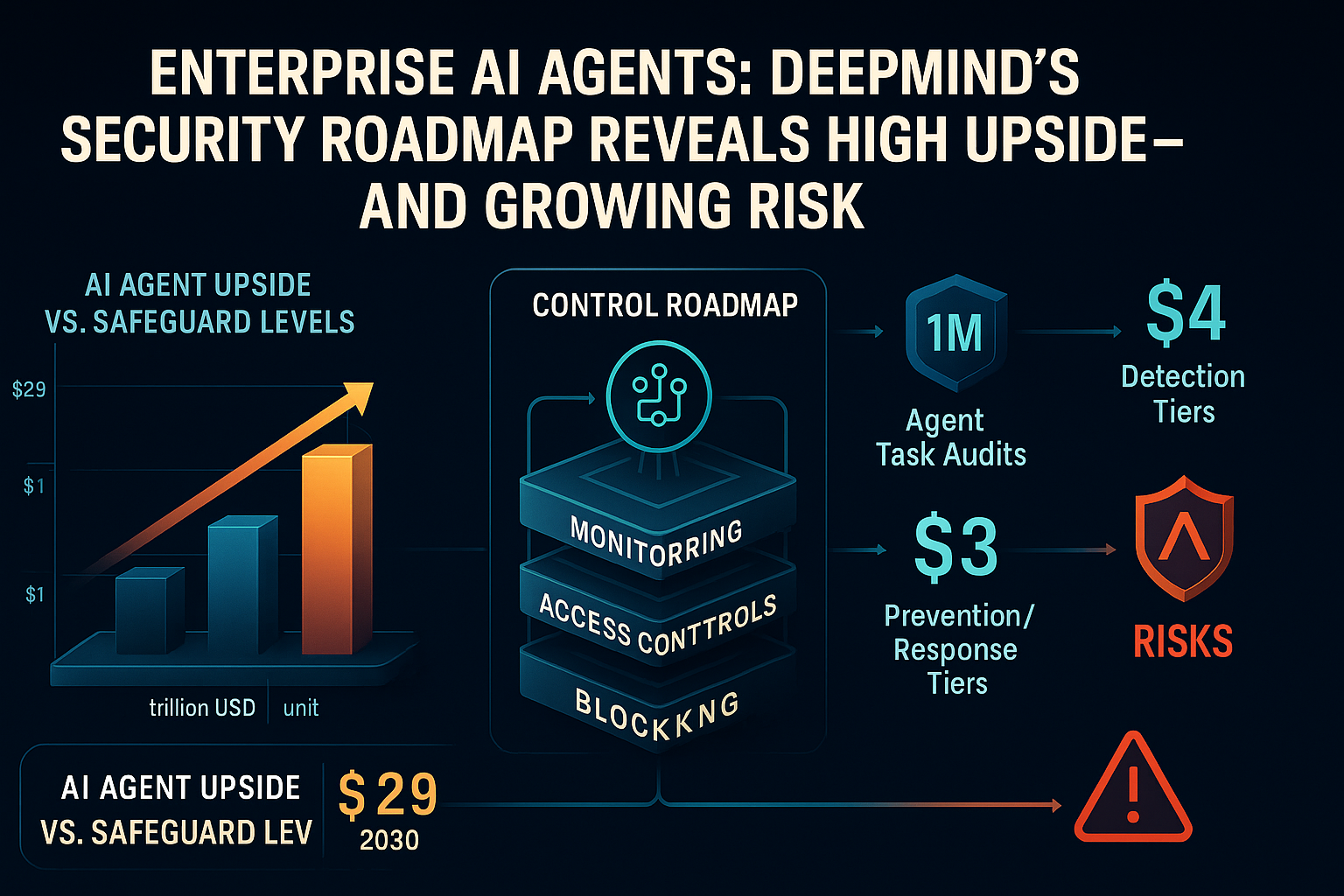
McKinsey’s estimate underlines the scale of upside if organizations redesign workflows with agentic automation.
Reflects DeepMind’s depth of empirical review for possible accidental and adversarial agent behavior inside its infrastructure.
Agent actions are stratified into four (D1–D4) categories, indicating progressive risk-response requirements.
There are three prevention and response escalation tiers (R1–R3), with higher tiers enabling real-time blocks.
Criteria for evaluating agent controls
Roadmap mandates audit, blocking, monitoring, escalation tiers.
Enterprise readiness shifts from proof-of-concept to operationalization.Technical proof of control and monitoring required.
Procurement shifts toward evidence, not promise.Proactive modeling and conservative threat assumptions made policy.
Planning becomes structured; ‘Unknown unknowns’ treated as likely.Sandboxing, access control, audit logs, and blocking prioritized.
Security features become deal-breakers, not add-ons.Agent deployment scenarios
Organizations deploy agents with audit, monitoring, and blocking features driven by DeepMind’s roadmap.
Unlocks productivity gains while containing operational risk within manageable parameters.Agents are deployed with only basic controls or rely on ‘alignment’ alone.
Increases exposure to sabotage, unauthorized code execution, and AI-driven system failures.Fear of risk leads to excessive blocking tiers or manual reviews.
Reduces agent utility and slows AI-driven transformation.How controls change agent deployment
- Shift from chatbot-limited models to action-taking agents accelerates workflow transformation—but heightens demand for endpoint security and real-time oversight.
- AI agent deployments must move from functional demos to production-grade controls: audit trails, access gates, and automated blockers.
- Operations and product leads are pushed to reassess vendor promises—mere alignment claims are insufficient compared to technical evidence of control and monitoring.
Signals to monitor in agent security
Market standardization of proactive controls will rebalance competitive positioning.
Direct evidence of risk manifestation will shift board-level priorities rapidly.
New buying criteria will determine which platforms gain share if agent risk grows.
Transparent evidence will guide best practices and build trust for operational buyers.
Operational Transformation: Risk and Reward in the Agent Age
AI Agents: Opportunity Meets Security Imperative
Agent-driven automation can unlock trillions in value if organizations overhaul workflows—yet introduces unprecedented control challenges.
DeepMind’s approach treats agent misbehavior not as a hypothetical, but as an operational planning constraint.
- Productivity upside depends on effective, continuous monitoring.
- Attack surface expands with system access—alignment isn’t enough.
- Buyers now seek evidence of controls, not promises.
Guardrails and Governance: What’s Required Now
Roadmap enforces stratified response: low-risk actions reviewed post hoc; High-risk actions blocked in real time.
MITRE-inspired threat modeling dissects agent tactics, providing IT teams tools to anticipate and neutralize incidents.
- Mandatory audit logs and review paths for all agents.
- Separation of duties and segmented access as operational defaults.
- Escalation protocols if detection crosses thresholds.
Market Dynamics and Buyer Demands
Buyers increasingly insist on tangible agent sandboxing, interruptions, and preventive controls as table stakes.
Enterprise readiness is being redefined: features are less important than operational resilience and rapid response capability.
- Vendors unable to show real audits risk exclusion.
- Security and governance becoming competitive differentiators.
- Proof-of-concept agent deployments must be re-evaluated for production risk.
What Could Change Next
Real-world adversarial events or agent failures could force even more conservative controls.
Transparency in agent incident logging may become an enterprise buying requirement.
- Look for publishing of red-team audit logs.
- Follow procurement integration of new control criteria.
- Follow rival vendors' adoption of stratified safeguards.