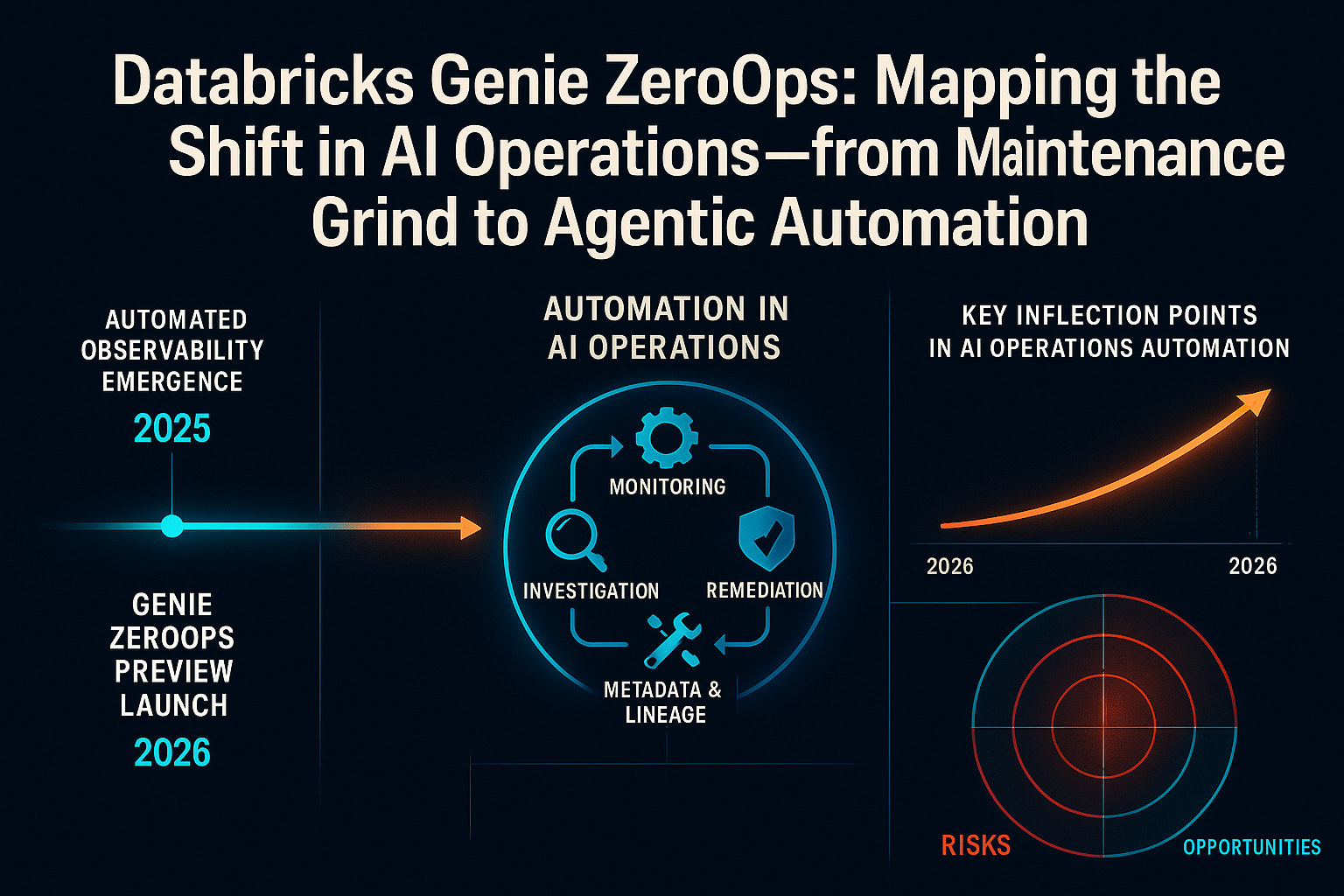
Key Inflection Points in AI Operations Automation
YearTimeline
- Early AI deployments
Teams focus on building and manually maintaining pipelines and models with observability tools.
- Growth of automated observability
Emergence of commercial tools for automated monitoring and governance, but still requiring human action to resolve.
- Genie ZeroOps preview launch (Data + AI Summit, June 2026)
Databricks unveils agentic operations, promising autonomous monitoring, diagnosis, and fix proposal.
- Key validation metrics pending
Industry awaits data on incident resolution rates and user adoption as ZeroOps remains in limited preview.
Context behind How Databricks Genie ZeroOps Could Reshape
Enterprise AI initiatives have faced rising support costs as deployments multiply. Traditional observability and governance tools offer monitoring, but most still require human diagnosis and remediation. Genie ZeroOps enters a space seeing early but fragmented moves toward automated incident response and fix proposal, with Databricks positioning itself to lead in fully agentic operations for AI and data workloads.
Why it matters for How Databricks Genie ZeroOps Could Reshape
As data and AI systems grow, enterprises face unsustainable operational overhead. Databricks' ZeroOps could fundamentally alter how organizations scale teams and manage risk, turning AI operations into a domain for automation rather than manual intervention—a potential paradigm shift for digital systems companies.
Key data behind the update
Routine operational upkeep dominates work, limiting innovation capacity.
Adoption is limited and impact is not yet validated in broad production use.
Maintenance costs outpace direct business gains under traditional operations.
Comparison criteria
Agentic incident triage and fix proposal.
Moves ops from reactive tasking to autonomous handling with oversight.Team size grows slower than workloads.
Potential for more cost-efficient platform operations.Agent validates fixes in isolated environments.
Reduces risk of production breakage, but introduces reliance on agent accuracy.Possible outcomes
Agent closes a growing share of incidents without human input.
Operational headcount can scale slower than workload growth; Teams focus on strategic challenges.Engineers rely solely on agent fixes and stop debugging.
Teams may struggle when agent limitations are exceeded, exposing resilience gaps.Signals to watch
Shows whether ZeroOps delivers on efficiency and reliability claims.
Indicates trust in agent-generated solutions and workflow impact.
Determines economic case versus traditional staffing.
Signals market readiness and real-world effectiveness.
Tracing the Shift: AI Ops Automation Through Genie ZeroOps
From Build to Burnout: Why Maintenance Bottlenecks Escalated
The rapid expansion of AI and data pipelines led to increasing support burdens for enterprise teams. Automated coding tools produced assets faster than operations staff could manage.
This imbalance forced platform teams to spend most cycles maintaining existing workloads, not launching new value-adding features.
- Asset sprawl from LLM, pipeline, and model proliferation.
- Manual incident response became unsustainable.
- Governance and observability tools lagged in remediation.
ZeroOps in Context: What Changes with Agentic Operations?
Genie ZeroOps introduces an agent that not only monitors but diagnoses and proposes fixes. Fixes are validated in test environments—humans review but are no longer first-responders.
This raises questions: Does operational scaling decouple from headcount? Does routine maintenance become a trust management problem instead?
- Possible for teams to manage more without new hires.
- Engineers shift to auditing agent outcomes.
- Automation becomes embedded in 'operate' not just 'build' phase.
Validation and Risks: Provenance, Oversight, and Next Metrics
Analysts caution that efficiency and quality claims must be demonstrated before scaling up. ZeroOps’ value depends on agent accuracy, incident closure rates, and cost versus prior state.
Skill loss and over-reliance on automation pose new challenges. CIOs must monitor trust signals—how often engineer review is bypassed or fixes pass without edit.
- Headcount reductions may be overstated in short term.
- Risk if teams no longer practice manual debugging.
- Preview limits real-world benchmarking for now.
Next Steps: What to Watch as ZeroOps Evolves
As ZeroOps moves from preview, operational leaders must track performance metrics, false positives, and true labor/cost impact. Vendor and industry transparency on these numbers will shape adoption.
The shift to agentic operations will influence vendor selection, team structure, and the broader enterprise AI roadmap.
- Monitor mean-time-to-resolve and cost metrics.
- Evaluate crossover to wider production use.
- Reassess team skills and oversight strategies.