Why it matters for Databricks Genie One
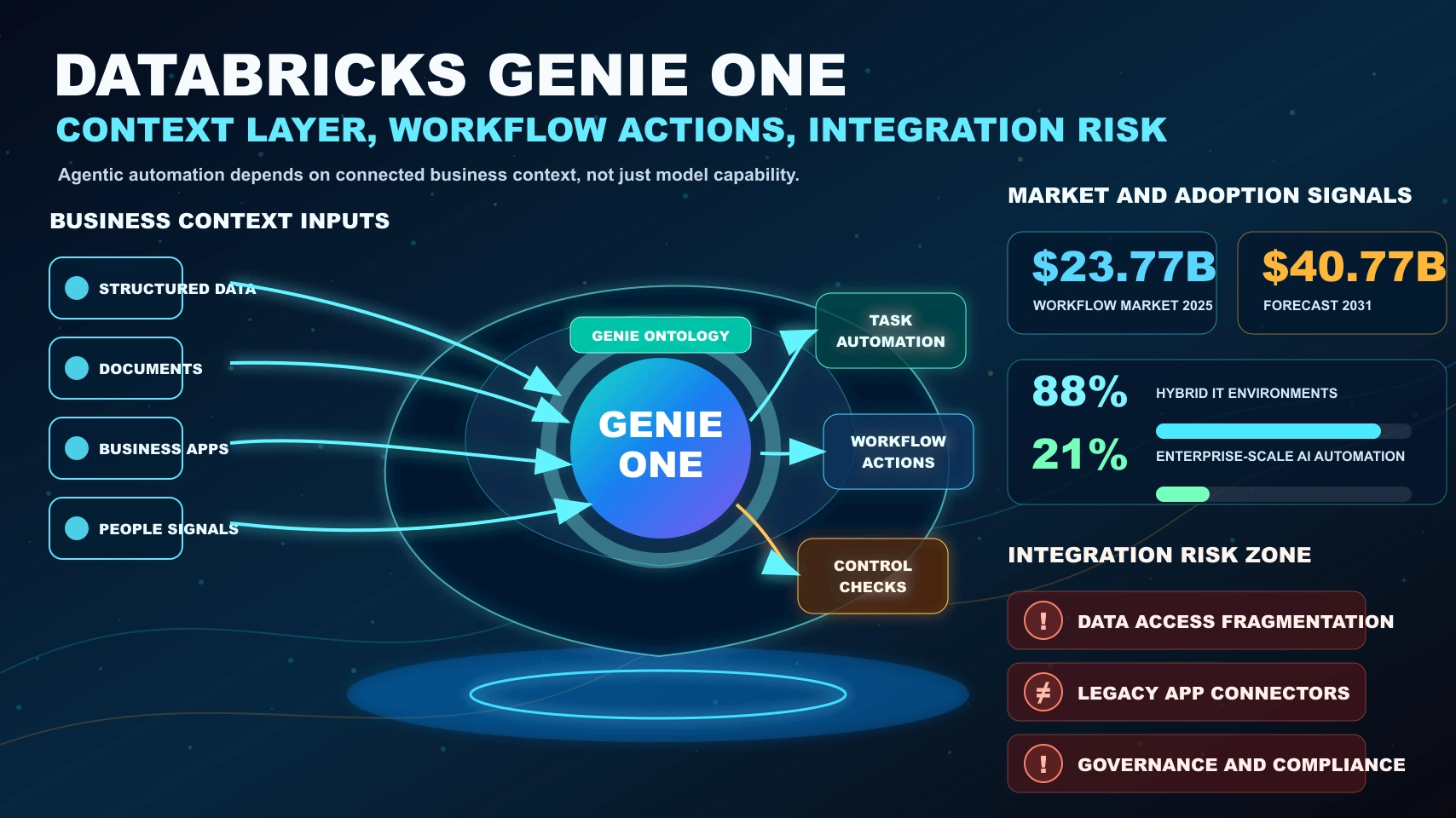
Genie One moves AI agents from analytics to acting on business workflows, but whether organizations realize these benefits depends on bridging fragmented data and standardizing governance. For operators, this means carefully evaluating internal data readiness and compliance controls before deployment.
Operational consequences
- Well-integrated digital organizations may accelerate automation projects and reduce manual workloads.
- Legacy or fragmented environments may struggle to see value without significant investment in data integration.
- Operators in regulated fields must reinforce compliance and monitoring, as new AI agents could act on incomplete or outdated data.
Evidence-backed metrics
Indicates substantial market appetite for advanced automation solutions like Genie One.
Rapid expected growth reflects rising enterprise investments in orchestration and automation tools.
Hybrid operational realities make data unification—critical for Genie One’s context—challenging for most organizations.
Most organizations are still early in automation maturity, limiting immediate adoption potential.
Source data behind the story
Source-reported valuesDecision criteria
Continuous ontology-driven context learning (Genie One)
Automation adapts to evolving business data but relies on data quality and access.Accesses both Databricks and third-party business sources
Promises broader workflow coverage, but increases governance/compatibility needs.Pay-as-you-go (token-based consumption)
Potentially more flexible for usage spikes, but may complicate budgeting or compliance tracking.Possible outcomes
Firms with strong data governance quickly deploy reusable AI agents, realizing productivity boosts.
Early movers gain workflow efficiency, shifting focus to optimizing human-AI collaboration.Integration and compliance blockers prevent Genie One from accessing required data context.
These organizations must invest in data infrastructure before AI automation delivers value.Workflow impact
- Enterprises with unified data lakes or strong integration pipelines can leverage Genie One for immediate business automation gains.
- Highly regulated or siloed operations may encounter risks if Genie One cannot access precise context, raising the potential for unintended automations or compliance breaches.
- Continuous context learning via Genie Ontology could reduce manual process mapping, but also increases dependence on the quality and accessibility of enterprise data.
Signals to watch
Genie One’s real-world ROI for most firms depends on seamless integration with both modern and legacy SaaS and on-prem platforms.
Operators need visibility and override capability as agents act on live business data, especially in compliance-sensitive processes.
Automation Opportunity and Uncertainty
What Genie One Actually Changes
Genie One marks a shift from analytical AI chatbots to agentic coworkers that automate tasks across business workflows. Instead of relying on fragmented or static context, Genie Ontology continuously curates and updates business knowledge from a wide array of internal and external sources.
Integration extends to third-party business applications, allowing Genie One to drive actions within sales, marketing, finance, and operational workflows, provided the data controls and connections are in place.
- Continuous context improvement aims to reduce AI guesswork.
- Cross-platform actions unlock broader process automation.
- Real-world impact depends on existing data integration and governance maturity.
Constraints Facing Operators and Architects
Fragmented data ecosystems, legacy system silos, and patchwork compliance regimes will limit immediate automation gains. Genie One’s effectiveness is highest in environments with unified data lakes and strong metadata management.
Highly regulated industries (finance, healthcare) must manage the risk of AI actions triggered by partial or out-of-date information, requiring dual focus on context enrichment and control.
- Legacy and siloed data hinder context extraction.
- Regulatory obligations drive demand for oversight and explainability.
- Integration capex may offset short-term automation ROI.
Operational Implications for Digital Systems
Organizations ready to build or buy automation should assess internal data accessibility and define guardrails around agentic actions. Pay-as-you-go pricing offers usage-based flexibility, yet may complicate budget management and compliance tracking.
Early Genie One success will likely depend on ongoing investment in data quality, integration, and governance automation—especially as operator trust remains a gating factor for AI-driven workflow execution.
- Data governance and accessibility are now central to automation.
- Usage-based billing aligns with cloud-native consumption models.
- Monitoring agent actions and outcomes is essential for risk management.