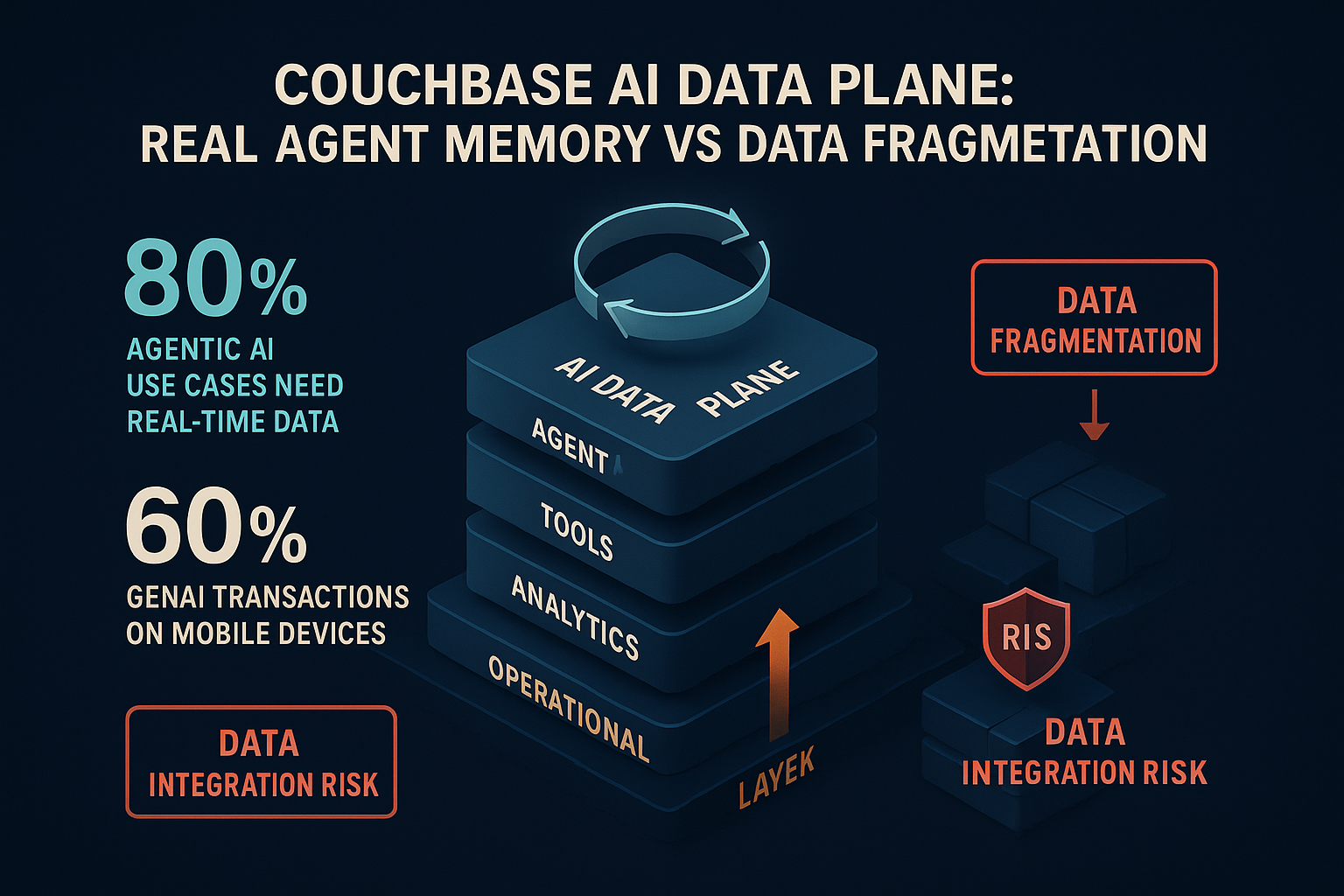
Why it matters for Couchbase AI Data Plane
System integrators, platform engineers, and SaaS builders face a major pivot: faster agent deployment can drive ROI only if the underlying data plane is stable, compliant, and extensible—all while minimizing the risk of introducing new silos or integration failures.
Operational consequences
- Enterprises adopting the AI Data Plane must migrate legacy and fragmented data, a potentially resource-intensive process.
- Centralized agent memory and context raises stakes for data breaches and compliance, magnifying impact if controls lapse.
- Operational reliability hinges on platform’s latency and edge sync performance, compelling new monitoring strategies.
- Inadequate change management could result in loss of agility for rapid AI prototyping.
- Vendors not aligning their analytics/lakehouse architecture risk being left with harder-to-integrate solutions.
Key data behind the update
The majority of advanced enterprise AI workloads depend on unified, low-latency access to diverse operational and contextual data.
Mobile endpoints—often edge devices—now drive most enterprise genAI transaction volume, influencing infrastructure needs.
Each new AI deployment adds another specialized data store, further complicating integration and governance.
Comparison criteria
Integrated persistent agent memory with state/context across cloud, edge, lakehouse.
Reduced time-to-production for multi-agent workflows; Potentially greater centralization risk.Unified operational/analytical data plane; Lakehouse federation.
Lower ongoing integration tax but higher migration cost and governance risk.Supports agent memory locally on mobile and field devices, async sync
Business resiliency up, but more distributed policy and compliance enforcement needed.Policy-based, org-level control for model access/cost in Capella iQ.
Improved alignment to enterprise guardrails if policy adoption keeps pace.Possible outcomes
Single governed memory/context layer is adopted across production agents.
Operational workflows (customer, field ops) become increasingly AI-driven; Deployment velocity rises.Existing fragmented data stacks prove costly to consolidate.
Teams delay full adoption, maintaining parallel architectures and increasing support complexity.Mobile and field deployments sync agent memory locally.
Business continuity improves, but governance boundaries must span distributed endpoints.Workflow impact
- Enables multi-agent systems to coordinate across front- And back-office workflows with persistent enterprise memory.
- Reduces need for bespoke data plumbing, potentially improving developer velocity and compliance posture.
- Places new demands on governance, as data unification ramps up risk if policy controls lag platform adoption.
- Facilitates analytics across operational and lakehouse data, potentially unlocking new business insights.
- Extends AI deployment to edge scenarios (mobile, field, stadiums), changing support and reliability requirements.
Signals to watch
Enables direct SQL queries into operational data from major cloud analytics platforms, reducing data duplication and ETL overhead.
Early deployments at the edge will test resilience, synchronization, and compliance in high-stakes real-world workflows.
Will show if cost and regulatory guardrails can keep up with flexible model and data access across teams.
Measures whether hybrid operational-analytical workloads run seamlessly, delivering unified visibility without redundancy.
Centralizing AI Agent Memory: Rethinking the Data Plane
A New Operational Layer for AI Agents
Couchbase’s release unifies memory, tool discovery, and analytics into a cohesive platform. Instead of standalone pilots, agents work together across business workflows with shared context.
Key innovation: Agent Memory acts as a persistence layer, enabling state retention, context sharing, and historical recall for multi-session and multi-agent orchestrations.
- One architecture for Capella and self-managed environments.
- Designed for sub-millisecond latency at operational scale.
- Memory and tool access standardized and governed at enterprise level.
- Multi-agent, multi-session workflows become feasible with less custom work.
Integration Risk: From Legacy Sprawl to Single Point of Control
Consolidating disparate databases, caches, and document stores may lower ongoing support burden, but migrating to a unified plane is non-trivial. The risk: failure to execute leaves teams straddling old and new systems, increasing short-term complexity.
Governance must keep pace: if security or policy controls do not match the breadth of the new platform, centralized memory could amplify compliance vulnerability.
- Integration costs rise temporarily during migration.
- New platform becomes a critical dependency for live workflows.
- Centralization can lead to large-scale incidents if controls fail.
- Edge/remote deployments add unique governance challenges.
Edge, Mobile, and the Expanding Agent Perimeter
Enterprise AI is no longer just a data center phenomenon—60% of transactions touch mobile endpoints. AI Data Plane brings persistent agent memory to mobile, field, and stadium deployments, synchronizing as connectivity allows.
Edge-first architecture improves reliability for distributed workflows but expands the compliance and monitoring perimeter.
- Supports agents in low-connectivity, high-variance environments.
- Manual data sync is replaced by coordinated, governed memory.
- Policy controls need to span both central and edge locations.
- Field users, such as retail clerks and technicians, benefit directly.
Lakehouse Federation and Analytics—Faster Insights, Fewer Copies
Tying operational and analytical data together, Couchbase leverages Iceberg lakehouse compatibility, asynchronous queries, and policy-driven access. This shift eliminates redundant ETL, consolidating insight pipelines.
Upcoming Trino support will allow live SQL queries on operational data, broadening access across major analytics platforms.
- No need to duplicate data for analytics workflows.
- SQL++ support spans multiple SDKs for language flexibility.
- Indexing and CDC features improve governed reporting.
- Analytics, operations, and AI share a single data layer.