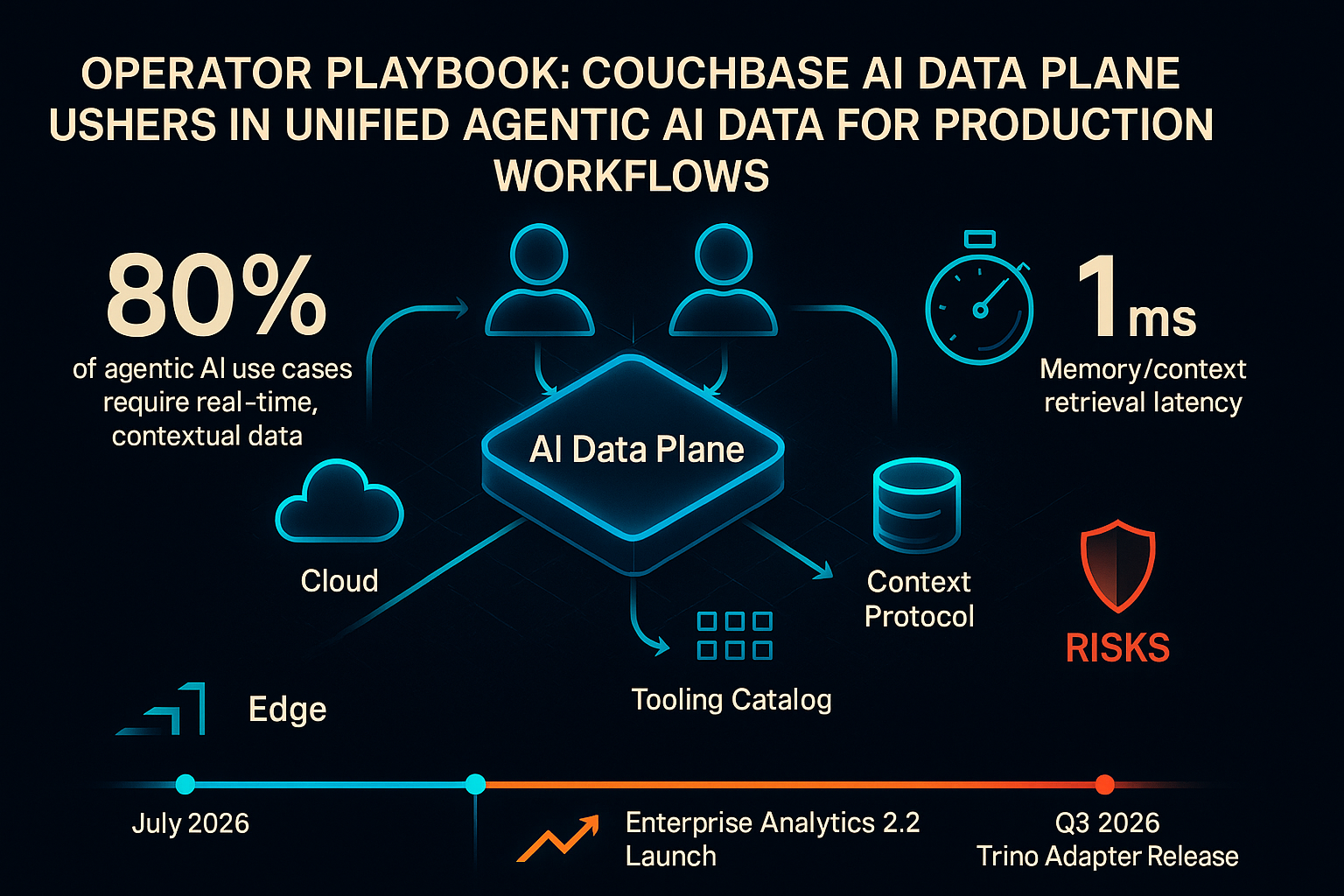
Key Metrics for Enterprise Agentic AI Data Operations
Production AI use cases requiring real-time, contextual data (%)
Memory/context retrieval latency (ms)
Workflow impact
- Reduces architectural friction in scaling agentic AI from pilots to full video/data operations.
- Enables switching between orchestration frameworks without agent memory rebuilds.
- Accelerates deployment timelines by consolidating memory, vector, and document storage needs.
- Strengthens governance and compliance through unified policy and access controls for agentic data.
- Facilitates edge and mobile AI agent deployment with synchronized context and local vector search.
Key data behind the update
Indicates high demand for unified, responsive data systems in production AI agent workloads.
Meets the low-latency requirements of high-interaction AI agents for smooth, predictable user experience.
Trino adapter arrival will simplify in-place analytics for existing data, reducing ETL and replication costs.
Operational consequences
- Platform and engineering teams must inventory and potentially retire overlapping point solutions used for agent memory, context, and retrieval.
- Workflows built on tightly coupled or non-governed data layers may face upgrade hurdles or redundancy.
- Operational complexity and integration costs are likely to decrease—provided the unified layer is adopted.
- Edge and mobile deployments gain consistency and data access parity with cloud, reducing failover or silo risks.
- Teams lacking unified governance for agent AI data risk increased compliance and cost exposure as scaling accelerates.
Comparison criteria
Unified, persistent agent memory for all AI agents in a single service.
Simplifies orchestration and reduces redundancy.Sub-millisecond, seamless context retrieval at decision points.
Production agents can reliably handle concurrent, multi-step tasks.Single, enterprise-supported platform across cloud and edge.
Centralized policy and greater visibility for compliance teams.Native query federation with Iceberg; Direct Trino integration.
Lower data duplication, near real-time analytics workflows.Signals to watch
Success of Iceberg federation will reveal adoption rate of open lakehouse governance models for AI.
Direct SQL access from Trino (including AWS Athena, EMR) could reshape operational analytics workflows.
Adoption rates and governance patterns will indicate maturity of multi-cloud AI deployments.
Pattern of edge uptake signals readiness for production-grade distributed AI workflows at the device layer.
Timeline
- AI Data Plane general availability (July 2026)
Operators can deploy unified agent memory/data platform for production agent workloads from July 2026.
- Enterprise Analytics 2.2 ships
Brings Apache Iceberg federation and other analytics enhancements alongside the Data Plane.
- Trino adapter available (Q3 2026 expected)
Enables in-place SQL querying from Trino-based tools and simplifies AI data workflows.
Operator Playbook: AI Data Plane for Production-Scale Agentic Workflows
Shift to Unified Agent Data Layers
Teams deploying agentic AI for video or operational content are urged to retire scattered agent memory, caching, and retrieval solutions.
A unified data plane means refactoring integration points and updating orchestration logic, especially for persistent and stateful agent workloads.
- Assess duplication of agent memory/cache/document stores.
- Prepare migration plans for legacy point solutions.
- Align governance practices to new unified layer.
Performance at Scale and Consistency
Sub-millisecond context and memory retrieval now become expected for production agents, smoothing video and human-AI interaction.
Edge and mobile consistency ensures offline or intermittent use cases keep functioning as agent workloads move to device and field environments.
- Benchmark actual latency under production loads.
- Validate session persistence across agent restarts.
- Test failover and local vector search at network edge.
Governance and Federation for Analytics
With Analytics 2.2, federated querying across Iceberg tables and Couchbase reduces complex pipelines, offering direct access to operational data.
Administrators gain improved control over model/provider selection, cost, and residency—vital for regulated video or workflow environments.
- Consolidate operational and analytical data policies.
- Use Trino adapter (Q3 2026) for in-place analytics.
- Re-evaluate multi-model query guardrails and team-level access.
Deployment and Scaling Considerations
As organizations progress to at-scale agentic AI, deployment surface consistency (cloud-to-edge) is critical for reliability.
Look for near-term indicators: rising adoption of Iceberg federation, shift to unified memory, new deployments using OpenAI or Bedrock with Capella iQ.
- Audit edge/mobile fleet for AI Data Plane readiness.
- Monitor support incidents for context retrieval issues.
- Track analytics workload migration from ETL-dependent stacks.