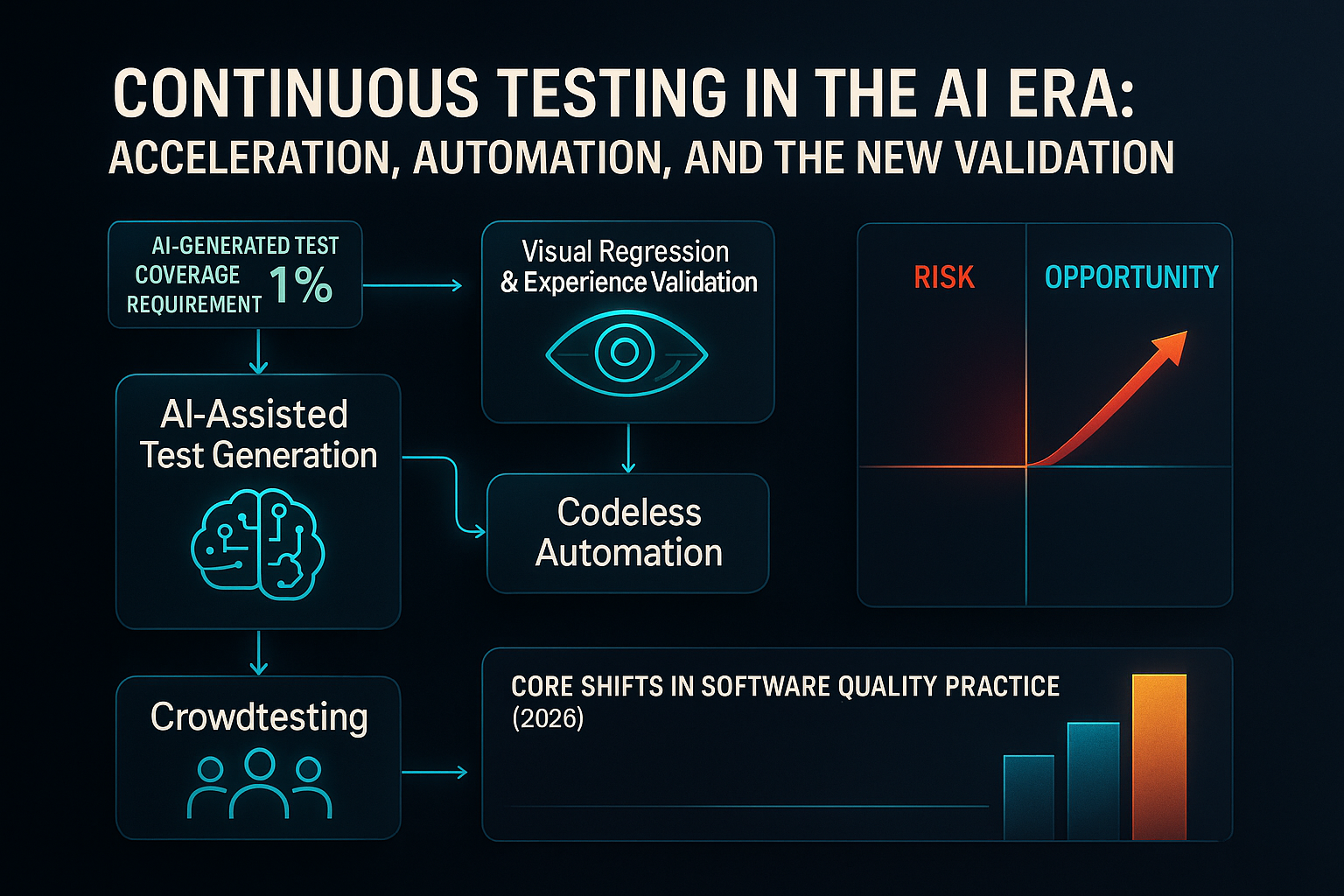
Why it matters for Continuous Testing in the AI Era
Business operations now depend on continuous, validated software delivery; AI-driven quality tools can increase speed but also introduce hidden risks if automated validation fails to keep up. Leaders must reassess where human oversight and automated checks intersect to avoid both velocity traps and reliability gaps.
Operational consequences
- Faster release cycles carry higher risk of undetected logic or visual errors if automated validation is incomplete.
- Responsibility for quality becomes more distributed, requiring new collaboration frameworks.
- Investment in visual regression, usability, and localization tests is rising, especially for user-facing applications.
- Automated systems might miss rare real-world usage breakdowns, requiring ongoing integration of crowd and manual testing.
- Organizations that do not adapt risk stagnation—or worse, customer-impacting production incidents.
Key data behind the update
Organizations are treating AI-touched code with skepticism, requiring robust automated validation.
Visual and usability testing have become core quality requirements, not just functional checks.
AI-powered self-healing test frameworks are now vital to maintain coverage as code changes.
When code changes exceed manual test update capacity, quality or velocity suffers.
Comparison criteria
AI-generated, self-healing, codeless automation expands capability
Accelerates feedback loops but introduces different error surfaces and dependence on tool sophistication.Visual, experience, and API testing are equal priorities
Wider validation scope addresses modern user experience risks but may stretch QA resources.Distributed across engineers, PMs, design, and dedicated QA
Increases test coverage for workflow specifics but adds coordination and oversight challenges.Self-adapting (self-healing) automated tests
Less manual effort per release, but risk if critical logic changes aren’t distinguished from cosmetic ones.Possible outcomes
Widespread adoption of AI-driven self-healing test automation and visual/experience testing
Teams can ship updates rapidly without sacrificing confidence in functional and visual correctness.False confidence from high test counts but weak real-world coverage
Defects escape into production if automated test logic fails to mirror true user behavior or edge cases.Expansion of codeless test authoring for business users and designers
Testing covers critical workflows otherwise neglected, but risk increases if tooling cannot capture edge logic.Workflow impact
- Organizations adopting AI-driven testing gain competitive speed and broader coverage.
- Reliance on automation shifts test ownership and demands greater cross-functional involvement.
- Reduced manual bottlenecks free up quality teams for higher-value tasks, but raise new risks if test logic or maintenance is overlooked.
- Poorly validated AI-generated code may pass casual review but introduce complex production defects.
Signals to watch
As organizations trust AI code, failures linked to overlooked test gaps can trigger major reviews and tool changes.
Leaders may seek broader coverage and real-world validation to catch failures outside automation’s reach.
Allowing broader contributors raises coverage and risk—watch for organizations doubling down or pulling back.
Backend contracts are validated earlier in the workflow, reducing front-end surprises.
New Era for Software Quality: Accelerating and Redistributing Risk
Faster Pace, Higher Stakes for Testing
AI-accelerated code creation now outpaces the manual test update cycles organizations once relied upon.
To avoid either stalling releases or letting defects slip through, investments in automated test generation, self-healing, and AI-powered prioritization have become the new baseline.
- Test coverage demands are increasing, especially for code touched by AI.
- Manual methods can no longer keep up—velocity and quality both hinge on tooling.
- Quality is redefined to encompass experience and visual presentation, not just functionality.
Redistribution of Test Ownership: Beyond Dedicated QA
Rising adoption of codeless and visual test platforms enables designers, product managers, and business subject-matter experts to contribute directly.
This broadens coverage but requires careful oversight to mitigate gaps or misunderstandings in workflow validation.
- Responsibility for testing is spreading across roles.
- Broader QA participation raises the bar but needs improved collaboration.
- Tool choice and integration become critical to preventing redundant or fragile tests.
Automation Isn’t Everything: The Case for Crowdtesting
AI and automation address many velocity challenges but rarely replace real-world validation.
Crowdtesting remains essential for spotting localization, usability, and accessibility flaws—and for ensuring coverage outside lab conditions.
- Real device testing uncovers context-driven failures missed by bots.
- Organizations need blended strategies: automation for coverage, crowdtesting for edge-case detection.
- Failing to retain manual or crowd insights can cause critical breakdowns post-release.
Persistent Risk: Trust, Validation, and the Limits of Automation
AI-generated code’s apparent correctness may hide subtle logic errors that escape casual human checks.
Businesses must treat automated test coverage as mandatory, not optional—especially for workflows tied directly to revenue or user trust.
- Skepticism is required even as test automation grows.
- Self-healing frameworks reduce maintenance but can mask drift in actual application logic.
- Ongoing review processes for automated test logic are crucial in high-stakes systems.