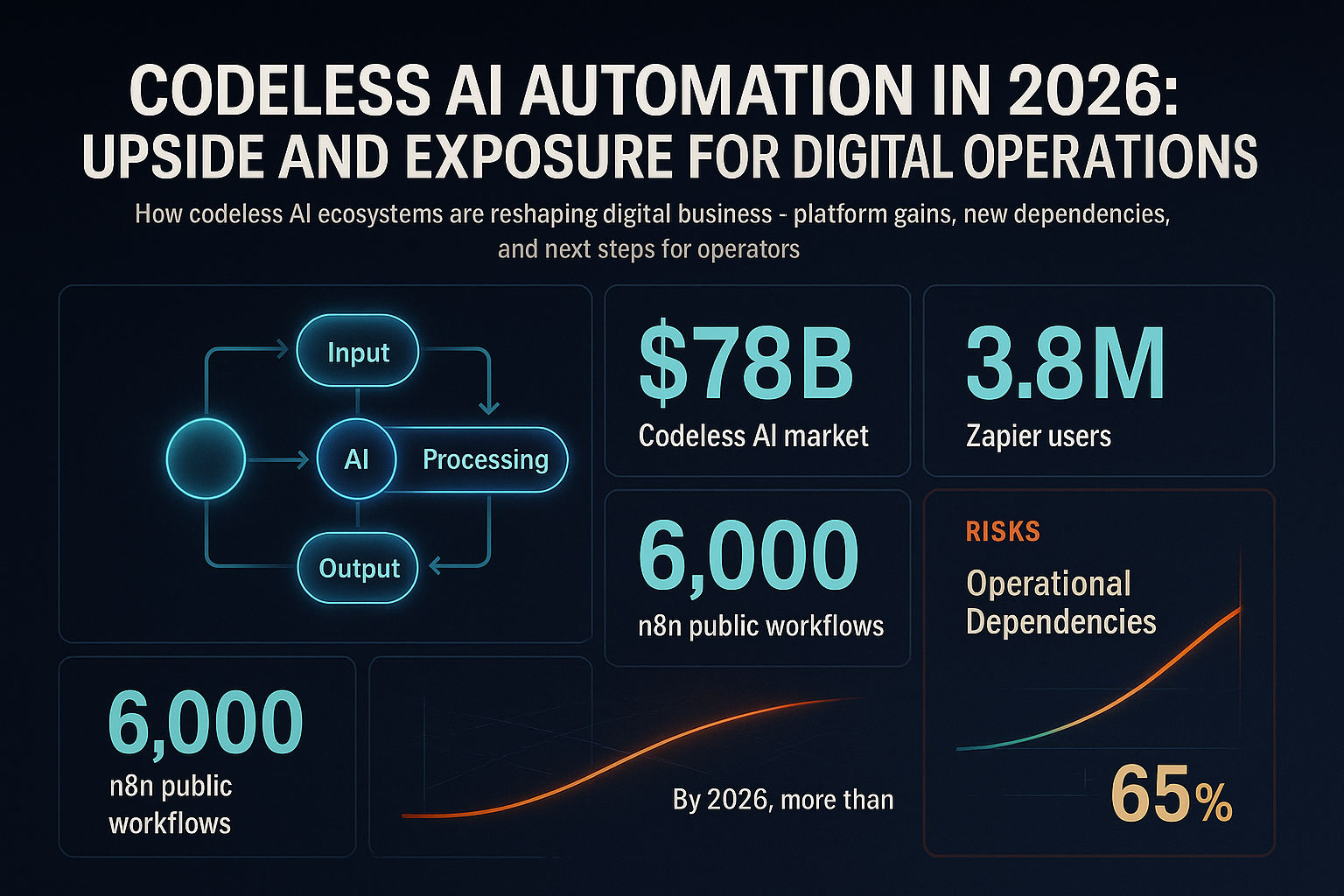
Why it matters for Codeless AI Automation in 2026
Operators in digital-first businesses can deploy automation at scale without developers, accelerating time-to-market, but shifting vital workflows onto outside systems can hinder governance, transparency, and resilience.
Operational consequences
- Vendor lock-in risk grows as processes become tied to platform-specific connectors and workflows.
- Loss of transparent control—workflow logic is often abstracted in the no-code layer.
- Increased attack surface—wider integrations and autonomous tasking raise oversight and security stakes.
- Non-technical teams may outpace IT controls, resulting in digital workarounds.
Key data behind the update
Indicates explosive market growth and broad demand for no-code automation systems.
Highlights massive business buy-in for no-code workflow automation.
Demonstrates Zapier's breadth for integration, a key operational consideration.
Majority of enterprise automation will shift from rule-based to AI agent-based approaches.
Shows developer engagement and rapid prototyping on open-source, codeless platforms.
Comparison criteria
Externalized in platform GUIs, reduced transparency
Harder to audit and trace actions in codeless environmentsDepends on third-party and integration security standards
Greater risk from integrations and indirect attack vectorsRapid—days instead of months
Cuts time-to-value but can leave governance behindLower—no dedicated developers needed
Broadens access but may mask long-term TCO and lock-inPossible outcomes
Rapid rollout of codeless agent features by major platforms
Non-technical teams take on broad automation control—speed increases, but oversight tightens.Multiple disconnected process ecosystems (e.g. Zapier, n8n, Make, Workato) within one company
Shadow IT grows, and visibility across systems declines, causing risks for compliance and continuity.Workflow impact
- Rapid automation rollout for non-developers increases productivity.
- Advanced AI agent features reduce manual work but may create opaque systems.
- Widespread enterprise adoption signals normalization of codeless solutions.
Signals to watch
Demand for deeper workflow autonomy will drive new market entrants and integrations.
As adoption solidifies, expect competition for user bases and technology platforms.
Governance, compliance, and security demands will force platforms to address black-box risks.
Desire for control and data residency will fuel open platforms like n8n's momentum.
How Codeless AI Automation Is Reshaping Business Operations—With New Exposures
Expanding Access, Shrinking Timeline
Operators can now deliver workflow automation in days. Visual editors and AI-driven auto-build features make complex integrations repeatable by non-specialists.
Entry barriers have fallen, but so has the time for risk assessment between idea and execution.
- Drag-and-drop interfaces accelerate deployment.
- Non-technical staff build operational workflows.
- Less engineering bottleneck; More direct business impact.
Autonomous Agents: Beyond Chatbots
Modern AI platforms execute full business processes—qualifying leads, onboarding, or support ticketing—without explicit scripting or manual triggers.
While this boosts productivity, it raises oversight questions as systems make unsupervised decisions.
- AI agents act independently, not just reactively.
- Use cases now include whole process flows.
- Failure modes can shift from visible to hidden.
Platform Dependency: New Risks for Digital Ops
As workflows embed into external platforms, companies lose direct control over security updates, reliability, and change management.
Switching costs escalate if custom features or integrations are deeply tied to a single vendor.
- Vendor outages disrupt core operations.
- Opaque workflow logic complicates troubleshooting.
- Export/migration can be costly or incomplete.
Open Source and Enterprise Choices
Some opt for open-source automation (e.g., n8n) for self-hosting and deep customization. Others stick to enterprise SaaS for wider support and compliance alignment.
Each route presents a different mix of flexibility, cost, and control.
- Open-source: control, but higher dev overhead.
- Enterprise SaaS: ease of use, possible lock-in.
- Hybrid patterns now emerging as teams diversify.