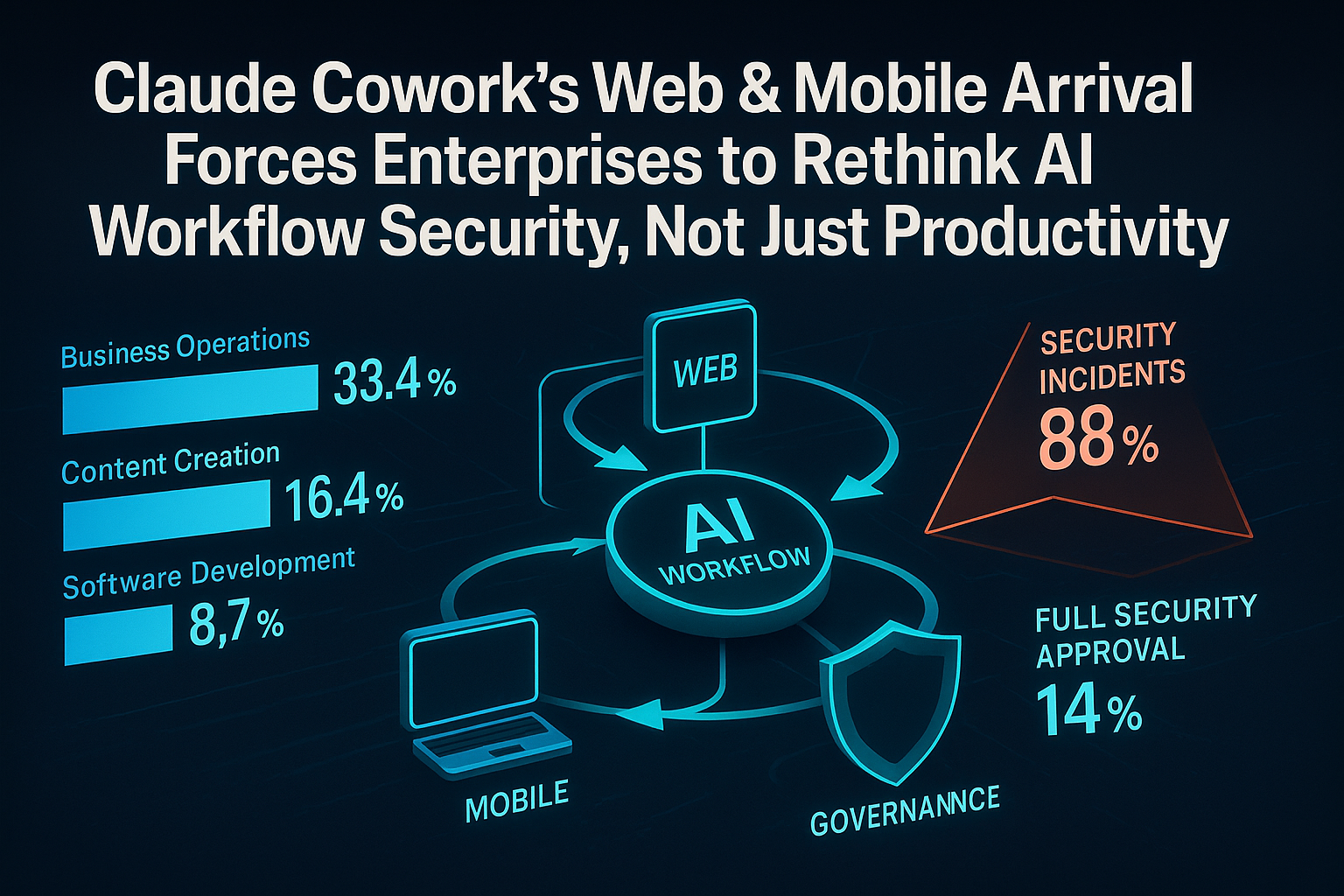
Key data behind the update
Business operations lead use of Claude Cowork sessions, shaping where the biggest workflow impact will land.
Content tasks are the second-largest use, but far below operations, indicating current enterprise priorities.
AI agent use is lower for dev workflows, pointing to possible future growth or current tooling gaps.
Security incidents are widespread in agent deployments, suggesting most enterprises face tangible operational risks.
Approval processes lag far behind adoption, with the overwhelming majority of deployments lacking complete security oversight.
Workflow impact
- Remote oversight of AI-driven business tasks becomes feasible, reducing process bottlenecks.
- IT and security teams face rising exposure as persistent agents access enterprise data 24/7.
- Knowledge workers transition from manual execution to supervision and exception review.
- Budgets may pivot toward cloud monitoring tools and identity management to support safe rollout.
- Deployment pace may create gaps between adoption and governance, risking non-compliance.
Comparison criteria
Web/mobile access; Persistent, cloud-based usage
Enables remote, continuous control—but broadens attack surfaceFew agents have full approval/risk controls (14%)
Current adoption outpaces governance, elevating risks and compliance burdens33.4% operational, 16.4% content; Less in dev/data
Ops and business support teams most disrupted by mobile rolloutHuman approval for key agent actions enforced by vendor design
Anthropic’s model may reduce risk, but organizational practices must catch upOperational consequences
- Teams must redesign approval and exception workflows to support supervision and business judgment at any location.
- Security and IT leads must prioritize identity controls and audit trails to contain new attack surfaces.
- Workforce planning will shift as supervision demand grows and manual process execution declines.
- Unaddressed governance gaps could lead to compliance failures or data breaches.
- Enterprises risk tool proliferation if they don’t coordinate mobile AI agent adoption with their overall SaaS platform strategy.
Signals to watch
Operators should watch for policy/pricing changes and plan for broader staff access.
New off-the-shelf or built-in features may address governance concerns—operators must track product updates.
Lower usage rates here may reveal workflow or integration bottlenecks, or show where to focus enablement.
Anthropic retains human approval for consequential actions; Competitors’ controls may differ, affecting risk.
Claude Cowork workflow and security risks
Decision Point: Accelerate, Delay, or Rethink AI-Agent Rollout?
Access to AI agents on web and mobile brings operational flexibility but also accountability risks. Operators in large-scale digital businesses must assess if mobile access should trigger more rapid workflow digitization—or be gated until governance is mature.
Current adoption metrics suggest productivity can increase, but most teams will need to immediately strengthen process supervision and IT policies.
- Choose between faster rollout or stricter staged deployment.
- Assess staff readiness for exception review and supervision.
- Balance productivity targets with the cost of process controls.
Workflow Implications: Supervising, Not Just Automating
Expansion means business process teams can review tasks and handle approvals remotely.
As AI agents take over document handling and data reconciliation, worker roles shift toward oversight and judgment, with direct manual execution decreasing.
- Mobile oversight shrinks process bottlenecks.
- Teams must set exception-handling protocols.
- Supervision grows as a necessary role in operational support.
Security & Governance: A Growing Gap to Close
Most enterprises roll out agents faster than they implement controls: only 14% of deployments meet full IT security approval.
Incidents are high—reported by 88% of IT/security leaders—driven by persistent background access to files, emails, and calendars.
- Identity and approval controls must be prioritized.
- Cloud-based agents increase compliance workloads.
- Audit trails and privilege management are no longer optional.
Budget and System Tools: What Changes—and When
Budgets will likely need to shift to identity governance, monitoring, and exception handling, not just automation tools themselves.
With broader support for enterprise plans imminent, procurement and workflow teams must finalize integration strategies soon.
- Budget for cloud monitoring and IAM (identity and access management).
- Hold procurement for new add-ons if current tools lack controls.
- Expect vendor updates addressing governance gaps.