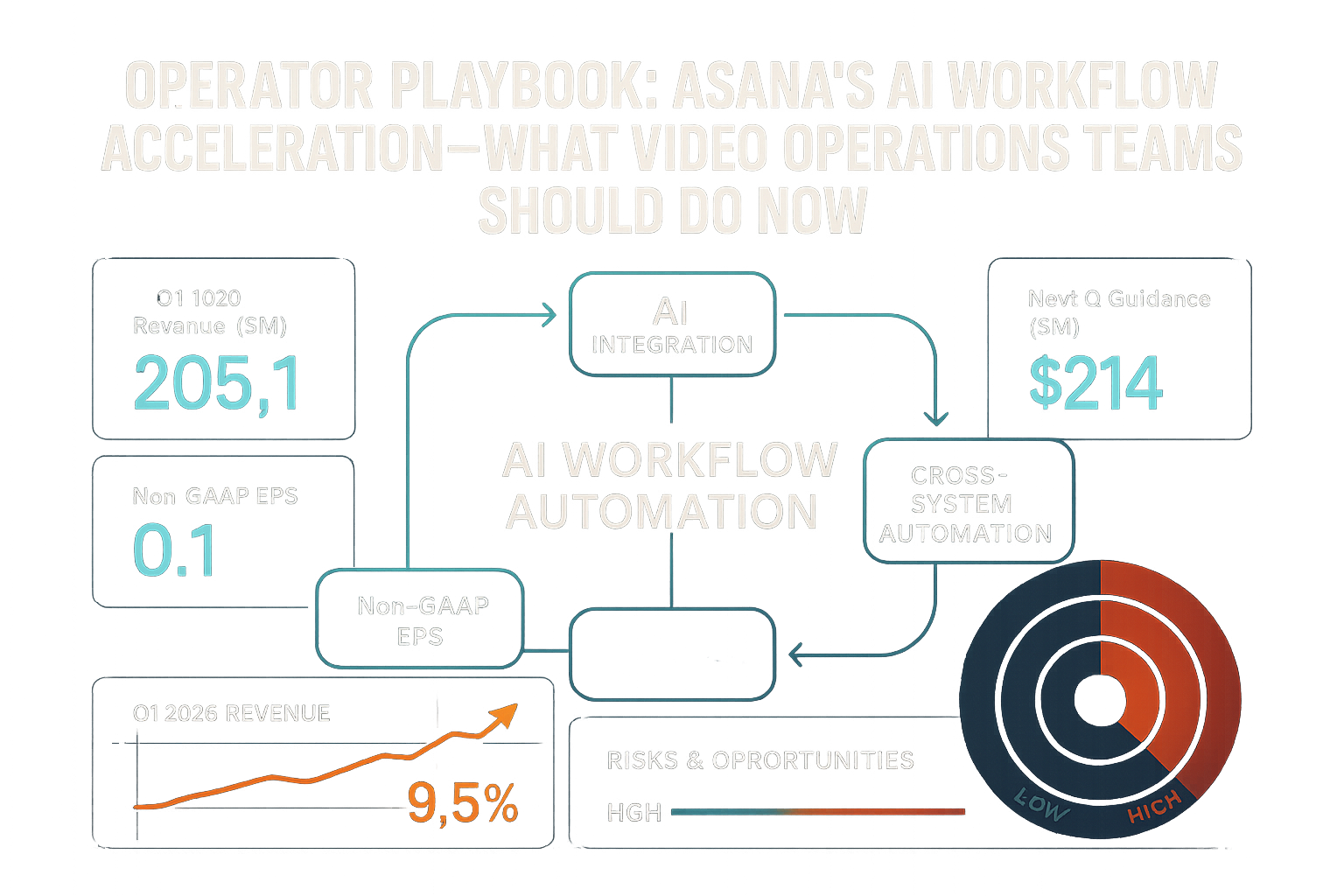
Asana Q1 2026: Key Financial and Adoption Metrics
Q1 2026 Revenue ($M)
Next Q Guidance ($M)
Non-GAAP EPS
Retention Trend (Quarters)
Workflow impact
- Teams using Asana or similar platforms must adapt workflows for broader AI automation and cross-system process management.
- Integration opportunities from Stack.ai acquisition may reshape content and video operations, enabling more advanced automation.
- Improved retention metrics suggest rising stickiness of next-gen productivity tools, affecting enterprise purchasing cycles.
- Positive technology sector performance may encourage renewed investment in workflow modernization for content-driven organizations.
Key data behind the update
Asana’s $205.1M in sales for the quarter marks 9.5% YoY growth, above market expectations.
Management projects $214M revenue for next quarter, 0.9% ahead of analysts’ forecasts.
Per-share non-GAAP profit came in 33.2% ahead of consensus.
Price rose to $6.99 from $6.74 post-earnings announcement.
Net retention improved for the fourth straight quarter.
Operational consequences
- Teams should evaluate whether current workflow automation platforms are leveraging multiproduct AI or lagging behind.
- Procurement cycles may accelerate as positive platform retention data influences budget allocation for automation projects.
- Stakeholders will require evidence of successful cross-system workflow execution driven by Stack.ai capabilities.
- Continuous monitoring of retention and AI adoption metrics will be essential for adjusting technology roadmaps.
Comparison criteria
9.5% YoY growth surpassed expectations
Indicates above-market demand for AI workflow automation33.2% above consensus
Operational efficiencies emerging, likely from automation impactAccelerating engagement with AI and workflow tools
Shift from testing to operationalized AI workflowsImprovement for four straight quarters
Stickier platform usage, better upsell/cross-sell outlookSignals to watch
Real-world uptake will validate ROI claims and affect project roadmaps for buyers.
Operational execution translates directly to user-facing productivity and process improvement.
Strong margin and retention trends drive confidence for expanding automation investments.
Big customer wins are leading indicators for product-market fit in video/content verticals.
Timeline
- Q1 2026
Revenue and profit beat guidance on AI-powered workflow expansion, with strong retention improvement.
- Current Quarter Outlook
Management guides to $214M, expects sustained AI product scaling and progress on Stack.ai integration.
- Near-Term Watch
Monitor adoption rates for AI Studio, execution of cross-system workflows, and vertical expansion in content/technology sectors.
Operational Briefing for Video Workflow Teams
AI Automation and Workflow Impact
Teams investing in video production or workflow automation must adjust their plans for more pervasive AI-powered activities. With accelerating customer demand and seat expansion, platforms like Asana are embedding AI tools at the core of workflow orchestration.
Evaluate how your current digital systems integrate with cross-system automation. As Stack.ai capabilities roll in, expect broader automation spanning content, production, and data sources.
- Audit workflow touchpoints ready for AI augmentation.
- Identify multiproduct opportunities to widen automation impact.
Retention and Operational Metrics—What to Monitor
Sustained retention improvement over four quarters highlights deeper, stickier platform engagement. This stickiness is increasingly linked to AI tool deployment and operational excellence.
Rising revenue and positive margin trends signal platforms are capturing—and keeping—budget for workflow and content management upgrades.
- Measure internal adoption velocity for AI workflow modules.
- Track retention and upselling activity per content team vertical.
Stack.ai: The Cross-System Automation Accelerator
The Stack.ai acquisition aims to unify automation across previously siloed platforms, critical for customers with distributed video and digital content operations.
Success depends on how rapidly these capabilities integrate into live production and distribution pipelines—watch for proof points on integration speed and vertical-specific deployments.
- Map legacy workflow paths and anticipate integration friction.
- Monitor feature release cadence and early adopter feedback.
Near-Term Risks and Adjustments
Management’s cautious approach to net retention assumptions suggests possible performance ceilings. Over-invested feature sets may not guarantee continued seat or license growth.
Organizations must calibrate for possible plateaus—engagement and churn management remain strategic levers even as AI modules expand.
- Balance enthusiasm for new automation with measurable engagement outcomes.
- Align procurement with phased, ROI-tied milestones.