Workflow impact
- More operations teams will adopt end-to-end document lifecycle toolkits instead of point solutions.
- Enterprises can expect reduced integration overhead in AI document processing stacks.
- The pressure to move from AI experiments to production will heighten scrutiny on document data quality pipelines.
- Developers and architects may shift away from fragmented, single-feature solutions toward full-featured platforms.
- Better structured data flow will unlock new automations in compliance, reporting, and business-critical workflows.
Key data behind the update
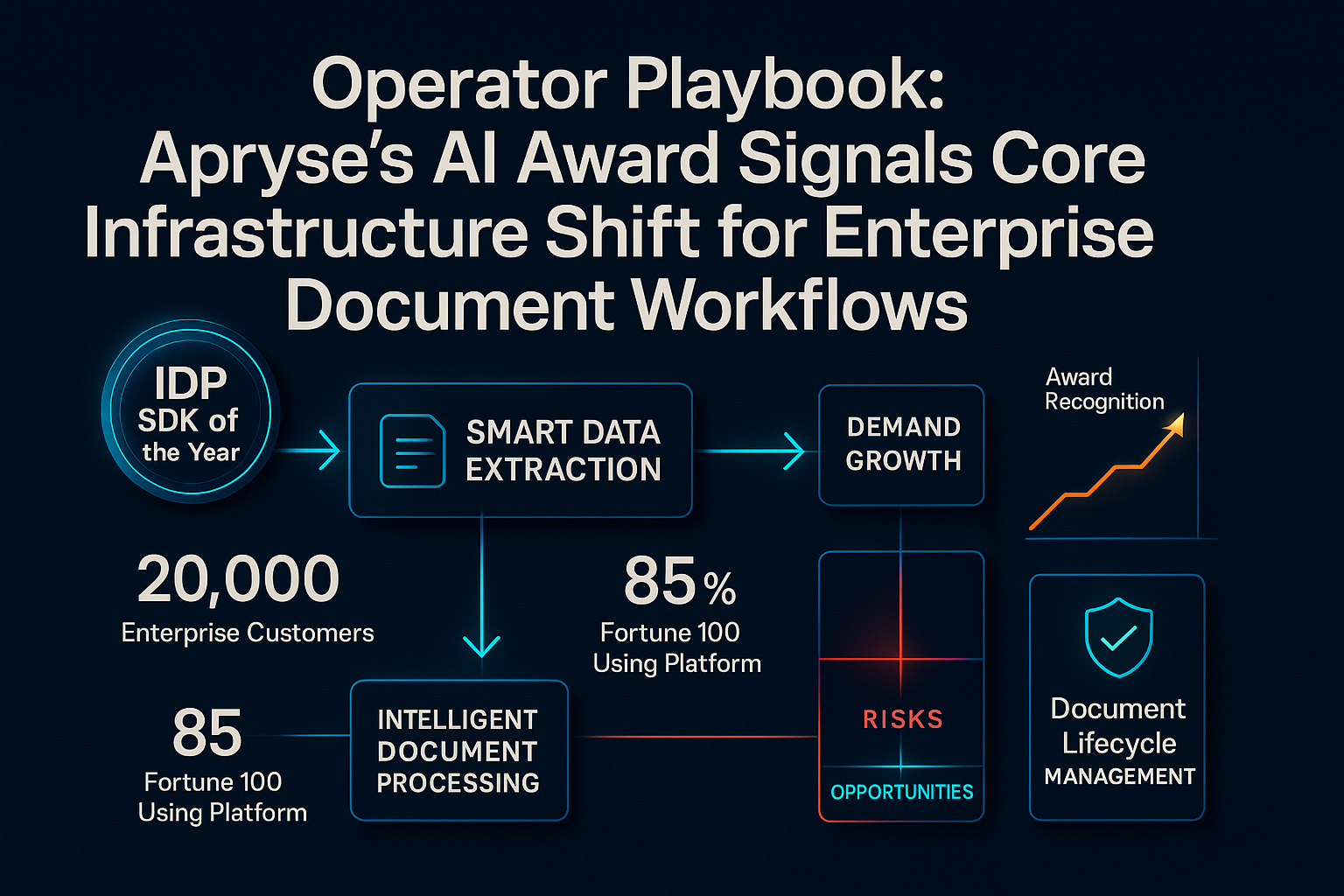
The platform is in production with over 20,000 business users, showing meaningful enterprise penetration.
Substantial share of major enterprises use this document infrastructure in mission-critical systems.
Recognized at AI Breakthrough Awards for its smart data extraction engine, validating infrastructure status.
Operational consequences
- Review document workflows for fragmentation; Consider consolidation for AI readiness.
- Evaluate if current extraction tools can deliver structured, context-rich data to downstream automation reliably.
- Monitor vendor trajectories: operators with embedded, end-to-end stacks may outpace point solution providers.
- Align compliance and security review processes to new, unified document infrastructure capabilities.
- Prepare for increased business demand to unlock data trapped in archive records, contracts, and legacy documents.
Comparison criteria
85% Fortune 100 use Apryse’s platform
Unified infrastructure is displacing fragmented workflows in top-tier companies.End-to-end lifecycle support (view, edit, extract, sign, automate)
Less integration work, lower operational risk, faster AI readiness.Awarded for IDP SDK excellence
Signals increasing expectation for recognition and reliability in core workflow tooling.Signals to watch
Acceptance of end-to-end infrastructure as the enterprise document standard will reshape ecosystem integration.
Evidence of accelerated deployment and ROI from unified stacks will influence adoption.
Signals market maturity and the expectation that all critical document functions are included in one stack.
Tighter requirements will drive further consolidation around scalable, accurate workflow tools.
Timeline
- 2026 Award Announcement
Apryse receives 'IDP SDK of the Year', validating its smart data extraction as foundational for intelligent document processing.
- Current Market Acceleration
AI-powered business systems require integrated data extraction, highlighting need for secure, accurate document infrastructure.
- Next: Expansion of End-to-End Platforms
Expect shifts from fragmented toolchains to platforms that support the full document data lifecycle as default enterprise standard.
Operational Takeaways for Document-Driven Teams
Why Integrated Document Platforms Matter Now
Demand for structured, accurate document data continues to surge as AI workflows scale beyond pilots. Apryse’s recent recognition reflects a shift: infrastructure platforms must provide full lifecycle support to minimize vendor sprawl and integration effort.
The ability to move seamlessly from viewing, to extraction, to digital signing in one platform offers direct risk reduction and operational efficiency.
- Single toolkit reduces integration and maintenance costs.
- Unified platforms can improve compliance and auditability.
- Production-grade structured data pipelines accelerate AI deployment.
Market Implications for Business Systems Operators
Teams responsible for digital operations and compliance face rising expectations for automation-ready data. The broad adoption of Apryse across global enterprises signals a trend toward consolidating document workflows for AI readiness.
Fragmented point tools often fail in scale, security, or context extraction—especially for regulated or business-critical documents.
- Over 20,000 companies use the platform.
- Majority of top enterprises have already standardized on unified stacks.
- Infrastructure-level offerings minimize workflow risks compared to mix-and-match strategies.
What Operators Should Watch and Do Next
Evaluate if current workflows depend on stitching together multiple vendors or limited-scope tools. Assess if those systems can deliver structured, AI-ready data for compliance and automation goals.
Monitor how core software vendors shift messaging from widget-level features to full-stack, infrastructure-grade solutions.
- Validate document data pipelines for reliability and flexibility.
- Assess audit and compliance risks with current extraction tools.
- Track enterprise vendor announcements for platform shifts and new integration.