Why it matters for AlphaSense AI funding
The move from fragmented information sourcing to AI-driven workflow engines can give digital operations teams speed and confidence—yet reliance on one provider for intelligence and automation may introduce single points of failure, reduce market diversity, and complicate future workflow changes.
Operational consequences
- Organizations embedding AlphaSense AI risk vendor lock-in, potentially complicating future migrations.
- Smaller firms, or those unable to match AlphaSense’s spending or integration footprint, may be disadvantaged.
- Growing dominance could mean less competitive pressure for cost control or innovation in enterprise intelligence.
- Expanded automation changes staff skill demands, potentially reducing manual research headcount.
Key data behind the update
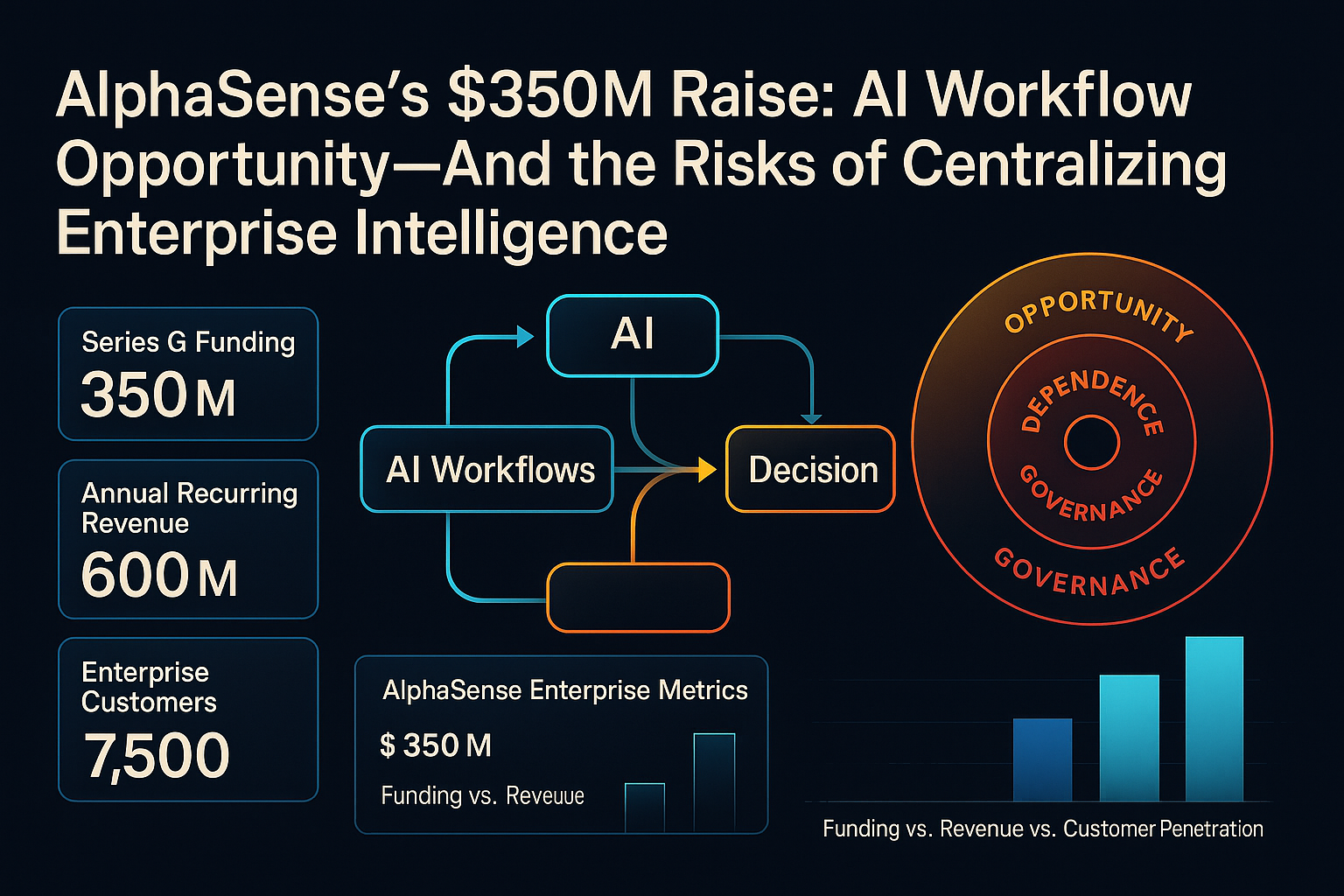
Large capital inflow accelerates product expansion and market reach.
High recurring revenue demonstrates platform stickiness and mission-critical status.
Large install base provides network effects and feedback for further improvement.
Comparison criteria
Over 500M premium business documents curated and citable
Faster, more authoritative insights; Possible access barriers for non-customersAI agents executing multi-step research and monitoring
Increased decision velocity but greater platform reliance7,500 enterprise customers, 90% S&P 100 coverage
Network effects and normative pressure toward AlphaSense standardization$600M+ ARR as of Q1 2026
Accelerating value capture as market consolidatesPossible outcomes
Enterprise customers renew and expand AlphaSense workflows
AlphaSense remains indispensable; Enterprises standardize on its automation, deepening dependency.New providers or tech models offer similar intelligence with more modularity
AlphaSense faces pressure to open up or risks client fragmentation.Workflow impact
- Enables financial and strategy teams to act faster on trusted, annotated data.
- Accelerates enterprise transition from manual information search to automated, workflow-driven decision processes.
- Raises barriers to entry for alternative providers as AlphaSense integrates with major industry players and becomes embedded in core infrastructure.
- May limit organizational flexibility and bargaining power if dependency grows unchecked.
Signals to watch
Indicates whether customers actually shift to autonomous workflow execution vs. Classic research.
Shows how deeply AlphaSense embeds into core enterprise platforms.
Early warning if concentration risk or lock-in costs become significant.
Will spotlight if AlphaSense leverages market dominance to alter costs for critical workflows.
AI-Driven Market Intelligence: Opportunity and Exposure
Acceleration of Enterprise Workflows
With over 500 million curated business documents, AlphaSense automates the leap from information to insight. The introduction of workflow agents and its SuperAnalyst feature means organizations can shift from manual data aggregation to AI-powered, decision-ready intelligence at speed.
For digital operations teams, this workflow leap offers shorter research cycles, more actionable insights, and lower error rates from incomplete information.
- AI agents automate multi-step research and monitoring.
- Trusted document sources allow verifiable insight generation.
- Mission-critical usage in finance, strategy, and M&A processes.
Risks of Single-Provider Dominance
AlphaSense’s deep integration sows new exposures: high customer penetration could mean workflow rigidity, reduced supplier leverage, and consolidation risks for operators.
Dependence on proprietary systems may make transitions costly; Alternative providers may struggle to compete on both data quality and workflow depth.
- Vendor lock-in risks grow as workflows become embedded.
- Cost negotiation power may erode as alternatives shrink.
- Market concentration increases systemic exposure for digital teams.
Market Impact and Competitive Landscape
By working alongside partners like Accenture, AlphaSense blurs the boundaries between information access and process automation. While this deepens its hold in enterprise infrastructure, it also challenges new entrants to match curated content at scale.
The platform’s expansion puts pressure on industry norms: manual research skills become less central, and the definition of competitive intelligence shifts toward AI-driven automation.
- Integration with process consulting partners magnifies influence.
- Barriers grow for smaller or less-resourced challengers.
- Reshapes market for workflow intelligence platforms.
Scenario Risks and Future Moves
Two major futures emerge: entrenched AI workflow dominance or market fragmentation if modular AI approaches outpace AlphaSense’s closed integration. Early signals—such as partner expansion, customer renewal patterns, and platform migration rates—will clarify the outcome.
Teams dependent on AlphaSense should track platform evolution, encode contingency migration plans, and regularly test for over-concentration risk.
- Monitor next product rollouts and integration depth.
- Track evolving terms of service, pricing, and access.
- Benchmark workflow portability against emerging alternatives.