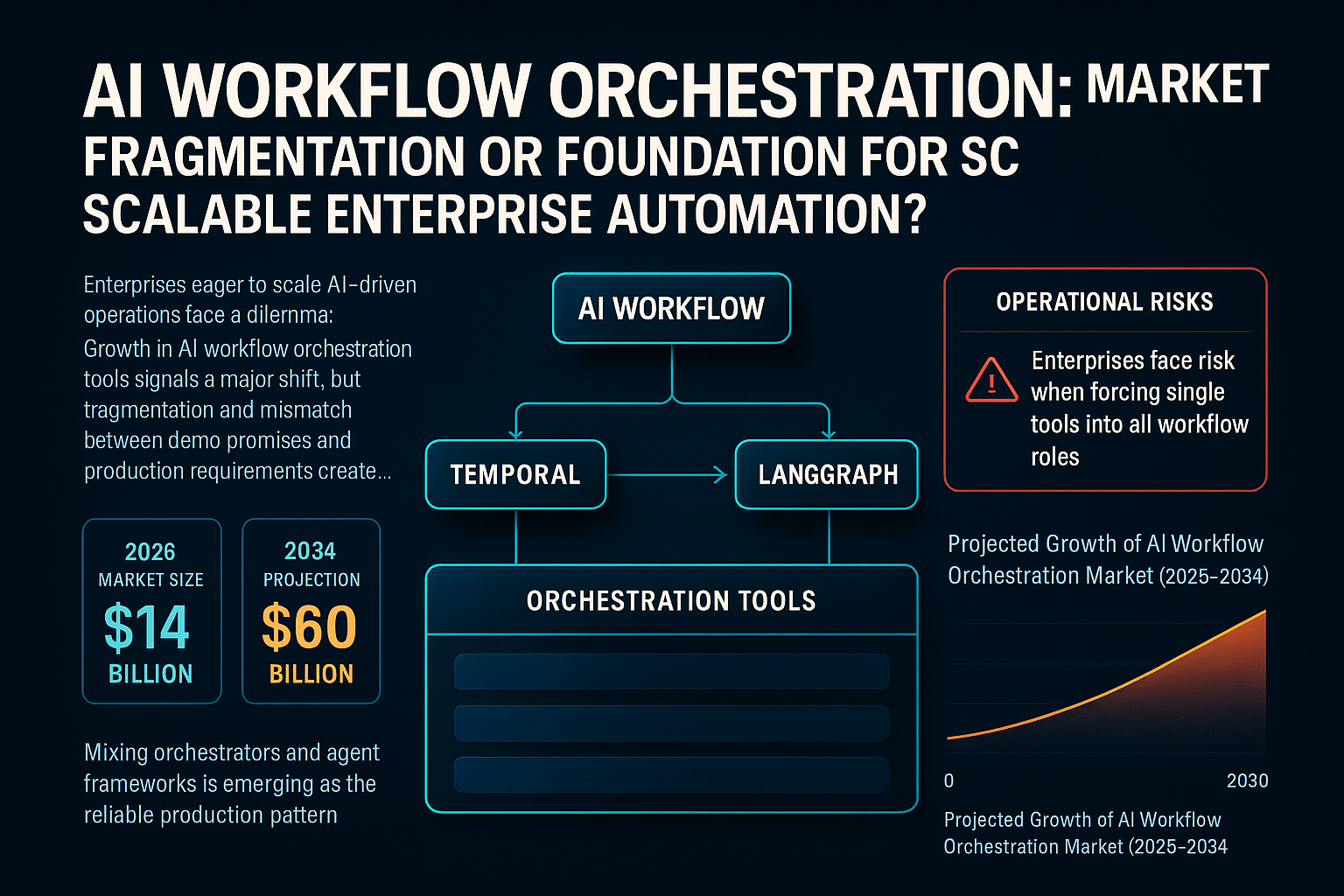
Key data behind the update
Represents the initial addressable revenue for orchestration vendors serving enterprises.
Indicates quadrupling of market size, reflecting rapid adoption and investment.
Widely used by OpenAI for Codex; Illustrates real-world adoption of Temporal for long-lived agent processes.
Typical production systems combine at least three platforms: data orchestrator, durable execution, and agent reasoning.
Why it matters for How AI Workflow Orchestration Tools Are
Mismatched orchestration strategies can undermine enterprise reliability, escalate costs, and stall AI project deployment. Recognizing the limits of each tool and combining them appropriately delivers reliability and operational scale—adopting the wrong stack can compound failure points instead.
Context behind How AI Workflow Orchestration Tools Are
AI workflow orchestration now means more than just scheduled data pipelines; It spans durable business process management and high-complexity agentic decision flows. As the market grows, tool specialization—and their integration—become critical for production-grade, scalable systems. The hype around fully autonomous agent frameworks often misrepresents what is robust enough for real-world workloads.
Workflow impact
- Improved reliability for mission-critical business workflows through durable execution engines.
- Greater traceability and debugging for AI agent decisions with state-graph tools.
- Reduced deployment risk and tech debt by using fit-for-purpose platforms.
Comparison criteria
Layered tools (e.g., Temporal+LangGraph) used for separate roles
Reduced failures, clearer debugging, more maintainable systemsVendors blur category boundaries
Persistent confusion increases risk of mismatched solutionsHigher when one tool forced to cover incompatible tasks
Cost savings only realized with appropriate tool selection$14B (2026) – $60B (2034)
Rapid expansion brings both choice and integration challengesTimeline
- 2026
AI workflow orchestration tooling market at $14 billion; Major platforms begin to specialize in discrete layers.
- Near-term
Most enterprise production stacks combine a data orchestrator, a durable execution engine, and an agent framework—each in its own workflow role.
- 2034 projection
Market expected to grow beyond $60 billion as multi-layered orchestration patterns become mainstream.
Signals to watch
Confirms shift from monolithic to specialized orchestration stacks.
Indicates maturing buyer knowledge and solution clarity.
Reflects real production pain points, highlighting vendor differentiation.
Can ease fragmentation if widely adopted.
A Fork in the Workflow: Specialization or Sprawl?
Shifting Baselines: Why Now?
The line between orchestrating deterministic workflows and managing AI agent reasoning is clearer than ever. Production failures often trace back to forcing one platform into multiple, incompatible roles.
Market expansion feeds both capability and confusion—tool variety is up, but so are vendor claims that blur real distinctions.
- One-tool approaches regularly cause costly errors.
- Growth in orchestration spending creates pressure for rapid adoption.
- Teams face a learning curve as functional boundaries sharpen.
Durable Execution vs. Agent Reasoning: Which Problem Are You Solving?
Temporal delivers on persistent, fault-tolerant business logic. It is less suited for improvisational model workflows without added workarounds.
LangGraph steps in where explicit agent-state logic and debuggability matter. Used alone, it can’t guarantee survivability across server failures.
- OpenAI’s Codex leverages Temporal for long-lived agent tasks.
- LangGraph’s time-travel debugging clarifies complex agent failures.
- Neither tool fully replaces the other in robust enterprise architectures.
What Breaks in All-in-One Architectures?
The main pain comes when orchestrators are mistaken for agent runtimes, or vice versa. Production demands more than what’s showcased in vendor demos.
Teams stretching schedulers to act as databases or agent frameworks to orchestrate everything often pay later with outages or opaque failures.
- Incorrect platform use creates hidden risks.
- Most robust deployments separate orchestration, durability, and agent logic.
- Choosing the right layers is now a competitive advantage.
What Must Change for Transformation?
Markets will only realize the projected value if enterprises adopt layered orchestration as a default, not an exception.
Vendors need to clarify product boundaries—or risk compounding confusion and tech debt in fast-moving AI programs.
- Clearer marketing about tool roles and boundaries.
- Better integration patterns and standards across tools.
- Focused investment in cross-stack observability and incident prevention.