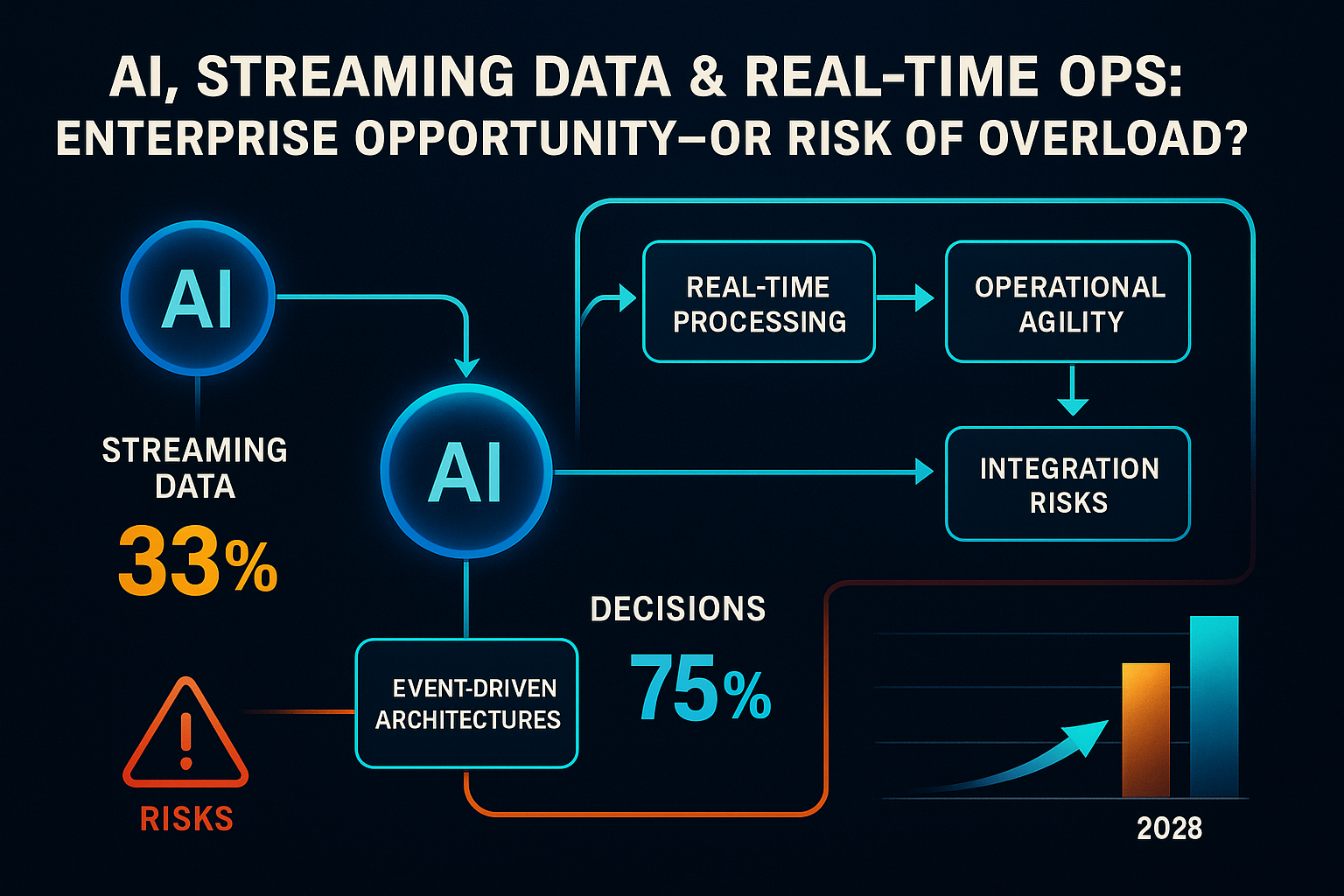
Why it matters for AI, Streaming Data & Real
Enterprises seeking AI-driven agility face critical decisions: integrating real-time data can accelerate responsiveness but may complicate tech stacks and vendor dependencies. The difference between operational advantage and systemic risk depends on platform choice and implementation strategies.
Operational consequences
- Integration complexity may increase as enterprises adopt real-time data pipelines and streaming platforms.
- Vendor lock-in concerns escalate if organizations rely heavily on proprietary streaming solutions.
- Efficiency and revenue can rise for those successfully embedding AI/real-time analytics—but failures in execution could lead to costly overruns.
- More stringent requirements for data governance and real-time monitoring may overwhelm unprepared teams.
- Continuous upskilling becomes necessary as real-time architectures reshape job requirements.
Key data behind the update
A significant portion of the market is poised for integration in the medium term; Not yet a majority, but material momentum.
A major market shift is expected toward standard information architectures that incorporate real-time streaming and event processing.
The vendor landscape is both crowded and competitive, emphasizing the challenge of platform selection.
Cloud incumbents are consolidating leadership in real-time data platform categories.
Comparison criteria
Event-driven, real-time architectures prioritized by enterprises
Responsiveness improves; Integration and data governance challenges multiplyCloud and streaming-first leaders dominate in rankings
Decision makers face more concentrated but also higher-stakes choicesIntegration, lock-in, and governance risks rise with adoption
Organizations must balance agility and sustainabilityMore than one-third to three-quarters adopting by 2028
Tech stack requirements shift from specialist to mainstreamPossible outcomes
Enterprise integrates AI agents tightly with streaming platforms and event data.
Immediate responsiveness is achieved, but long-term flexibility depends on avoiding deep vendor lock-in.Organization adopts multiple niche streaming products without unified governance.
Operational friction grows, as integrations and updates create hidden technical debt.Enterprise delays migration from batch to real-time, citing risk or complexity.
Competitors outpace them in AI-driven services, eroding market position.Workflow impact
- Data and IT teams will need to retrain and adapt workflows to accommodate real-time ingestion and analytics.
- Vendor selection in a crowded market can affect interoperability and long-term upgrade flexibility.
- Legacy systems risk obsolescence unless updated for streaming data and event-driven architectures.
- Increased dependence on AI autonomy raises the stakes for data governance and monitoring.
Signals to watch
Will validate forecasted mainstream adoption and force stragglers to adapt.
Directly links to the success or failure of real-time streaming adoption.
Alters the risk and opportunity profile for platform selectors.
Signals which traditional platforms will survive the transition.
Enterprise Real-Time Data: The Upside and the Exposure
AI-Driven Agility: The Competitive Promise
Real-time streaming data unlocks new possibilities for AI to autonomously manage business events, minimizing lag between event and action.
- Immediate event response powers workflow automation.
- AI agents require current data to deliver real-time decision support.
- Operational intelligence increases as streaming analytics become standard.
Integration and Vendor Risks: The Hidden Costs
Adopting real-time architectures means enterprises are now exposed to integration complexity and potential vendor lock-in, especially as cloud and streaming leaders consolidate.
Multiple platform choices—the ISG guide assesses 58 providers—create both flexibility and confusion.
- Mismatched integrations generate technical debt.
- Proprietary solutions risk future migration barriers.
- Platform switching or upgrades become costly if vendor standards diverge.
Data Management and Governance Complexity
Blending real-time (in motion) with at-rest data creates new governance challenges.
Data lineage, monitoring, and orchestrating event-driven flows stretch traditional teams beyond familiar batch regimes.
- Unified architecture now needed for all data states.
- Event processing fuels demand for holistic data policies.
- Security and compliance processes must adapt in real time.
The Vendor Landscape: Opportunity vs Lock-in
While the diversity of 'Leaders' in ISG’s vendor analysis suggests healthy competition, cloud titans (AWS, Microsoft, Oracle) dominate top slots.
Emerging platform specialists remain, but their future depends on integration openness and innovative analytics.
- Top performers win on capability and customer experience.
- Innovators in event-driven and analytics platforms show rapid growth.
- Future-proofing tech stacks means watching for further market consolidation.