Why it matters for SaaS workflow actors
For digital platform leaders and workflow architects, the transition from user workflows to agentic automation is not just a technical upgrade—it changes the risk surface, requiring proactive updates to governance, data integrity, and permission systems to avoid automation drift and loss of accountability.
Operational consequences
- Operators must invest in enhanced permission and identity management to ensure agents act within defined guardrails.
- Data quality, validation, and auditable record-keeping requirements grow as automated actions multiply.
- Companies may face resistance or unintended outcomes if role definitions and human collaboration models are not updated to reflect new automation actors.
Evidence-backed metrics
Illustrates significant and growing investment in automated enterprise workflows.
Represents growing opportunity for vendors and operators in the automation and orchestration ecosystem.
Reflects steady, above-average expansion, driven by AI and multi-cloud orchestration.
Early AI workflow pilots demonstrate major efficiency increases in knowledge work—but scaling is gated by governance.
Attended bots cut key process times dramatically, validating value but requiring validation controls.
Healthcare automation achieves large accuracy improvements, showing automation’s value when properly governed.
Source data behind the story
Source-reported valuesDecision criteria
AI agents increasingly trigger workflow actions autonomously
Less visible control; Requires new monitoring and governance infrastructureHeadless, API-first, and agent-initiated flows
User interfaces become optional; Operators must enable and secure API and agent accessRoutine tasks shift to agents; Humans handle exceptions and oversight
Job roles move up the stack, with new demands on judgment and auditingAutomated flows depend on authoritative records and permissions
Incorrect agent logic or weak data validation can propagate errors fasterPossible outcomes
Organizations integrate AI agents with deterministic business systems, enforce strong permissioning and audit controls.
Maximized efficiency and flexibility, with traceable outcomes and regulatory compliance.Automation proliferates ahead of permission and audit readiness.
Higher risk of automation errors, compliance lapses, and untraceable actions—potential regulatory and reputational fallout.Enterprises automate routine workflows but retain human-in-the-loop for exceptions and sensitive actions.
Balanced productivity gains with managed risk, but limited upside versus full-scale automation.Workflow impact
- Human work shifts to exception handling and oversight, while routine tasks migrate to agents—changing job roles and internal compliance requirements.
- Architectural decisions must now prioritize API exposure, context-layer integration, and automated governance checkpoints.
- The interface layer is decoupling from workflow execution, raising challenges in monitoring invisible automation and tracing decision logic across distributed systems.
Signals to watch
Indicates vendor commitment to agentic automation and re-shaped user/operator interfaces.
Signals a shift from early AI pilots to operational deployments requiring robust governance.
Would signal control gaps and drive demand for new monitoring and rollback tools.
Operational Shift: From Workflow Tool to Workflow Actor
AI Agents Redefine Enterprise Automation
Enterprise platforms are incorporating AI agents able to interpret business context, initiate automated actions, and coordinate cross-system workflows. This extends beyond chatbots: software is becoming a participant in—rather than just a facilitator of—routines, decisions, and processes.
Salesforce and others now design context layers and APIs that allow both humans and machines to interact, enabling workflows that run invisibly across business units.
- Routine steps can now trigger without user input, streamlining repeated transactions.
- Vendor competition is shifting to context, orchestration, and governance features.
- Interfaces are de-emphasized in favor of API-driven architectures.
Rising Market Value and Performance Gains
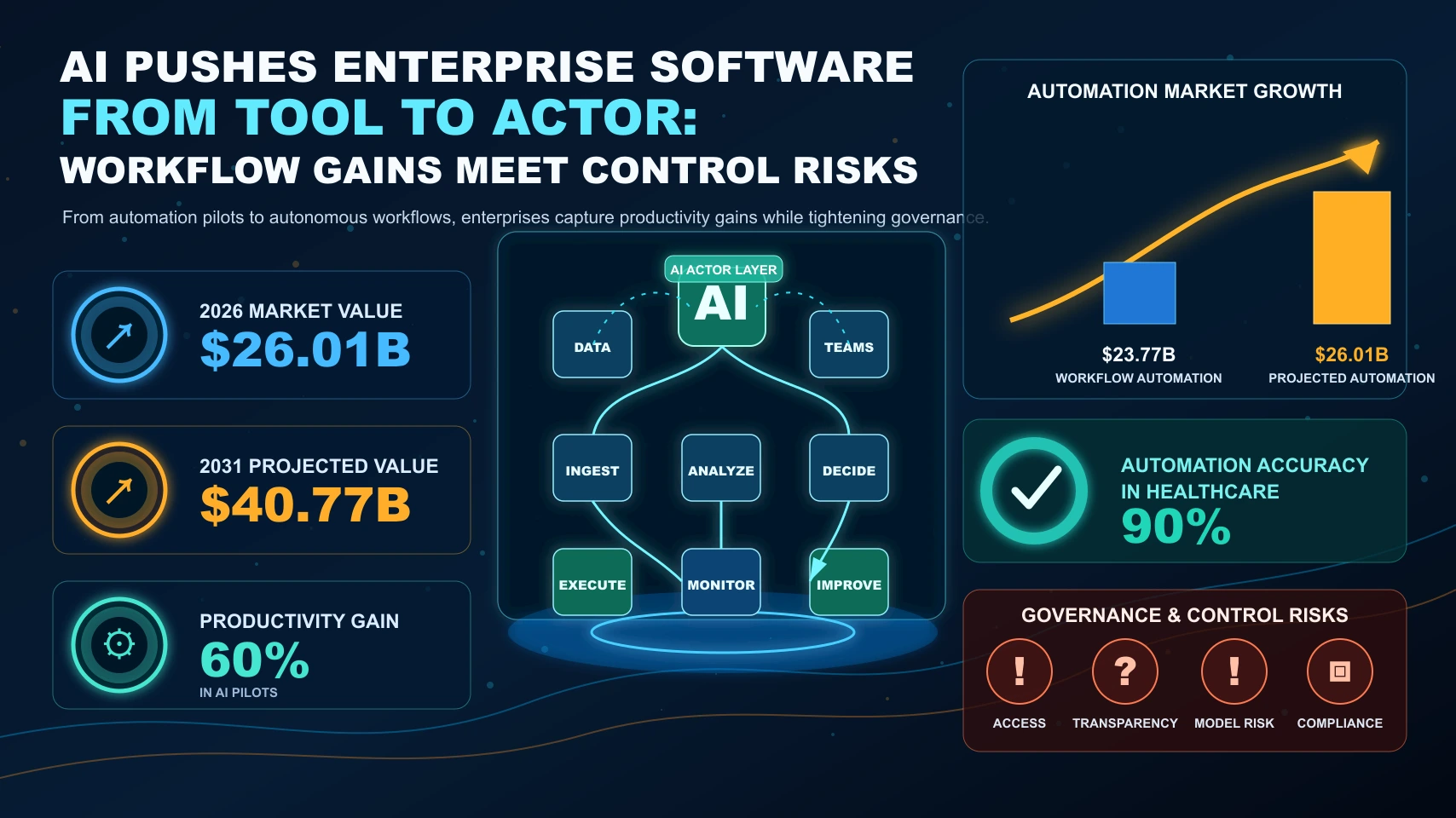
The workflow automation market is forecasted to expand steadily, reflecting rising investment in orchestration and AI-powered systems. Early pilots highlight strong gains in both productivity and accuracy, particularly in compliance-heavy and high-volume industries.
Yet, performance improvements depend on robust controls, as automation without governance amplifies errors.
- $40.77B forecast value by 2031 at 9.41% CAGR.
- Banking bots: 70% faster processes; Healthcare: up to 90% accuracy.
- Organizations scaling automation see largest upside when controls are in place.
Control Risks: Governance and Permissioning Challenges
Shifting execution from users to agents means less direct oversight. Mistakes can propagate more quickly, and permission errors can trigger unapproved actions across systems.
Systems must enable granular permissioning, real-time audit, and clear segregation between human-eligible and agent-eligible processes.
- Automation drift: AI follows rules as coded, not as intended.
- Sensitive actions must retain human approval checkpoints.
- Auditability and rollback tools become critical in API- And agent-driven stacks.
Automation Decision Boundaries
Operators must define boundaries: routine, well-defined tasks can safely migrate to agentic automation; Exceptions, disputes, and sensitive cases require human oversight to prevent errors or regulatory violations.
Collaboration models and job roles must be updated, with new focus on monitoring, exception handling, and architectural review.
- Assess which workflows benefit from agent execution.
- Update governance for agent-initiated actions.
- Train staff for exception management and oversight in the new workflow paradigm.