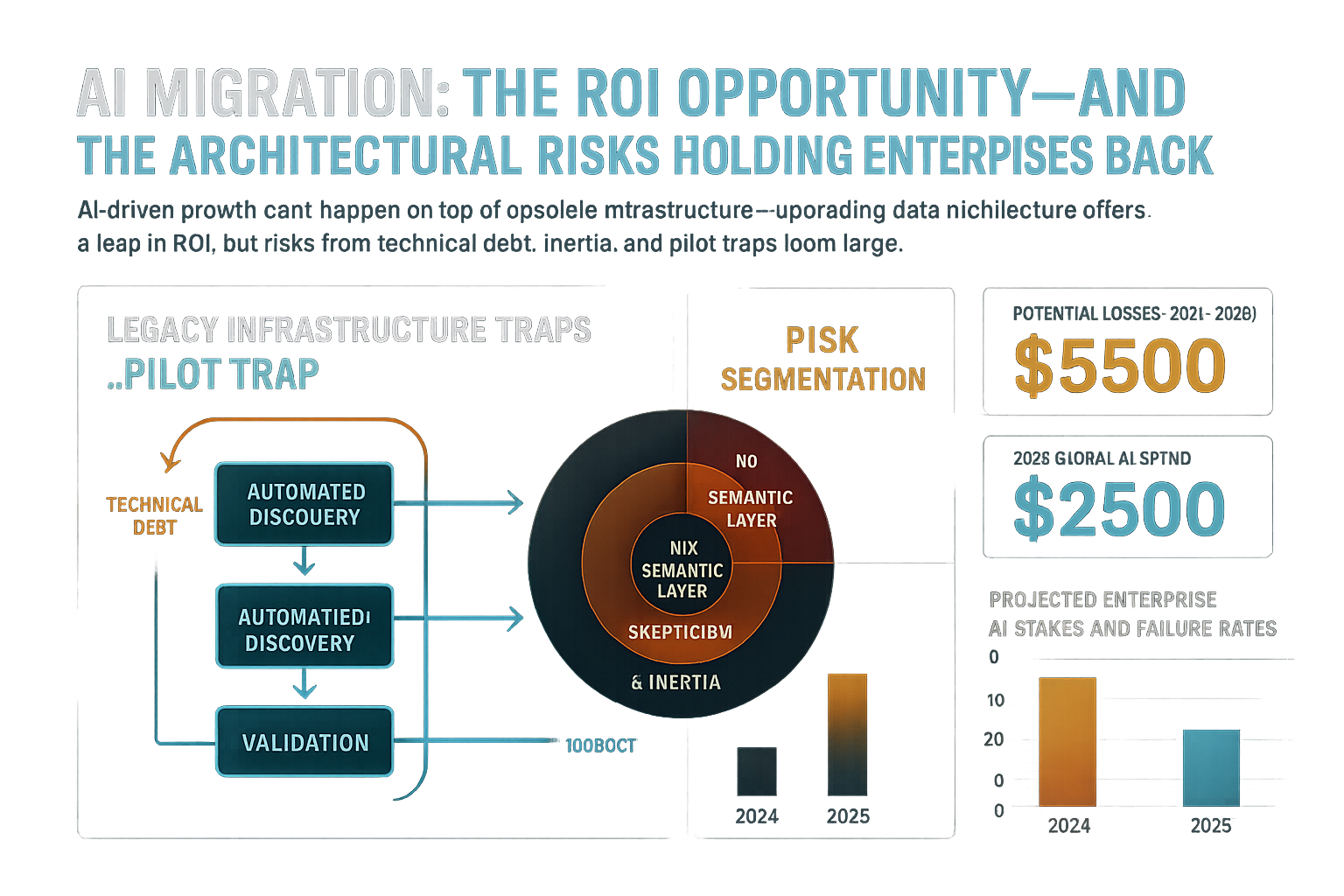
Why it matters for ROI From AI Migration? The Unseen
Enterprises facing mounting technical debt risk missing out on the projected trillions in AI-driven gains. For operators prioritizing streamlined workflows, data readiness, and automation, failure to modernize isn't just lost opportunity—it's rising liability that compounds daily as competitors accelerate automation on modern stacks.
Operational consequences
- Delayed modernization compounds technical and regulatory debt, reducing future competitiveness.
- Attempting migration without automation is impractical, heightening risk and resource drain.
- Siloed business logic suppresses organization-wide AI adoption by preventing knowledge consolidation.
- Failure to establish pre-project ROI metrics leads to stalled or canceled initiatives and eroded executive buy-in.
Key data behind the update
IDC warns that companies slow to modernize risk massive financial losses.
Gartner projects a high cancellation rate directly linked to outdated architecture.
Substantial investment reflects enterprise urgency, but most will underperform without infrastructure readiness.
High performers realize significant returns, whereas most lag due to foundational barriers.
Comparison criteria
Automated, architecture-first pipelines for AI readiness
Shift enables real-time, scalable AI vs. Stagnant, high-latency operationsSemantic layers and automated migration create single sources of business truth
Drives cross-functional AI enablement vs. Ongoing friction for integrationShared financial and operational metrics set pre-migration
Enables proactive decision-making vs. Stalling from lack of clarityStateless, containerized migration engines in private cloud
Zero-trust migrations reduce privacy risk vs. Hidden liabilitiesPossible outcomes
Organizations implement deep discovery, logic translation, and regression testing pipelines.
Foundational issues are rapidly addressed, resulting in scalable, auditable AI deployments and higher, defensible ROI.Executive risk aversion and skills gap prevent large-scale migration.
Firms remain stuck in pilot mode, see growing technical debt, and increasingly lag behind market innovators.Auditable change trails and data privacy assurances become regulatory imperatives.
Migration projects gain executive priority, but success still depends on architecture-driven automation.Workflow impact
- Workflows reliant on legacy systems endure higher latency and are shut off from real-time AI leverage.
- Migration complexity diverts engineering resources away from high-impact AI-powered workflows.
- Cloud-native, automated migration is positioned as the only viable path to delivering audit-ready, scalable AI agents.
- Those failing to upgrade architecture will underperform on AI accountability, regulatory compliance, and operational agility.
Signals to watch
Defines business concepts for AI, unlocking automated onboarding and faster deployment cycles.
Signals industry consensus around a new standard for agent-data integration.
Positions privacy-first approaches as best practice for complex, sensitive estates.
Will clarify which strategies deliver defensible business value.
AI Readiness: Unpacking Upside and Barrier
Legacy Traps and Opportunity Costs
Many organizations still rely on database platforms engineered for a batch-processing world, housing secretive, undocumented business logic. While these systems feel indispensable, their latency and technical debt directly handicap AI returns.
AI pilots running atop such infrastructure stall rapidly. Even with generous AI budgets, the true ROI is rarely realized.
- Long refresh cycles turn legacy databases into liabilities.
- Undocumented scripts and rules block AI agents' reasoning capabilities.
- Institutions struggle to measure ROI on piecemeal upgrades.
Automation As Architecture—Not a Band-Aid
Automated migration pipelines are now the practical standard. Steps include dependency mapping, auto-translation of logic, and regression testing. These create the audit trail and groundwork for safe, regulator-friendly AI.
This shift makes it possible to migrate without risking business continuity or privacy breaches.
- Automated discovery surfaces hidden, legacy business logic.
- Logic translation adapts batch workflows to event-driven clouds.
- Rigorous validation ensures operational fidelity and trust.
Organizational Inertia and ROI Proof Traps
Most enterprises underinvest due to operational risk aversion and difficulty building a migration ROI case up front. The skills gap between legacy code and cloud-native targets widens the risk.
Siloed, hard-coded business logic further frustrates cross-team buy-in. Without aligned metrics, projects stall before value is realized.
- Risk-averse execs delay adoption despite technical feasibility.
- Absence of shared metrics erodes cross-functional support.
- Tied-up engineering slows both migration and AI enablement.
Decision Signals for Enterprise Operators
Regulatory pressures will force the issue in many industries. For some, the only viable path is architecture-led, auditable automation—anything else raises liability and resource waste.
Shifts in platform protocols, notably the emergence of MCP handshakes, are early warning signs of sector-wide standardization.
- Track adoption of semantic layers to support agentic workflows.
- Monitor industry standardization around Model Context Protocol.
- Benchmark AI ROI based on architecture-first migrations.