Why it matters for AI Marketing Automation
For digital systems operators and workflow architects, AI automation offers major efficiency gains—if and only if systems, data, and team trust are in place. Rushing AI-driven automation into messy or disconnected environments doesn't fix problems, it magnifies them. The difference between accelerated output and scaled dysfunction depends on rigorous implementation and human checkpoints.
Operational consequences
- Rapid scaling without strong data integration increases the risk of irrelevant messaging and brand harm.
- Overreliance on AI for creative or strategy work degrades authenticity and connection with target audiences.
- Teams forced into new workflows without visible wins or clear SOPs may revert to manual work, wasting investment.
- Failure to align automation cycles with human approvals leads to misaligned campaigns and inconsistent execution.
- Fragmented adoption and lack of shared standards prevent operational efficiency gains and heighten friction.
Key data behind the update
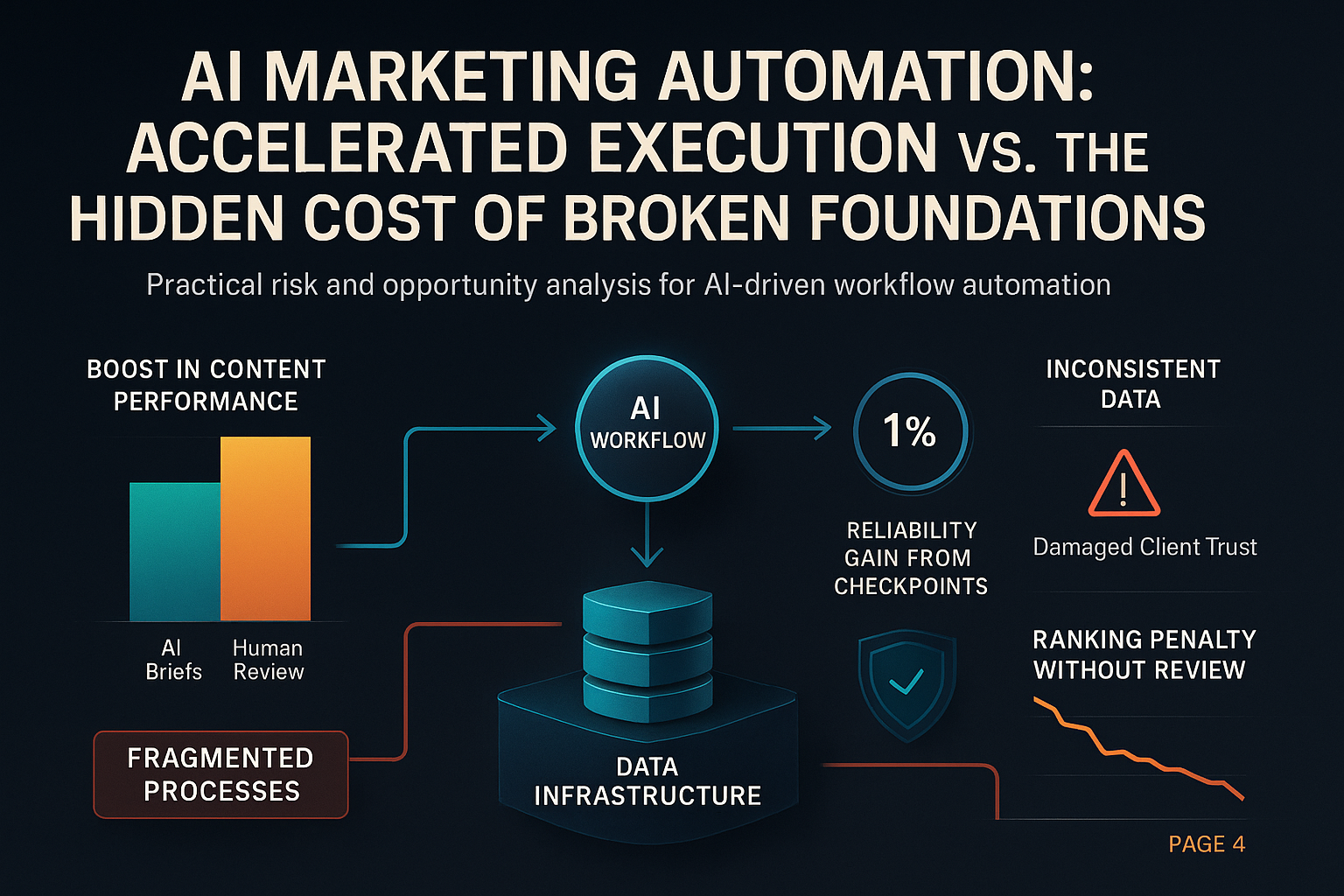
A human review step between AI briefs and assignment led to a 40% increase in content performance.
Addition of checkpoint review steps allowed reliable scaling while meeting client expectations.
Automated nurture sequence sent irrelevant messaging due to unvetted CRM data, damaging client trust.
Content produced solely from AI briefs ranked on page four until a manual intent check was added.
Comparison criteria
AI automation layered on validated and unified data.
Solid data foundation enables smart automation; Poor data yields errors and risk.Humans retain oversight, use AI as assistant.
Trust and engagement rise with support role; Fail with forced replacement.Standardized taxonomies and synchronized assets.
Aligned processes prevent version drift and campaign misfires.Stepwise, accountable rollout.
Measured rollout builds confidence and reduces resistance.Possible outcomes
Automated output misaligned with brand/strategy and poor data quality.
Leads to trust erosion, broken campaigns, and operational regression; Little benefit realized and possible reputation risk.AI deployed for repetitive tasks, with humans overseeing final decisions and quality.
Gradual confidence increase, real productivity gains, and improved output quality while maintaining brand safety.Low trust in AI outputs, staff revert to manual workflow despite automation tools in place.
Missed efficiency gains; Wasted investment in AI/automation; Risk of talent disengagement.Workflow impact
- Organizations with robust data and process see measurable boosts in campaign scalability and team capacity.
- Teams lacking integration or unified data pipelines risk misaligned output and brand trust erosion.
- Successful automation shifts staff duties towards final review, curation, and insight rather than manual execution.
- Content quality and relevance depend on both AI guidance and human context correction.
- Market leaders deploy automation into validated workflows, not as a fix for underlying issues.
Signals to watch
Source cites major gains from aligning taxonomy and integration before scaling automation.
Proving value in low-risk areas accelerates adoption and confidence, per several case insights.
Checkpoints consistently enable scale without sacrificing reliability or brand trust.
Extending too fast before foundation maturity caused failure in multiple source accounts.
Automation Speed Tradeoffs
Data Quality and Integration Define Automation Limits
Automation yield is directly tied to input integrity. Without unified pipelines or standardized categories, automated outputs quickly veer off-script.
Examples include nurture flows sending off-message content and reporting systems surfacing contradictory success metrics.
- Build and validate integration layers before launching automation.
- Define clear success taxonomies for all stakeholders.
- Audit source data for completeness and currency.
Adoption: Gains, Resistance, and Human Roles
Automation often polarizes staff, some fearing replacement while others resist new tools entirely. Teams advanced fastest when AI was positioned as a tool to accelerate output, not eliminate jobs.
Overcoming habits and aligning performance accountability proved critical to lasting adoption.
- Position AI tools as assistants, not replacements.
- Deploy automation to narrow, repetitive tasks first.
- Track and publicize small wins to build confidence.
Review Loops—The Secret to Reliable Scale
Pure automation led to misranked content and misaligned messaging, but checkpoints between AI and final output increased reliability and results.
Humans must remain in the loop for quality, context, and brand voice, especially as scale increases.
- Insert human review at key checkpoints in workflow.
- Evaluate AI output for strategy and brand fit before release.
- Synchronize taxonomy and assets across platforms to avoid version drift.
Common Pitfalls and Recovery Paths
Rush to scale or adopt shiny tools without infrastructure causes automation to fail and teams to revert to manual work.
Success stories share a stepwise deployment: integrate, test with small wins, and only then expand automation.
- Do not automate workflows with inconsistent or manual-only data.
- Respond to early failures by pausing and closing foundation gaps.
- Enforce shared onboarding and rollout standards for all teams.