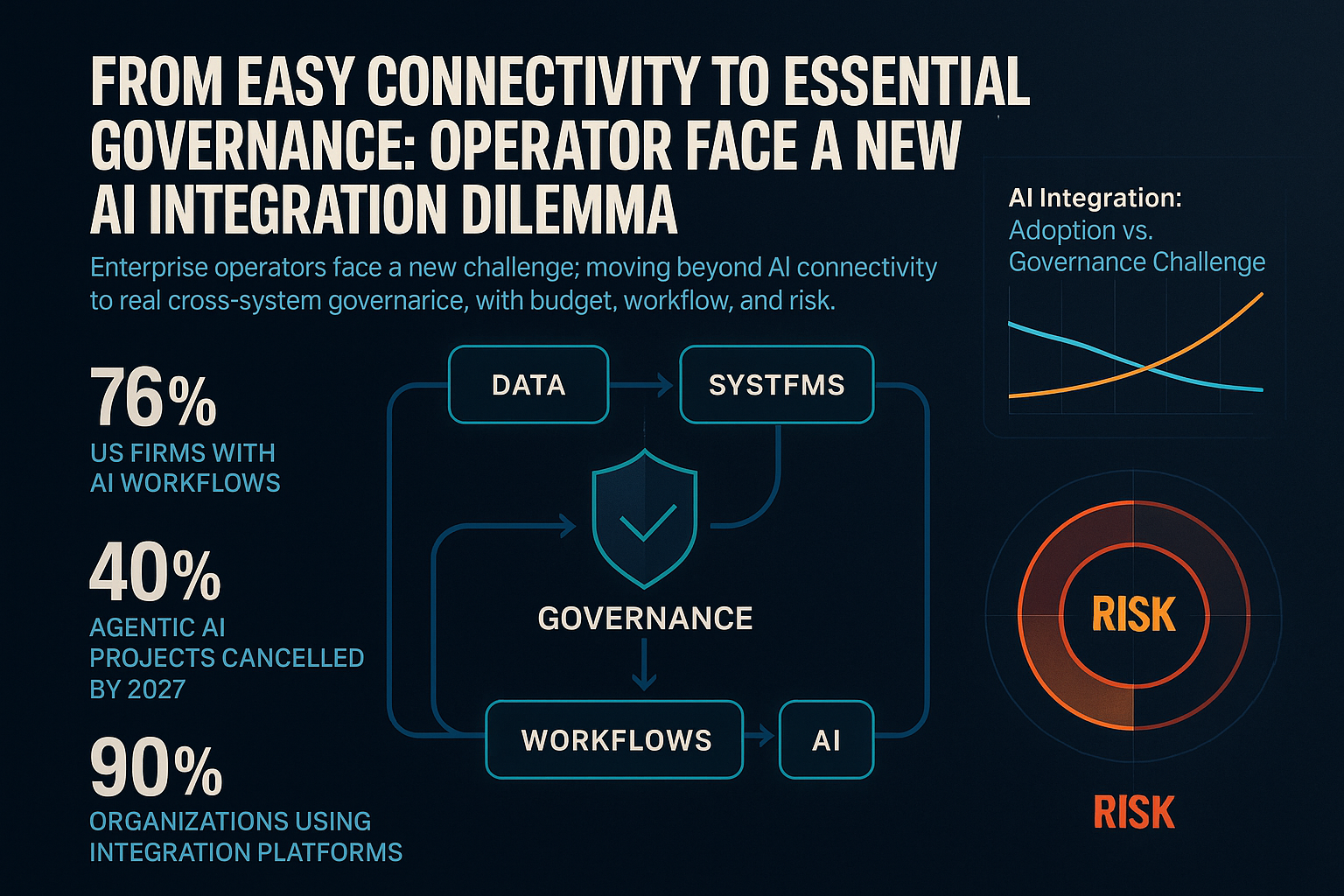
Key data behind the update
AI integration is mainstream among mid-to-large US enterprises.
A high proportion of agentic AI projects are expected to fail due to governance, not technology.
Successful enterprises treat integration as both enabling and controlling business AI.
Workflow impact
- Budget priorities may shift toward advanced integration platforms supporting unified governance.
- Workflow automation designs now require embedded auditability and error-resilient guardrails.
- Operators face a mandate to decide where AI is appropriate—and how much human oversight is required.
- Failure to adapt will likely heighten incident rates, audit failures, and unplanned project cancellations.
- Measurement of ROI on AI projects must include governance and control costs, not just adoption speed.
Comparison criteria
Integration platform as governance control plane
Larger operational and compliance footprint for integration tools.Governance, cost, and accuracy issues
Operator focus shifts toward access, policy, and risk mitigation layers.Agentic AI creates cross-system opacity
Increased demand for audit and rollback infrastructure.Deciding AI vs. Deterministic fit for each workflow
More nuanced operational and budget decisions per process.Operational consequences
- Operators must inventory which workflows require deterministic logic vs. AI, rather than assuming full automation is ideal.
- Purchasing criteria for automation tools must now weight governance, not just feature breadth or speed.
- Organizational charts and team responsibilities will need updating to clarify AI workflow approval, exception handling, and risk triage.
- Integration layer budgets will likely expand to accommodate governance capabilities and open standards support.
- Project go-lives will be delayed unless traceability and rollback are built into cross-system automations.
Signals to watch
Unified standards will tell if cross-system governance becomes feasible beyond vendor boundaries.
Direct operator intervention points can reduce risk, especially for finance or customer-facing use cases.
Codified governance frameworks will show which firms are operationalizing best practices, not just technology.
Rising or falling cancellation rates will demonstrate if governance fixes are working.
Operational Maturity Now Means Governance First
New Operator Mandates
AI integration is no longer just a technology deployment; It's a governance challenge. Operators, IT leads, and workflow owners must reassess choices in automation, oversight, and budget allocation.
With AI agents crossing traditional automation boundaries, the key responsibility now includes designing auditability into every cross-system workflow.
- Define which actions require human review before execution.
- Clarify process ownership—who approves exceptions and tracks incidents.
- Re-examine vendor roadmaps for governance compatibility.
Governance Gaps and Workflow Tradeoffs
Legacy API integration did not solve traceability or consistent policy enforcement for AI-driven workflows. Early attempts to add governance remain vendor-specific and fragmented.
Operators face a tradeoff: speed in AI rollout vs. Operational maturity, with the risk of costly errors and project cancellations rising in the absence of unified oversight.
- Manual reconciliation of audit logs often required.
- Diverging access controls increase policy drift.
- Cross-functional incidents become harder to resolve post-fact.
Structural Demands: Least-Agency and Human-in-Loop
Applying AI where it fits best, while leaving deterministic automations in control elsewhere, is now a design discipline called 'least agency'.
- Integrate guardrails as workflow steps—not as add-ons.
- Opt for platforms supporting open standards for agent connectivity.
- Document accountability pathways for every autonomous action.
Organizational and Budget Repercussions
Enterprise spend on low-code and integration layers will rise as governance becomes a budgeting requirement, not a feature add-on.
Responsibility for exceptions, oversight, and error handling will shift from line-of-business to central operational teams.
- Assess need for new roles in compliance and risk review.
- Prepare for project slowdowns as audit and rollback get embedded.
- Revisit SLAs to include governance and incident response.