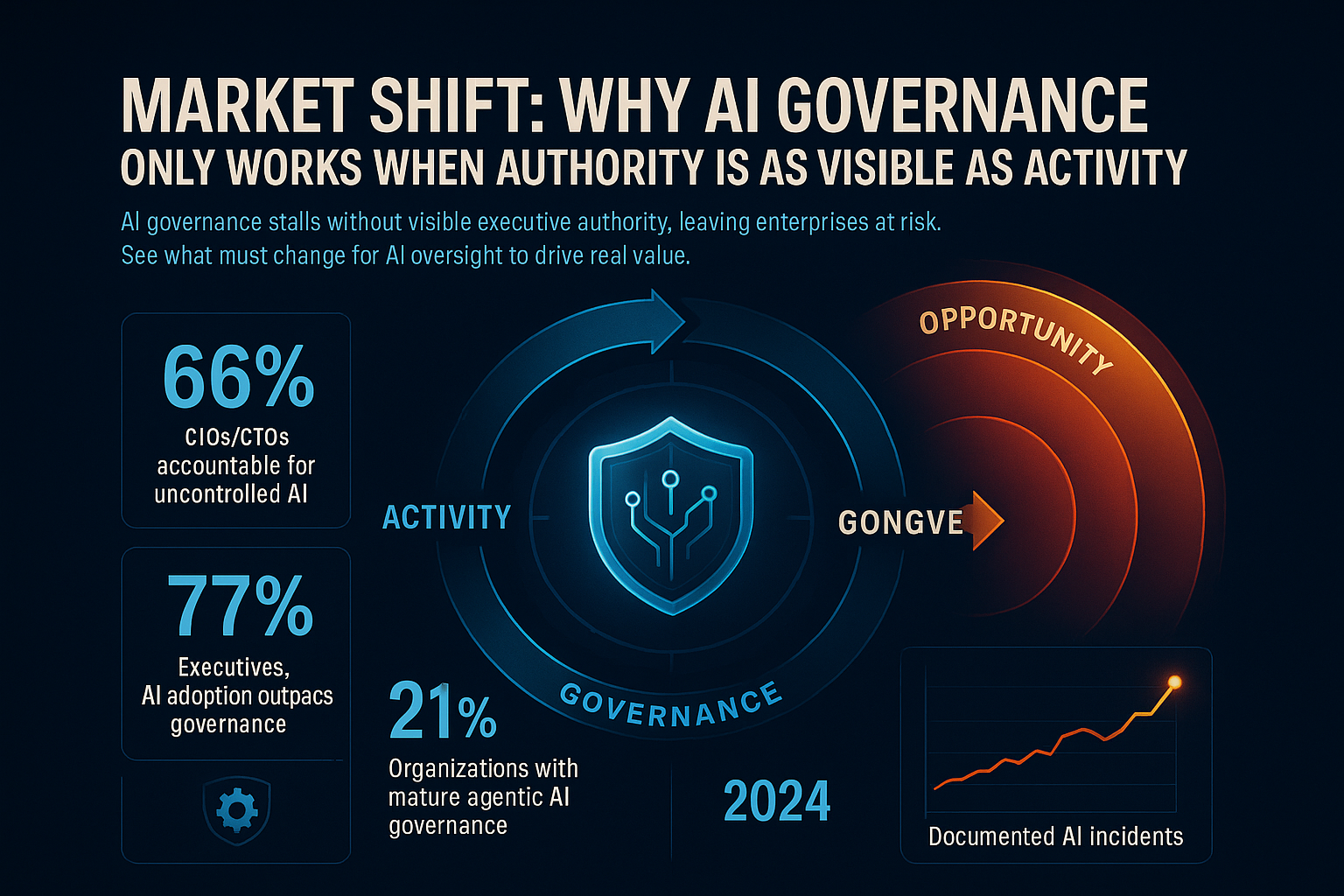
Key data behind the update
Leadership is responsible for AI risks but lacks the means to act.
AI is scaling faster than most governance frameworks can manage.
Vast majority lack solid governance for autonomous AI agents.
Increase in reported AI-related incidents spotlights slow governance adaptation.
Why it matters for Why AI Governance Needs Executive Authority
Without visible authority tied to AI governance, organizations risk slow responses to emerging value or risk signals—hampering AI's business impact and amplifying operational confusion. For business systems leaders, shifting from static documentation to actionable governance is essential to maintain agility, accountability, and scale as workflows become more autonomous.
Context behind Why AI Governance Needs Executive Authority
While AI usage has surged in business operations, the supporting governance frameworks remain rooted in slower, more controllable environments designed for earlier technology eras. Tools and policies abound, but the leap to system-wide, executive-led AI governance—where visible authority and real-time action are standard—remains elusive for most enterprises.
Workflow impact
- Delayed governance action raises risk of operational drift and unaddressed AI incidents.
- Fragmented accountability slows AI investment ROI and increases exposure to regulatory scrutiny.
- Organizations unable to adapt governance become less competitive as AI integrates deeper into core processes.
- Centralized committees risk overwhelming due to fast-growing use cases, stalling business velocity.
Comparison criteria
Majority lack mature governance for AI agents; 21% report maturity.
AI-specific risk response much weaker, more incidents likely.CIOs/CTOs accountable but lack direct control over AI systems.
Accountability gaps and potential for misaligned decisions.77% see adoption outpacing governance.
AI value may be undercut by lagging oversight and uncertain risk management.Timeline
- 2024
AI incidents documented rise to 362, indicating a surge in operational and ethical challenges.
- 2026
Deloitte and IBM report that most organizations' governance cannot keep pace with agentic AI deployment.
- 2027 (projected)
74% of organizations expect moderate or greater use of AI agents—without current governance maturity.
Signals to watch
Signals board-level accountability and move beyond checkbox compliance.
Enables actionable intervention and continuous alignment with business goals.
Shows governance shifting from documentation to actionable ownership.
Why ‘Visible Authority’ Is the Real Test of AI Governance Readiness
The Accountability Vacuum
Surveyed executives admit they are accountable for AI-driven outcomes but lack tools and authority to correct course as risk or value drifts. This shortfall turns governance from a business enabler into a fragmented set of artifacts.
Current frameworks often produce oversight theater—more reviews, dashboards, and policies—without empowering responsible actors to intervene, resulting in slow or missed responses.
- Key decisions delayed due to unclear ownership.
- Review bottlenecks create drag instead of assurance.
- Documentation outpaces agility, failing to reduce incidents.
Governance Maturity Gap: Agentic AI Outpaces Controls
Modern AI systems now act across workflows without waiting for approvals or committee reviews. Yet, only a minority of organizations have built mature models to govern these autonomous operations. Most firms still operate with policy-driven, not signal-driven, governance.
As AI agents multiply, audit trails, real-time monitoring, and defined ownership will become critical to prevent incidents and value leakage.
- 74% expect moderate or more agentic AI use by 2027.
- Over 80% lack key governance features for agents.
- Operational drift is rarely detected in time with legacy controls.
The Executive Layer: What Real Visibility Enables
Dashboards are everywhere, but only disciplines that assign explicit ownership—where intervention rights are clear and actionable—make governance meaningful.
When signals of value, risk, or workflow drift are paired with empowered owners, businesses can align AI deployment with outcome targets.
- Executives set action triggers, not just metrics.
- Business units are assigned risk and value owners.
- NIST frameworks emphasize governance as cross-cutting.
Conditions for the Market to Shift
For governance to become a performance lever, not a bureaucratic hurdle, organizations must formalize visible authority and link every AI signal to a decision right—whether via role, system, or process.
Progress depends on boards and leadership integrating AI risk into routine management, not just annual review.
- Assign ownership for every critical AI signal.
- Move from static to real-time, proactive governance.
- Monitor for bottleneck buildup in oversight functions.