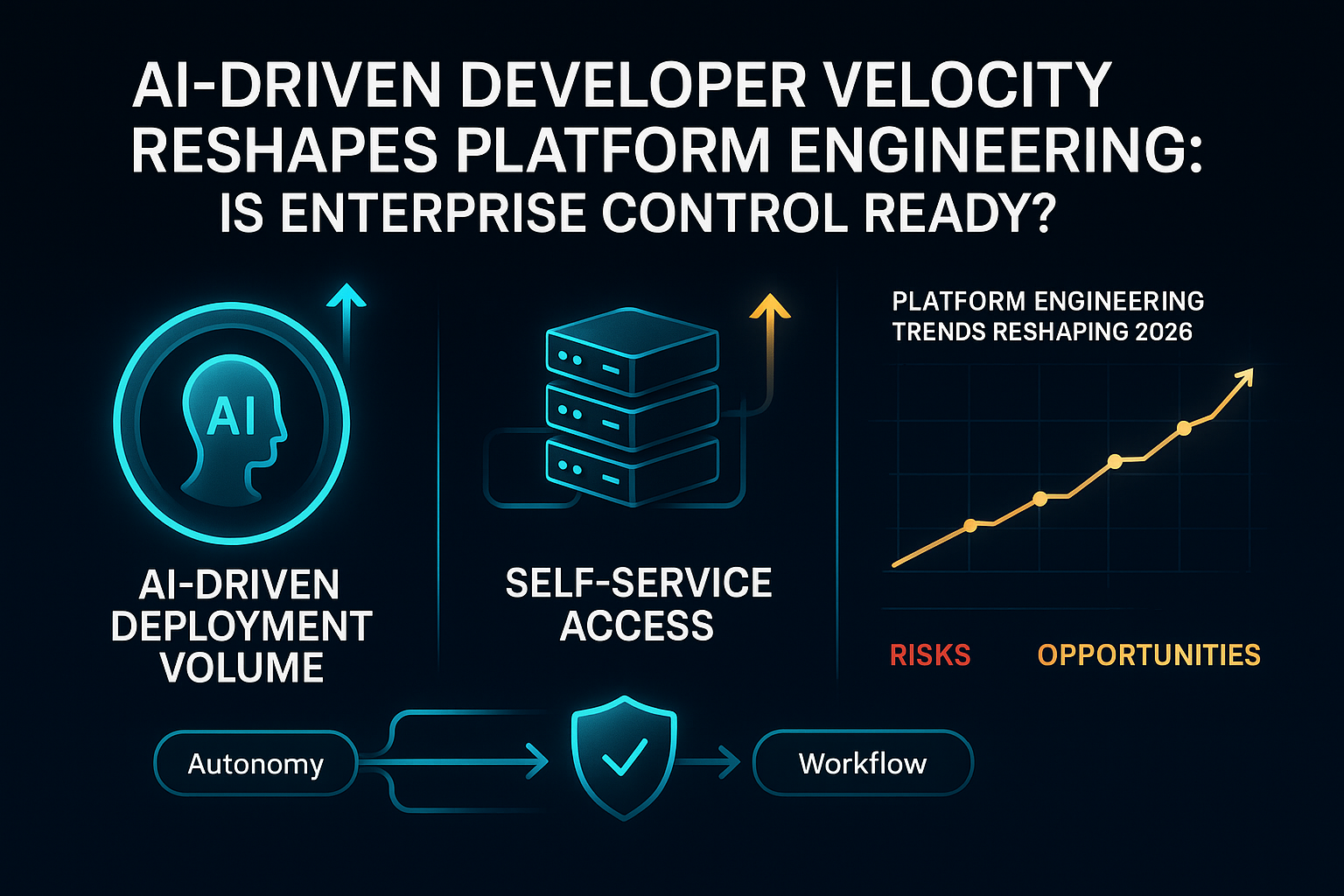
Platform Engineering Trends Reshaping 2026
IndicatorAI-driven Deployment Volume
Self-Service Coverage (Humans + AI)
Key data behind the update
Measurement tooling is now essential for justifying platform spend.
AI is substantially raising code creation and deployment needs.
Platform capabilities must be governable and accessible by autonomous agents.
Standardized processes are required for safe and fast developer (and AI) actions.
Why it matters for How AI and Developer Experience Are
As organizations face unprecedented code delivery speed, unchecked AI and developer autonomy can erode security and compliance. Market leaders who standardize self-service, measurement, and guardrails across both human and AI activity will set the bar for operational efficiency and resilience—shifting what is expected from digital operations platforms.
Context behind How AI and Developer Experience Are
Enterprises once tolerated ad hoc developer access and team-specific infrastructure patterns. The mainstreaming of AI coding tools accelerates code and deployment growth, exposing brittle or manual processes. Mature platform engineering—once the hallmark of elite shops—now becomes foundational for any organization seeking scalable, efficient, and secure software delivery.
Workflow impact
- Engineering leadership must justify platform engineering spend using quantifiable productivity and stability data.
- Standardized self-service and guarded infrastructure access extend beyond developers to AI agents, reshaping internal platform requirements.
- Platform engineering becomes a critical enabler for balancing fast software iteration with governance needs, especially as code volume surges.
Comparison criteria
Designed for both humans and AI agents, with governed guardrails
Supports higher velocity but demands new audit and security patternsEmpirical, system-level metrics used for platform investment decisions
Investment decisions become defensible; Platform teams gain influenceGolden paths and service catalogs establish defaults
Reduces risk, lowers onboarding time, but sacrifices some flexibilityIntegrated solution stacks and portals supporting discoverability and automation
Enterprises consolidate vendors, seek seamless platform experiencesTimeline
- 2026: AI coding tools trigger surge in code and deployments
AI-driven agents increase code output, forcing platform engineering to upscale governance and automation.
- 2026: Golden paths, developer analytics, and AI agent self-service rise as category priorities
Market leaders invest heavily in self-service, measurement, and standardized delivery as core requirements.
Signals to watch
Indicates maturing demand for empirical platform ROI justification.
Shows market recognition of AI as an active user class, not niche add-on.
Confirms leadership buy-in for the new platform engineering behaviors.
Signals value of outcome transparency as a competitive differentiator.
How Platform Engineering Faces Its AI Inflection
AI Coding Surge Puts Pressure on Platforms
Organizations are facing an acceleration in code creation and software delivery as AI agents automate developer tasks. Without mature, standardized platform controls, this surge risks overwhelming current guardrails or causing deployment chaos.
- Code generation and deployment are scaling faster than many teams can govern.
- Autonomous agents now provision, deploy, and test infrastructure directly.
- Manual review or team-specific scripts can't keep up with AI-augmented velocity.
New Standard: Self-Service for Humans and AI
The leading internal platforms now require seamless, guarded access for human developers and AI agents alike. Golden paths—safe defaults for common workflows—are being codified as the only viable way to deliver speed and control together.
- Golden paths automate risky manual steps, reducing cognitive load.
- Service catalogs expose approved APIs and automation actions for both user types.
- Internal developer portals become the interface for safe experimentation.
Platform Investment Shifts to Proven Metrics
Leadership increasingly demands clear, data-backed justification for platform investments. Tools are now measuring friction, deployment speed, and the impact of infrastructure changes on developer productivity—reshaping upgrade priorities.
- Outcome data supersedes anecdote in platform team budgeting.
- Platforms track deployment frequency, lead time, and incident rates.
- Engineering intelligence tooling informs continuous improvement.
System Integration and Governance Take Center Stage
With portals, orchestration, analytics, and security training often provided by distinct vendors, systems integration and policy enforcement become critical. Only organized, governed use of these components can contain risk and sustain enterprise velocity.
- Fragmented tooling undermines golden-path efficiency gains.
- Unified audit trails and standards are now minimum table-stakes.
- Security and compliance depend on proactive, policy-driven workflows.