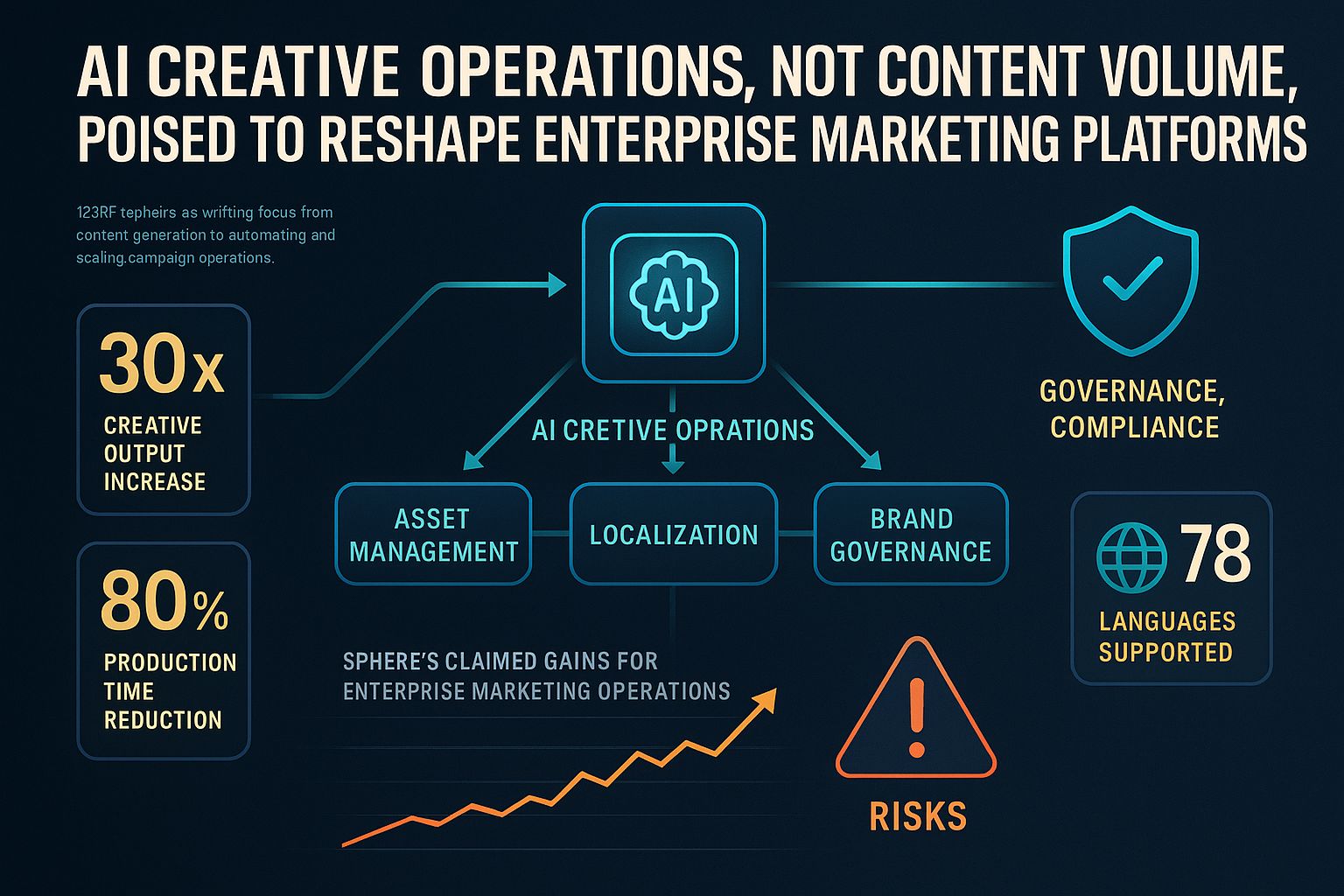
Key data behind the update
123RF claims Sphere enables organizations to produce up to 30 times more content compared to traditional processes.
Production timelines can be cut by as much as 80 percent using Sphere, reducing time-to-market.
Sphere can adapt campaigns into 78 languages, supporting global marketing operations.
Why it matters for creative operations
If operationalized AI becomes a higher priority than content generation, digital systems firms serving enterprise marketing must build or adopt platforms enabling centralized, automated, and governed campaign execution. This affects product roadmaps, competitive differentiation, and go-to-market plans across content, workflow, and governance toolchains.
Context behind creative operations
The generative AI marketing software race has led many companies to focus on producing more and faster assets. However, for large enterprises, asset quantity is not the stumbling block—coordinating production, localizing content, and ensuring compliance present steeper challenges. According to 123RF, its Sphere platform addresses this by integrating automated asset generation, governance, and workflow management, marking a step toward AI-native marketing operations.
Workflow impact
- Traditional AI content tools may lose ground to platforms focused on scaling and governing operations.
- Enterprise software budgets could shift toward systems capable of automating localization, approvals, and asset management.
- Marketing teams may need to redesign creative processes to fully benefit from AI-powered operations.
- Companies lacking integrated creative operations platforms may face slower campaign delivery and inconsistent brand execution.
Comparison criteria
Operational execution, workflow automation
Market differentiates by system efficiency—tools must help teams move from brief to market at scale.Automated for 78 languages
Scalability and brand consistency improve if automation proves robust.Built-in brand governance and compliance
Reduces risk and approval cycle friction in complex enterprises.Up to 30x more output, 80% faster
Decouples creative capacity from team size—company can scale campaigns with flat resource growth.Timeline
- Pre-2026: Fragmented AI marketing adoption
Most organizations use point tools for AI generation, creating asset and workflow silos.
- July 2026: 123RF Sphere expansion announced
Sphere pivots from AI generation to automated, governed creative operations for enterprise marketing.
- Next 12-24 months: Market adoption phase
Enterprises test end-to-end AI workflows, platform vendors race to define new category.
Signals to watch
Indicates buyers prioritize operational automation beyond content generation.
Would confirm market demand for operationalized AI rather than pure asset generation.
Suggests process adaptation is catching up to technology adoption.
Real-world outcomes validate or challenge claimed efficiency gains.
Creative operations bottleneck
From Asset Output to Workflow Transformation
123RF is repositioning Sphere as a platform that centralizes campaign strategy, automates repetitive creative production, and reduces time-to-market—moving beyond the standard model of AI content tools.
This operational shift reflects what large marketing teams increasingly find: the complexity of asset management, localization, and approvals far outweighs the challenge of mere content generation.
- Traditional AI tools output images or copy in isolation
- Sphere aims to automate the full pipeline from briefing to campaign delivery
- Fragmented toolchains contribute to slow execution
Market Impact: Efficiency and Governance Rise to the Fore
If Sphere’s claims are accurate, organizations can multiply creative output while slashing campaign timelines. However, the move only matters if buyers demand—and can actually implement—integrated operations.
Sphere’s governance and security features signal a critical shift for highly regulated or brand-sensitive sectors, which have struggled to trust generic AI content platforms.
- Brand governance and encrypted infrastructure built into Sphere
- Relevant for industries facing compliance and asset protection pressures
- May drive shift in purchase criteria for enterprise marketing platforms
Limits, Caveats, and Signals to Monitor
The wider market’s move from AI experimentation to process automation isn’t guaranteed. Many teams may continue to bolt AI generators onto legacy workflows, keeping old inefficiencies in place.
Measurable impact will come only if enterprises re-engineer operations and see tangible gains—in speed, scale, and business metrics.
- Real-world adoption and results are not yet independently validated
- Competitive responses will test Sphere’s differentiation claims
- Organizational change may be a larger barrier than technology rollout