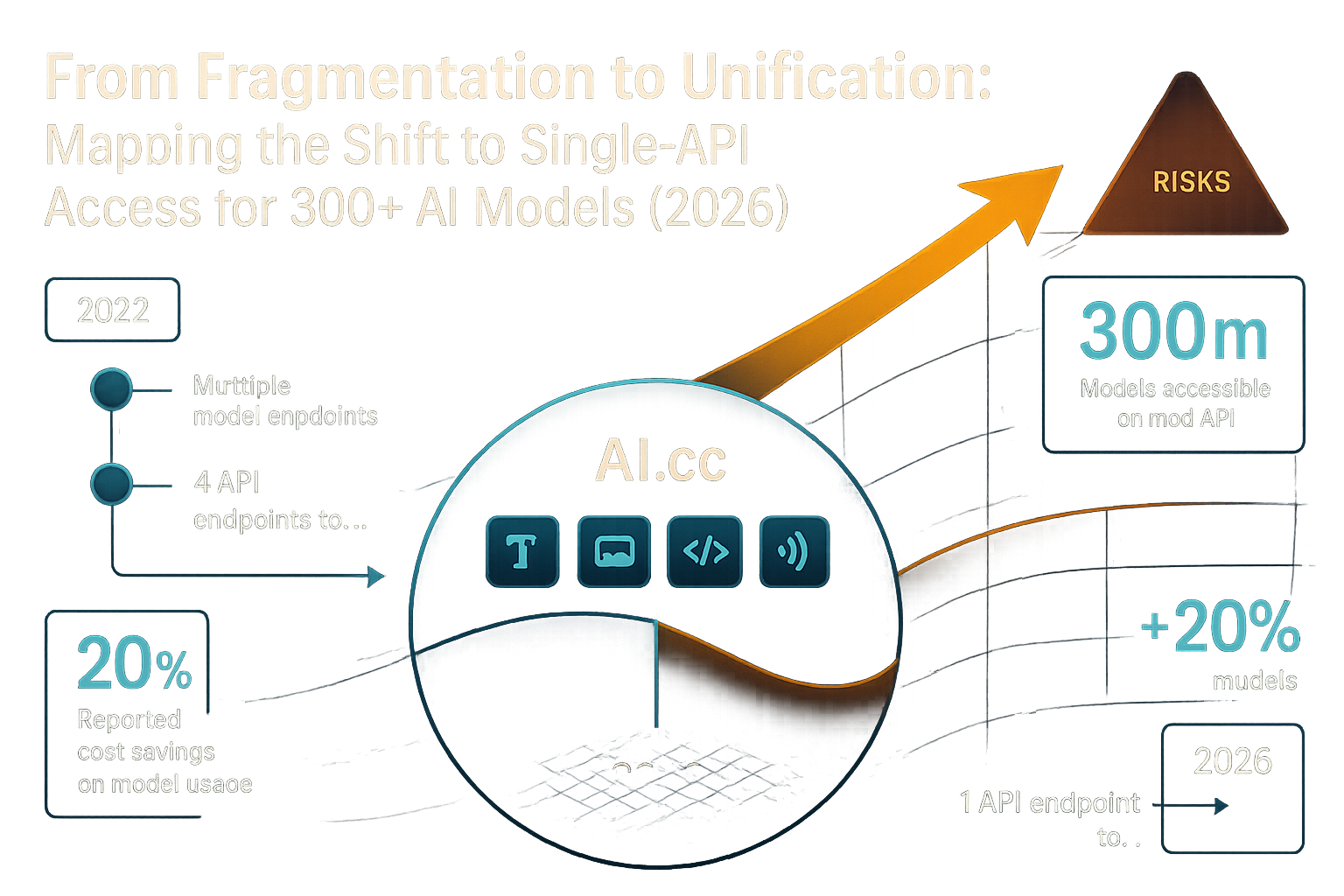
AI Model Integration: From Fragmentation to Unified Access
API endpoints to access modelsTimeline
- 2022–2025: AI model sprawl
Explosion in generative AI models prompts enterprises to integrate models from OpenAI, Google, Anthropic, xAI, and others, increasing operational complexity.
- Jun 25, 2026: AI.cc launches one-key access to 300+ models
Announces unified API for all major modalities and providers; Offers OpenAI-compatible migration path.
- 2026–2027: Assessment and adoption phase
Operators and digital system providers evaluate, pilot, and adopt (or reject) unified-access platforms as core infrastructure.
- 2027+: Market adaptation and aggregator platform evolution
Competitive pressure prompts new entrants, expanded feature sets, or incumbent responses—further shaping orchestration strategies.
Context behind Unified AI API Launch
Before 2026, AI teams often stitched together model integrations manually—balancing multiple endpoints, rate limits, credentials, and cost dashboards. Each new provider meant additional overhead, code refactoring, and system fragility. AI.cc’s unified API approach parallels trends in cloud abstraction and API management, repackaging orchestration as a productivity and cost lever for business operations.
Why it matters for Unified AI API Launch
As generative AI deployment accelerates, managing connections to dozens of models becomes a bottleneck for operators and developers. AI.cc’s one-key platform could reshape digital system architecture, reducing integration overhead and enabling rapid access to best-of-breed models—if real-world costs and disruption risks remain manageable.
Key data behind the update
Large multi-modal coverage reduces the need for parallel integration.
Significant potential savings for mainstream models claimed by the provider.
Supports operational workflows across various AI-automated tasks.
Reduces migration friction for teams using OpenAI-compatible libraries.
Comparison criteria
Single API, unified endpoint, minimal refactoring
Migration is less disruptive, scaling is simplerTransparent unified billing, reported savings
Improved financial controls and cost analysisUpdate model parameter, no rewrite
Accelerated experimentation and deploymentCentralized architecture, platform support
Potential trade-off: single point of failure vs. Simplified supportPossible outcomes
Major SaaS and digital operations providers adopt unified API as standard.
Single-API systems become standard for business operations, forcing competitors to offer similar aggregations.Leading enterprises continue in-house or best-of-breed direct integrations.
Unified APIs fill a niche but manual integration or proprietary stacks remain prevalent.Signals to watch
Indicates whether unified APIs are rapidly displacing manual integrations.
Market entry or undercutting signals a new orchestration layer race.
Feature breadth may determine whether operators will migrate mission-critical workloads.
May alter the balance of power between first-party and aggregator platforms.
Why Unified AI APIs Signal a Systems Shift
Integration Challenges Before Unified APIs
Prior to platform-level aggregation, digital operations teams faced mounting integration challenges—balancing dozens of credentials, managing rate limits, and rewriting core code with each model swap.
The rapid spread of new AI providers created a tangle of endpoints and increased operational fragility.
- Every additional provider extension led to growing maintenance debt.
- Rate-limit and billing inconsistencies complicated scaling.
- Switching models required significant re-engineering.
- Downtime and cost spikes became routine risks.
One-Key Aggregation: How AI.cc Proposes to Solve the Problem
AI.cc’s solution layers a universal authentication and routing system on top of over 300 models. Migration is designed to be as simple as changing a base URL and updating a model parameter.
Included tools—such as the AI Playground and real-time dashboards—target both developers and cost controllers.
- Supports multi-modality: text, code, images, voice, and more.
- Lowers friction for OpenAI library users.
- Serverless core architecture ensures high concurrency.
- Unified billing with real-time insight reduces surprises.
Short-Term and Long-Term Implications
The platform’s impact depends on how many systems move to unified providers versus maintaining direct ties to model vendors.
As orchestration becomes a defining layer, competition may shift from core model performance to platform features and service reliability.
- Consolidation may quicken AI rollout for enterprise operations.
- New customer acquisition shifts from models to aggregator loyalty.
- Potential for vendor pressure or lock-in at orchestration tier.
- High uptime and support now affect aggregator viability.