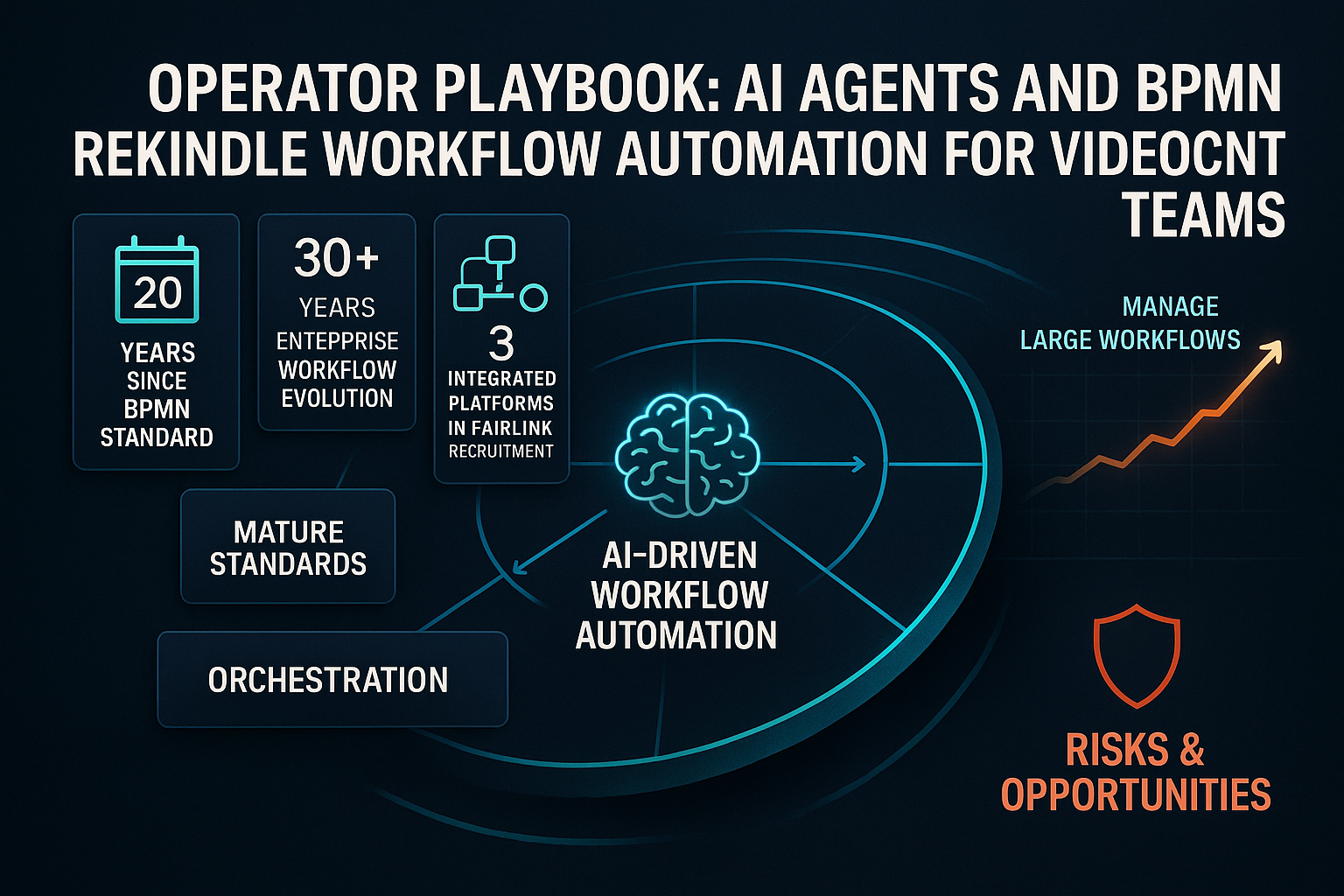
Metric Snapshot: BPMN & Workflow Automation Trends
Years/platformsYears since BPMN standard
Years of enterprise workflow frustration
Fairlink platforms integrated
Workflow impact
- Reduces time spent on manual orchestration with automation that connects directly to content contributors and stakeholders.
- Enables support for diverse languages and communication modes, such as voice notes, across distributed workforce pipelines.
- Offers rapid implementation for small teams, without the burden of monolithic workflow tools.
- Raises new integration, compliance, and transparency requirements at the intersection of AI agents and human workflows.
Key data behind the update
After two decades, BPMN regains traction due to AI-driven automation.
Longstanding challenges in enterprise workflow now see new solutions due to convergence.
Safety and transparency achieved by blending three systems in recruitment workflows.
Small teams now orchestrate workflows previously requiring thousands.
Operational consequences
- Operators must re-evaluate legacy workflow platforms against AI-ready, orchestratable alternatives for agility and compliance.
- Human-in-the-loop design choices are essential when workflows affect vulnerable or distributed teams.
- Vendor selection needs to account for integration with communication channels and the need for real-time voice and language support.
- Future workflow engines will blend process transparency, real-time orchestration, and adaptive approval layers.
Comparison criteria
AI-powered, adaptive, real-time orchestration with BPMN.
Operators can rapidly adjust processes as needs and platforms change.Small teams orchestrate end-to-end processes.
Agility and cost efficiency improved, especially for niche or distributed workflows.Integrated checks and transparency for recruitment workflows.
Built-in governance provides assurance and risk mitigation.Voice and language integration with messaging apps.
Broader user inclusion and faster onboarding.Signals to watch
Operator demand for cross-language orchestration will drive new features.
Easier integration and support for complex, multi-platform workflows will reshape tooling decisions.
Greater transparency and human-in-the-loop requirements may emerge in response to automation risk.
Standardization allows diverse tools to interoperate, minimizing lock-in for operators.
Timeline
- 2006: BPMN standard established
Object Management Group launches Business Process Model and Notation.
- 2026: CamundaCon demo and agentic AI-BPMN convergence
Fairlink and Casci demonstrate real-time voice orchestration at CamundaCon 2026 Amsterdam.
AI, BPMN, and the Next Wave of Workflow Automation
Operator Actions: Assess & Integrate Adaptive Orchestration
Teams must review legacy workflow tools' compatibility with AI orchestration. Focus on platforms that accommodate dynamic, real-time interactions and language diversity.
Evaluate the feasibility of embedding voice and messaging support to handle distributed, multilingual contributor engagement.
- Check if existing workflows can be externalized and orchestrated via AI agents.
- Test integration paths for messaging platforms and voice assistants.
Process Convergence:AI and Standardization Reduce Risk
The union of AI-driven workflow and industry standards like BPMN gives operators a business-language framework for orchestrating cross-functional video production.
Small teams are increasingly empowered to manage end-to-end processes, increasing operational resilience and cost efficiency.
- Use BPMN to model dynamic approval and compliance layers.
- Rely on AI agents only where transparency and auditability are preserved.
- Favor modular platforms that enable lightweight scaling.
Human and Platform Balance: Design for Safety & Accountability
Especially in human-sensitive workflows (e.g., content staffing with global contributors), maintain an explicit balance between AI automation and human governance.
Extensible orchestration engines now make it feasible to adapt safeguards to real-world process needs.
- Embed transparency checkpoints for vulnerable stakeholders.
- Review compliance and fraud risks before full process automation.
- Link orchestration tools to systems of record for closing governance gaps.